
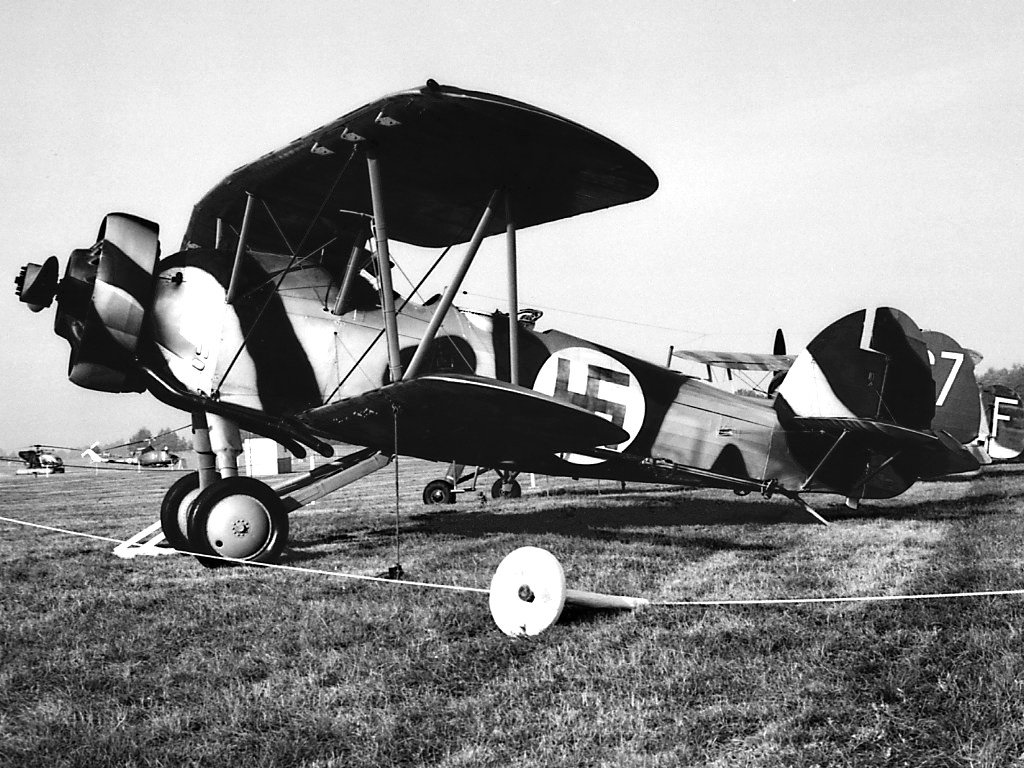
Designed by Sydney Camm for the Royal Air Force (RAF), the Hawker Hart was a high-performance two-seat light bomber that emerged in the late 1920s. The prototype first flew in July 1928, meeting an Air Ministry specification (12/26) that required a minimum speed of approximately 160 mph. The resulting aircraft was so advanced that its performance exceeded that of any fighter aircraft in existence at the time of its introduction, a fact that eventually forced the RAF to re-evaluate its fighter and training doctrines. To address this performance gap, Hawker introduced a specialized Hart Trainer variant in 1932.
Technically, the Hart featured an all-metal structure consisting of a steel-tube fuselage and wings with steel spars and duralumin ribs, all covered in fabric. It was powered by a liquid-cooled V-12 Rolls-Royce Kestrel piston engine, which was geared and supercharged. Depending on the specific engine mark, such as the Kestrel IB or IV, power output ranged between 525 and 600 hp. This propulsion system allowed the Hart to reach a maximum speed of approximately 176 mph and a service ceiling of around 22,000 feet.
Production was primarily handled by H.G. Hawker Engineering Company Ltd (which became Hawker Aircraft Ltd in 1933) at Kingston-upon-Thames. A total of 1,004 Harts were built: 962 in the United Kingdom and 42 under license in Sweden. This total included 460 bombers and 474 trainers. The UK production run concluded in October 1936, while Swedish-built Harts remained in service until 1947.
In military service, the Hart entered RAF squadron operations in February 1930 with No. 33 Squadron. It was utilized by seven home-based regular bomber squadrons and five squadrons in the Middle East and India. Beyond the RAF, the aircraft saw service with the air forces of Estonia, Egypt, and Yugoslavia, as well as the South African Air Force (SAAF), which operated over 320 Hart and Hart Special aircraft. During the Winter War, Swedish Harts were deployed on January 11, 1940, to assist Finland against the Soviet Union.
The Hart's legacy is defined by its role as the progenitor of a massive family of biplanes, including the Audax, Demon, Hardy, Hind, and Hector, totaling over 3,000 aircraft. Furthermore, the structural techniques developed by Sydney Camm for the Hart directly influenced the creation of the Hawker Hurricane. Today, a Hart II (J9941) is preserved in the collection of the RAF Museum at Hendon.