
Service History
The Ju-52/3m dominated European air transport throughout the 1930s, with Deutsche Luft Hansa operating the type extensively on continental routes where its reliability and economy proved exceptional. Over 12 airlines worldwide adopted the aircraft, including Swissair and Lloyd Aéreo Boliviano, which received the earliest known Ju-52/3m in 1932. The aircraft's ability to operate from rough, short airstrips made it invaluable for establishing air service to remote regions across continents.
Wartime Operations
From 1936, the Ju-52/3m served in the Spanish Civil War, initially operating the Morocco-Spain air bridge and later functioning as an improvised bomber in early operations. During World War II, the aircraft became the backbone of Luftwaffe transport operations, delivering paratroopers during the invasions of Norway and the Low Countries in 1940, and the Balkans and Crete in 1941.
The type pioneered large-scale airlift logistics during the Demyansk operation in 1942, sustaining besieged German forces across multiple theaters. The Ju-52/3m fleet suffered grievous attrition during the attempted resupply of the Sixth Army at Stalingrad from 1942-43, where severe weather, Soviet opposition, and inadequate capacity doomed the operation. The principal military variant, designated Ju-52/3mg7e, could accommodate up to 18 troops or 12 stretchers for medical evacuation duties.
The Manufacturer
Junkers, based at Dessau, Germany, developed the aircraft under the direction of aeronautical engineer Ernst Zindel and his design team, who began conceptualizing the aircraft in 1925. The company initially produced both single-engine (Ju-52/1m) and tri-motor variants, with the single-engine prototype making its first flight on October 13, 1930. German production continued until 1944, yielding approximately 3,234 aircraft before wartime manufacturing ceased.
Post-war production shifted to other manufacturers, with France producing the AAC.1 Toucan variant from 1945 and Spain manufacturing the CASA 352 series until 1952. The Spanish variants utilized Elizalde and later ENMASA BETA B-4 air-cooled nine-cylinder radial engines instead of the standard BMW powerplants.
Engine & Technical Details
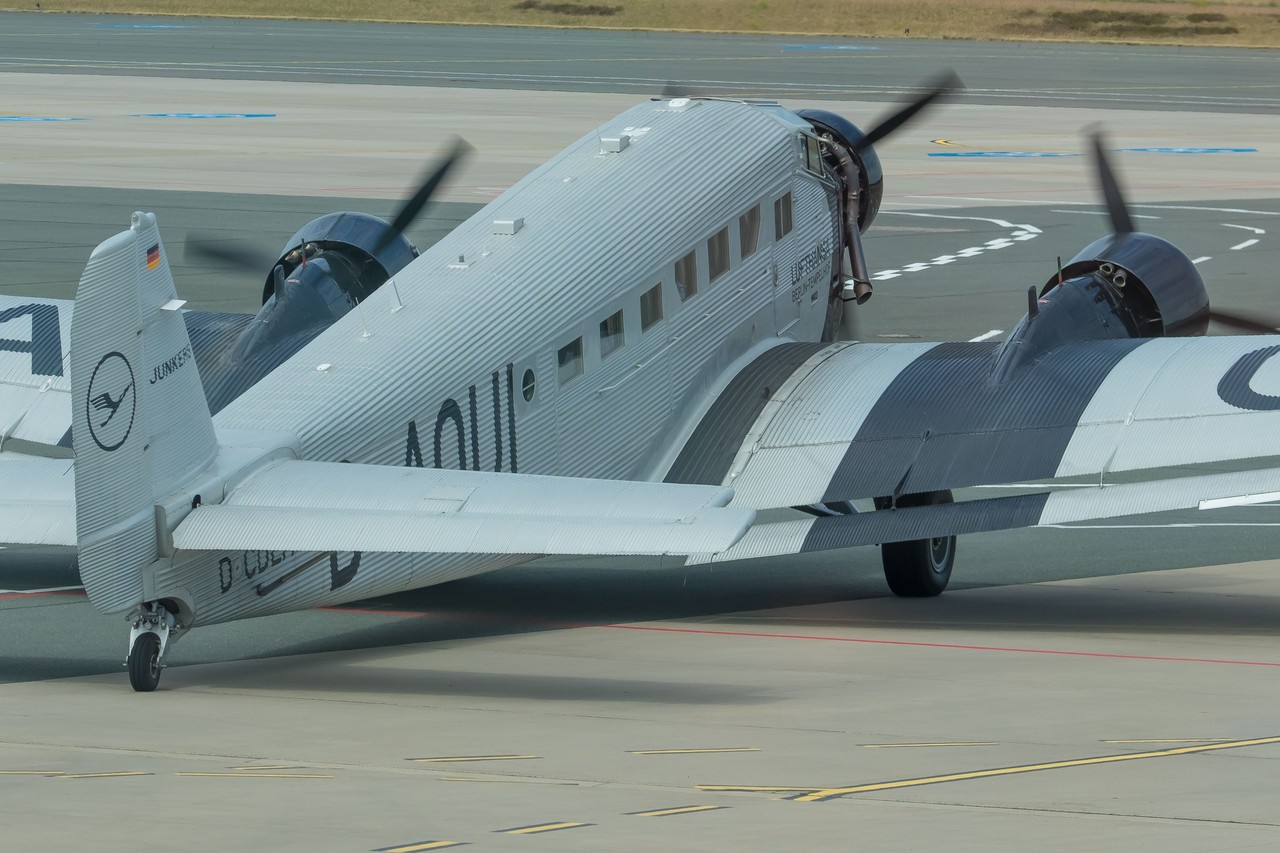
The Ju-52/3m was powered by three radial engines, with early prototypes using 550-horsepower Pratt & Whitney R-1340 Wasp engines. Production aircraft standardized on license-built BMW 132 radial engines, which powered the primary variants including the Ju-52/3mce and Ju-52/3fe by the mid-1930s. The aircraft required a crew of two pilots and featured Junkers' characteristic corrugated duralumin construction, which provided exceptional durability and structural strength.
The design incorporated Handley-Page-type leading-edge slats and generous flaps, enabling excellent short-field performance and low landing speeds essential for operations from rough or improvised airstrips. This configuration made the aircraft ideal for utility operations where reliability and short takeoff and landing capability mattered more than speed.
Design Philosophy
Zindel's team designed the Ju-52/3m with specific emphasis on economy, reliability, and short-field performance rather than speed or passenger comfort. The corrugated metal skin, while creating additional drag, provided structural rigidity that allowed the aircraft to withstand harsh operating conditions that would damage conventional smooth-skinned aircraft. This robust construction enabled operations from unpaved strips and rough terrain that excluded more delicate aircraft.
Production & Legacy
Total production reached 4,835 aircraft between 1931 and 1952, including 170 license-built CASA 352L variants manufactured in Spain. The aircraft's longevity reflected a design philosophy that prioritized utility over performance, enabling operations spanning five decades from its 1932 maiden flight through the 1980s.
Switzerland's air force operated the Ju-52 until the mid-1980s, representing one of the longest service records for any transport aircraft. Several examples continued providing heritage flights into the 2010s, though stricter European safety regulations ended most commercial operations after 2018.
The National Museum of the USAF maintains a Ju-52 trimotor in storage, while La Ferté-Alais in France operates F-AZJU, a 1943-built German aircraft originally flown by the Spanish Air Force. The aircraft's distinctive appearance and historical significance have made it an aviation icon, demonstrating that practical design virtues can prove as historically significant as technological advancement or performance achievements.