
Service History
Since entering service in January 2008, the Kodiak 100 has established itself as the backbone of humanitarian aviation and remote operations. With over 320 aircraft delivered by 2024, the type has accumulated more than 278,700 flight hours across diverse mission profiles. Launch customer Spirit Air received the first production aircraft in January 2008, following a deposit placed in May 2005. The fleet has proven its reliability through consistent growth, with Sunstate Aviation receiving the milestone 100th aircraft in September 2013, followed by the 200th delivery in December 2016 and the 250th in 2018.
The aircraft's design specifically targets operations where traditional aircraft cannot effectively serve. Mission Aviation Fellowship and JAARS operate multiple Kodiaks through the Quest Mission Team program, which provides aircraft at reduced cost to qualifying humanitarian organizations. More than 90 of the 320-plus aircraft serve in multi-mission roles including public safety, resource monitoring, and intelligence surveillance reconnaissance for operators including the State of North Carolina.
The Manufacturer
Quest Aircraft Company originated the Kodiak program in 1999, founded in 2001 by investors including Tom Hamilton and Dane Voetmann in Sandpoint, Idaho. The company operated independently until February 2015, when Setouchi Holdings acquired ownership, followed by French aerospace conglomerate Daher's acquisition in 2019. Daher had previously expanded into aircraft manufacturing through acquisitions including a majority stake in Socata in 2009, adding the Kodiak line to complement their TBM turboprop series.
The transition to Daher ownership has accelerated development and production capabilities. Manufacturing continues at the original Sandpoint facility, with production backlog extending into 2025 as of January 2024. The facility underwent a 25 percent expansion in 2016 to meet increasing demand.
Engine & Technical Details
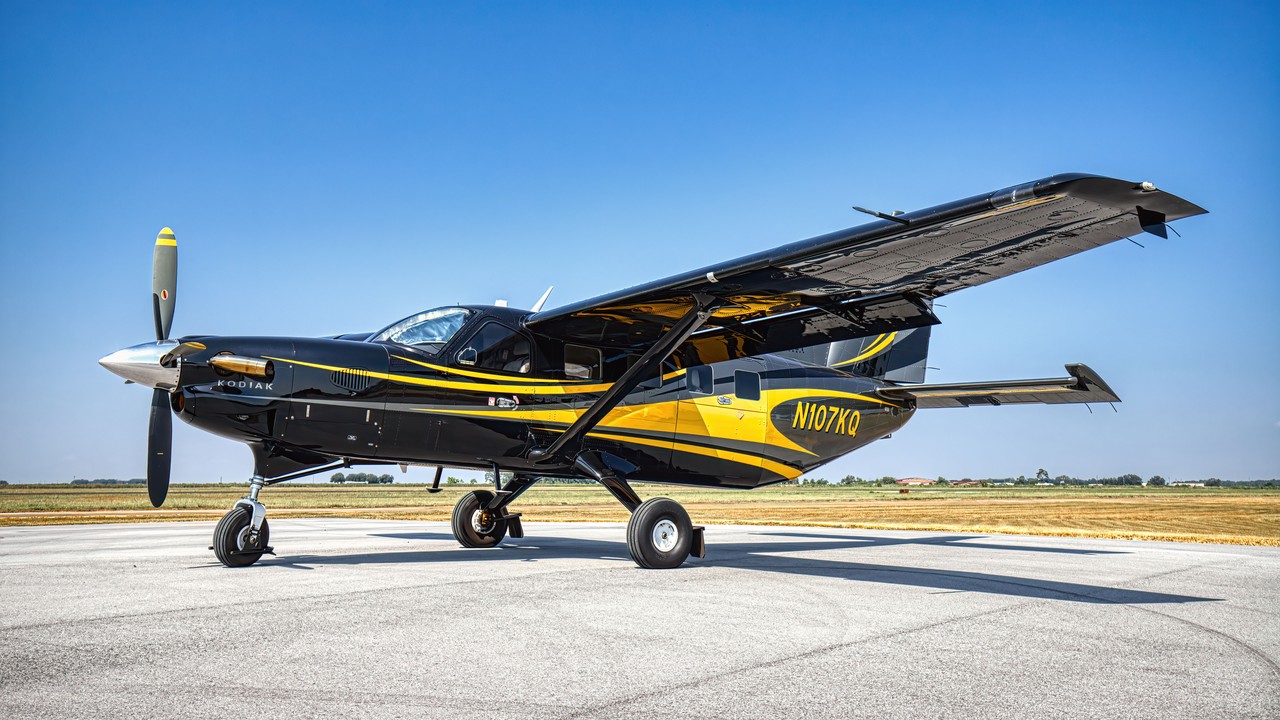
Powering the Kodiak 100 is a single Pratt & Whitney Canada PT6A turboprop engine, the free-turbine design that has dominated the utility turboprop market since the 1960s. The engine provides reliable hot-and-high performance essential for operations in challenging environments and remote locations. Series III models offer an optional five-blade composite Hartzell propeller for enhanced performance characteristics.
The aircraft employs fixed tricycle landing gear and an unpressurized cabin configuration optimized for utility operations rather than passenger comfort. This design philosophy prioritizes operational simplicity and maintenance accessibility in remote locations where sophisticated support infrastructure may be unavailable.
Evolution and Variants
Daher has systematically improved the Kodiak through distinct series developments. The Series II, introduced in 2018, featured upgraded Garmin G1000NXi avionics systems. The Series III, launched in 2021, incorporated additional avionics improvements and offered an executive eight-seat configuration alongside the standard utility layout.
The most significant development emerged with the Kodiak 900, which completed its first flight on February 28, 2020, and achieved FAA certification on August 30, 2022. This variant features a 3.9-foot fuselage extension and upgraded PT6A-140A engine producing 900 shaft horsepower. Deliveries commenced in January 2023, expanding the model line's capabilities for operators requiring additional passenger or cargo capacity.
Performance Characteristics
The Kodiak 100's short takeoff and landing capabilities define its operational advantage, achieving takeoff distances under 1,000 feet with full passenger loads. This performance enables access to airstrips measuring less than half the length required by comparable aircraft. Range exceeds 1,000 miles, providing substantial operational radius for remote area missions.
By 2018, the highest-time aircraft in the fleet had exceeded 5,000 flight hours, demonstrating the type's durability under intensive operational use. The fleet maintains high utilization rates, with 90-plus multi-mission aircraft logging 28,500 annual hours as of 2021 data.
Production Legacy
The Kodiak program represents successful niche aircraft development, identifying and serving markets underserved by existing aircraft types. Production milestones reflect steady market acceptance, from FAA certification on May 31, 2007, through continuous delivery growth spanning more than 15 years. The program's focus on humanitarian missions distinguishes it from purely commercial aircraft developments, with the Quest Mission Team program providing aircraft to qualifying organizations at reduced cost ratios of approximately one in eleven aircraft produced.
Continued production under Daher ownership, combined with variant development through the Kodiak 900, indicates sustained market demand for specialized short takeoff and landing turboprops. The aircraft's role in enabling aviation access to previously unreachable locations ensures its continued relevance in humanitarian, government, and specialized commercial operations.