
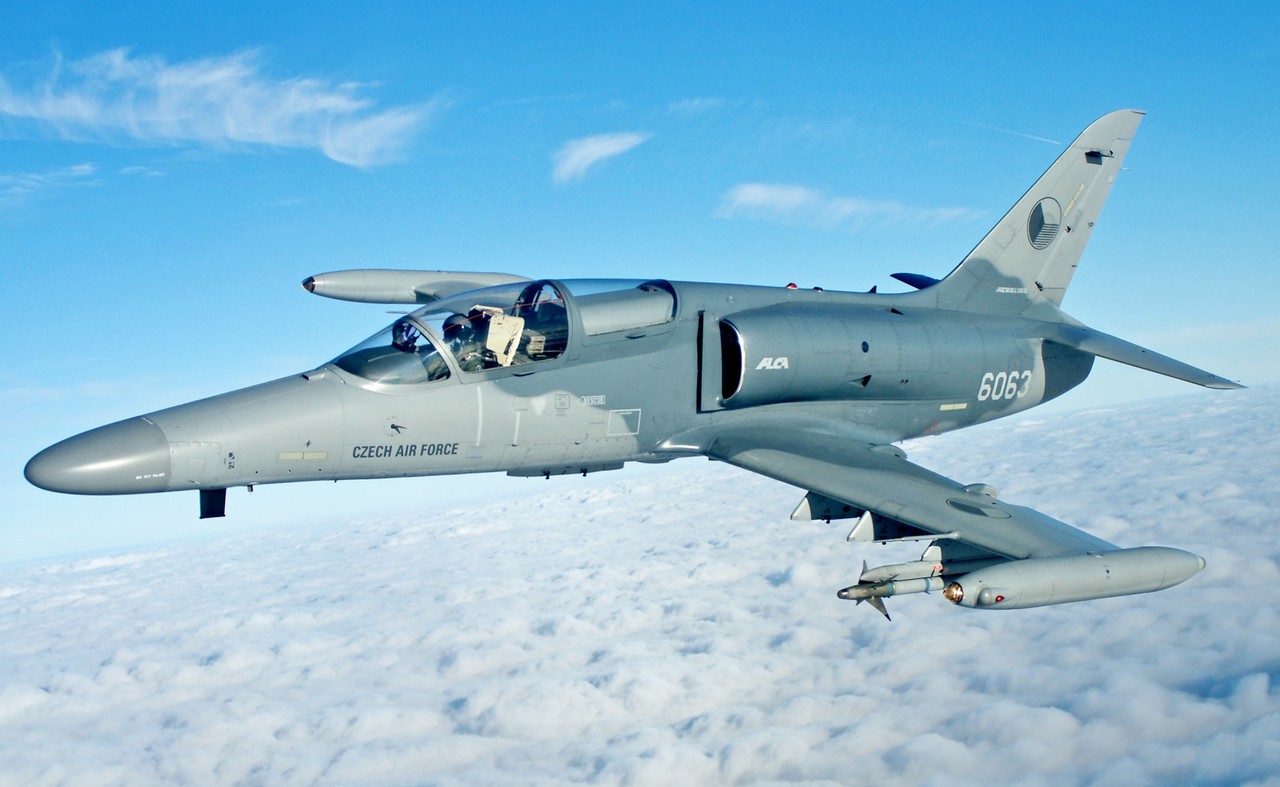
Development and Design
The L-159 ALCA emerged from a critical need to modernize the Czech Air Force following the collapse of the Soviet Union. Beginning development in 1993, Aero Vodochody's engineering team took a pragmatic approach, evolving the proven L-59 airframe rather than creating an entirely new design to control costs and development time. This strategy proved successful when the Czech government ordered 72 L-159A aircraft in 1995.
The aircraft incorporated Western avionics systems from Rockwell Collins (later Boeing) during its technical development phase from 1994 to 1997. The two-seat prototype, serial number 5831 bearing the marking "376 white," achieved first flight on August 2, 1997. The single-seat L-159A prototype followed on August 18, 1998, with serial number 5832 and "356 white" markings.
Production History
Aero Vodochody commenced production in 2000, delivering the first L-159A to the Czech Air Force on April 10, 2000. However, budget constraints forced the Czech military to reduce their operational fleet to just 24 aircraft, with the remaining 48 examples placed in storage. Production initially ceased around 2004 after completing the Czech order.
The program experienced a renaissance when production resumed on March 31, 2017, driven by export orders. Iraq became a significant customer, ordering 15 aircraft through contracts spanning 2015 to 2023. The final L-159 for Iraq was delivered in 2023, marking the completion of this export campaign.
The Manufacturer Legacy
Aero Vodochody boasts over a century of aviation manufacturing, having been established in 1919. The company built its reputation producing more than 11,000 aircraft throughout its history, including nearly 2,900 L-39 Albatros jets between 1971 and 1997. The post-Cold War period presented significant challenges for the state-owned enterprise, leading to a strategic partnership with Boeing in 1998.
Boeing's involvement as a strategic investor proved crucial for both the L-159 project and Aero Vodochody's survival. Today, the company operates as Aero Vodochody AEROSPACE a.s., continuing to produce L-159 variants and upgrades while also manufacturing the next-generation L-39NG and Skyfox aircraft.
Engine and Performance
The L-159's heart is the Honeywell F124-GA-100 turbofan engine, also designated IVC-1. This reliable powerplant, originally developed by Garrett AiResearch before Honeywell's acquisition, provides the thrust necessary for both training and light combat missions. The engine's high bypass ratio design offers improved fuel efficiency and reduced infrared signature compared to older turbojet designs.
Performance specifications include a maximum speed of Mach 0.83 (approximately 930 kilometers per hour) and a service ceiling exceeding 13,000 meters. Range capabilities improved with later production batches, which incorporated wet wing fuel tanks extending operational radius to approximately 1,000 kilometers.
Operational Service
The Czech Air Force remains the L-159's primary operator, maintaining 16 L-159A single-seat aircraft and 5 L-159T1 two-seat trainers as of 2016. These numbers reflect ongoing upgrade programs that have sustained the fleet for 25 years of continuous service as of 2025. The aircraft serves dual roles as an advanced jet trainer for pilot progression and as a light attack platform for tactical missions.
Iraq's adoption of the L-159 included comprehensive pilot training programs conducted in the Czech Republic. Iraqi pilots received instruction on both single-seat and two-seat variants, with deliveries including converted aircraft such as L-159T1 serial number IQAF-5901, originally produced in 2003 but converted for Iraqi service in 2007.
Variants and Upgrades
The L-159 family encompasses several variants addressing different operational requirements. The baseline L-159A serves as the single-seat attack variant, while the L-159T1 provides two-seat training capabilities. The first L-159T1, serial number 6069, completed its maiden flight on March 8, 2007, and was delivered on November 23, 2007.
Advanced variants include the L-159T1+, unveiled in March 2017, featuring the Grifo-L radar system for enhanced combat capabilities. The L-159T2X demonstrator, converted from the original L-159B prototype and redesignated on December 14, 2015, showcases potential future developments. Aero Vodochody has also promoted the F/A-259 Striker variant for export markets.
Current Status and Legacy
Approximately 40 L-159 aircraft remain in active service or available for operations between Czech and Iraqi air forces. The aircraft's seven hardpoints accommodate Western bombs, missiles, and rockets, demonstrating successful integration of NATO-standard weapons systems. This capability proved crucial for the Czech Republic's transition to NATO membership and standardization with alliance equipment.
The L-159 program represents more than a successful aircraft development; it symbolizes Czech aviation independence and technological capability in the post-Cold War era. The resumption of production for export orders validates the design's continued relevance, while ongoing upgrade programs ensure operational viability well into the 2020s and beyond.