
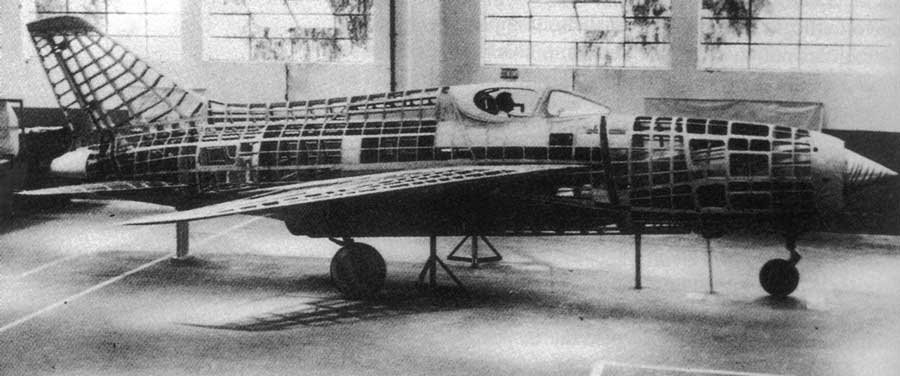
The Aerfer Leone represents the final developmental stage of the Sagittario family of aircraft. Designed by engineer Sergio Stefanutti, the Leone was conceived as a high-performance, fully supersonic interceptor intended to bolster Italy's indigenous aviation capabilities. A key shift in the Leone's design compared to its predecessors was the move toward missile-armed interception; the aircraft was planned to carry up to four air-to-air missiles, moving away from a reliance on cannon-based dogfighting.
Technically, the Leone was characterized by a complex mixed-propulsion arrangement. The design specified a Bristol Orpheus B.Or.12 turbojet located in the front, providing 3,089 kg of thrust, paired with a De Havilland Spectre rocket motor at the rear, which contributed an additional 4,100 kg of thrust. This combination was intended to provide the rapid climb rates and high-altitude performance necessary for a dedicated interceptor. According to project specifications, the aircraft was capable of a rate of climb of 220 m/s and a takeoff run of 560 m. Performance figures vary within available records, with maximum horizontal speeds cited between 2,159 km/h and 2,490 km/h at an altitude of 16,500 m, and a service ceiling reaching as high as 25,000 m.
Physically, the Leone featured a wingspan of 6.93 m, a length of 10.60 m, and a height of 3.32 m, with a total wing area of 16.50 m². The airframe had an empty weight of 3,375 kg and a maximum loaded weight of 6,400 kg, accommodating a single crew member. Despite these detailed specifications, the Leone never entered series production. No verified airframe count or first-flight date exists in the documented record, and the project remained a prototype or conceptual study.
The legacy of the Leone is found in its role as a symbol of Italy's postwar effort to develop indigenous supersonic fighters. It served as the ultimate expression of Aerfer's high-performance interceptor line before the Italian military transitioned to the American-made F-104 Starfighter. No surviving examples of the Leone are known to exist in museums or flying condition.