
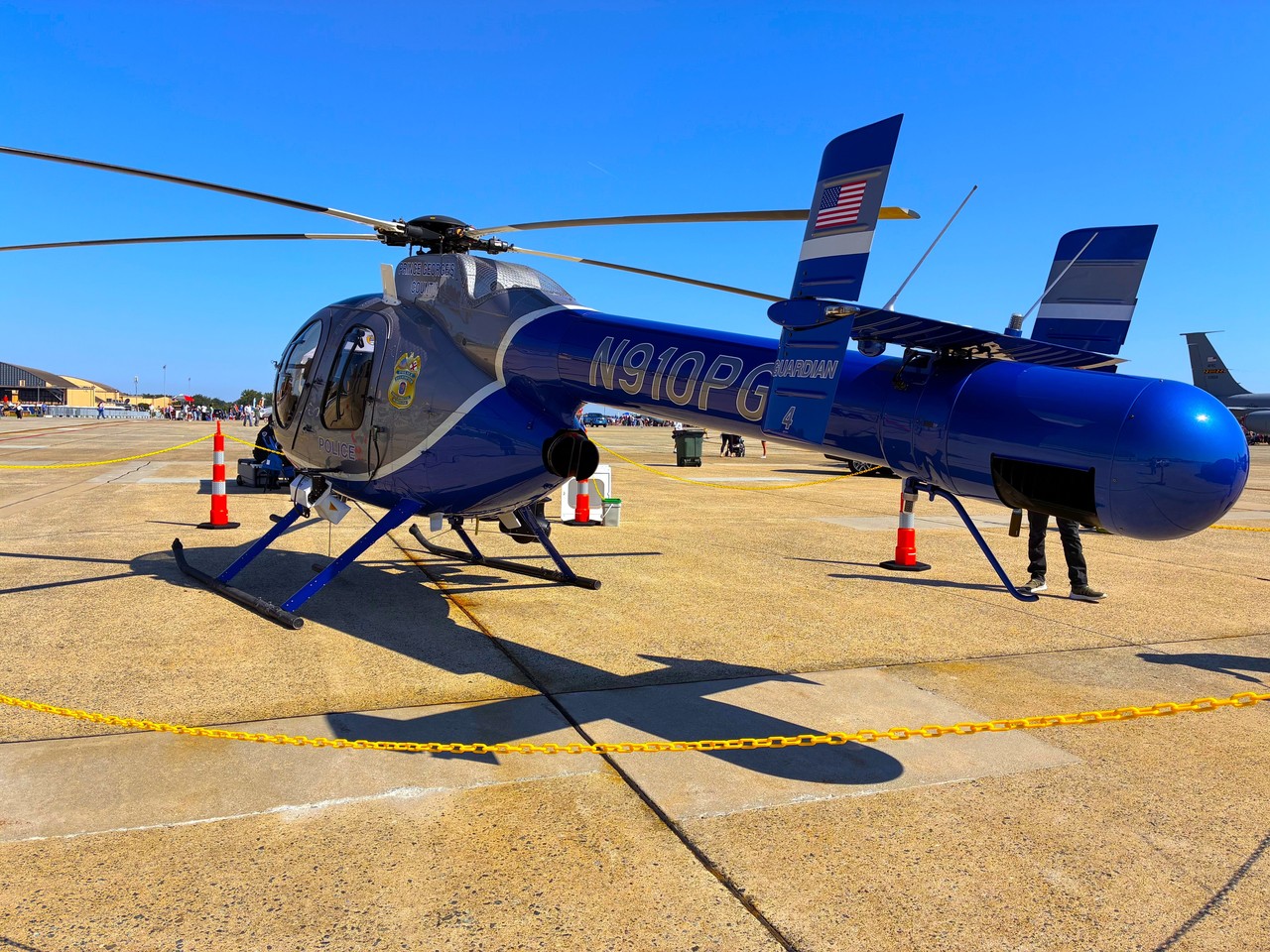
Revolutionary NOTAR Technology
The MD-520N represented a breakthrough in helicopter safety and design philosophy when McDonnell Douglas launched the program in January 1989. The NOTAR system replaced the conventional tail rotor with a variable-area thruster housed within a composite tailboom, addressing long-standing concerns about tail rotor strikes and ground crew safety. Development of this innovative anti-torque system began with a concept demonstrator in December 1981, with full-scale commitment following in 1987.
Development and Certification
The engineering team at McDonnell Douglas Helicopters designed the MD-520N as a commercial variant of their successful MD 500E series. The first production prototype took flight on December 29, 1989, followed by the definitive MD-520N configuration on May 1, 1990. Certification came remarkably quickly, with FAA approval granted on September 13, 1991. The Federal Aviation Administration expressed more concern about the composite tailboom construction than the NOTAR system itself, which had already proven its reliability in testing.
The first production unit rolled off the Mesa, Arizona assembly line on December 31, 1991, marking the beginning of commercial NOTAR operations. McDonnell Douglas initially planned an ambitious production schedule of five aircraft per month, targeting 60 units for 1992 alone.
Production Success and Market Response
Early market reception exceeded expectations, with firm orders for 165 aircraft and options for 25 additional units recorded by mid-January 1992. Production proceeded steadily through the 1990s, with documented serial numbers ranging from LN-005 through LN-052 and beyond. At least 52 units were manufactured between 1991 and 1993, with production continuing into 1999 as evidenced by serial number 100899.
The Manufacturer's Evolution
McDonnell Douglas Helicopters inherited a rich rotorcraft legacy when it acquired Hughes Helicopters from Hughes Tool Company in 1984. The Hughes lineage traced back to 1955 and included legendary aircraft such as the OH-6 Cayuse, of which the U.S. Army ordered 1,000 units in 1960. Full-scale production of the Hughes 500 series began in 1968, evolving through major variants including the 500C, 500D, and 500E models.
When McDonnell Douglas merged with Boeing in 1997, the helicopter division spun off as an independent entity, becoming MD Helicopters, Inc. This company continues operations today under the MD Helicopters name, maintaining the Mesa, Arizona manufacturing facility.
Technical Innovation and Performance
The heart of the MD-520N was its single Rolls-Royce 250-C20 series turboshaft engine, available in multiple variants including the 250-C20, 250-C20R/2, and later the enhanced 250-C20R+. The 2000 model year introduced the 250-C20R+ variant, delivering 3-5 percent more power for improved hot-and-high performance, along with diffuser and fan rigging modifications that increased operational range.
The NOTAR system's composite tailboom represented a maintenance revolution, designed for removal by just two people in five minutes. Engineers projected a 5,000-hour time between overhaul for the tailboom, significantly reducing lifecycle costs compared to conventional tail rotor systems.
Performance specifications impressed operators with a maximum cruise speed of 125 knots indicated airspeed and a never-exceed speed of 152 knots. The helicopter achieved a service ceiling of 20,000 feet with a rate of climb reaching 1,546 feet per minute. With 64 gallons of fuel capacity (403 pounds), the MD-520N provided a maximum endurance of 2.2 hours and range of 202 nautical miles.
Operational Service
Law enforcement agencies became the primary operators of the MD-520N, attracted by the safety benefits and reduced noise signature of the NOTAR system. The City of Phoenix Police Department took delivery of N527FB in 1992, becoming an early adopter. The City and County of Honolulu acquired N18GH in 2017, demonstrating the type's longevity in service.
Other notable operators included Chatham County Mosquito Control, which operated N527FB in 2010, and various international users such as Seoul Aviation with HL9135 delivered in 1996. Private operators like FTAV LLC, Hagedorn Aviation, and Longhorn Air LLC continued acquiring MD-520Ns through the 2010s, with registrations including N909AG (2015), N520MG (2008), and N984DT (2017).
Legacy and Continuing Operations
The MD-520N succeeded in proving commercial viability of NOTAR technology, influencing subsequent light helicopter design by eliminating tail rotor vulnerabilities. Multiple aircraft remain airworthy as of 2017, with ongoing registrations confirming the type's durability and continued utility in specialized roles.
The helicopter's cultural significance extends beyond its technical innovations, representing the evolution of the Hughes/MD 500 series into modern utility applications while pioneering safer, quieter helicopter operations for urban environments.