
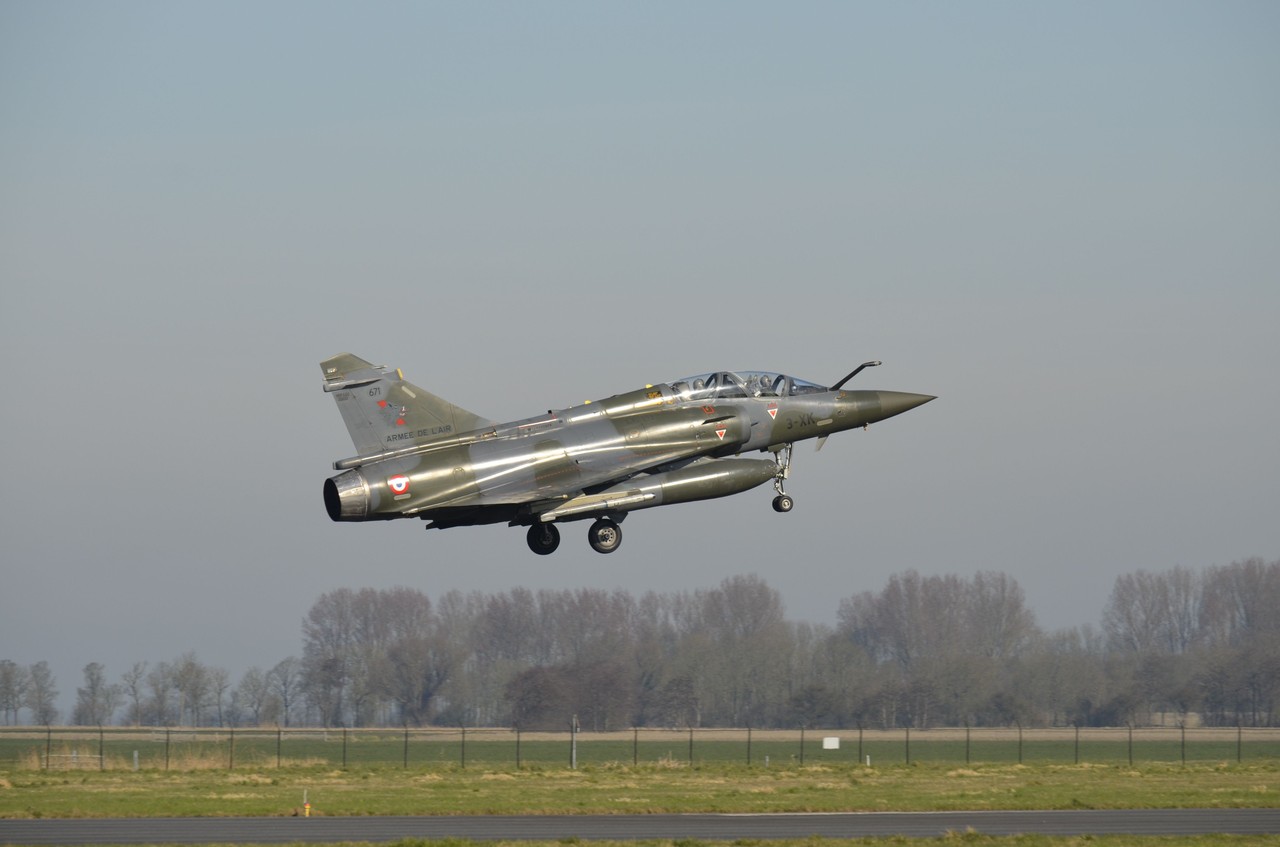
Service Dominance
The Mirage 2000 quickly established French air superiority doctrine after entering operational service with the Armée de l'Air in 1984. Within two decades, it had captured international markets across four continents, with approximately 280 aircraft exported to nine nations including India, Egypt, Greece, Brazil, Peru, Qatar, Taiwan, and the United Arab Emirates. The aircraft's export success rate of nearly 50 percent demonstrated its competitive edge against American F-16s and Soviet MiG-29s during the height of the Cold War arms competition.
Operational Variants and Combat Evolution
Dassault developed multiple specialized variants to meet diverse mission requirements. The baseline Mirage 2000C interceptor formed the foundation, while the two-seat Mirage 2000B served as an operational trainer with 32 examples built for France. The nuclear-capable Mirage 2000N variant achieved initial operational capability in 1988, equipped to deliver France's ASMP nuclear standoff missile from 75 dedicated aircraft. The conventional strike-optimized Mirage 2000D entered service in April 1995 with 86 examples built, featuring advanced terrain-following radar and precision-guided munitions capability.
The improved Mirage 2000-5 variant, first delivered in 1996, incorporated upgraded avionics, enhanced radar systems, and compatibility with modern beyond-visual-range missiles. This version represented the pinnacle of Mirage 2000 development, extending the aircraft's operational relevance into the 21st century.
Manufacturing Excellence
Dassault Aviation orchestrated a sophisticated tri-site production system across France. Wing assemblies originated at the Martignas facility, while fuselage construction occurred at Argenteuil northwest of Paris. Final assembly and flight testing took place at Bordeaux-Mérignac Airport, where Jean Coreau piloted the first prototype on its maiden flight March 10, 1978. The first production aircraft flew on November 20, 1982, marking the transition from development to operational manufacturing.
The company's manufacturing precision achieved remarkable consistency across 601 aircraft over 29 years of production. Initial deliveries to the French Armée de l'Air began in 1983, with 321 aircraft ultimately serving French forces while 280 examples fulfilled export contracts.
Engineering Innovation
The SNECMA M53-5 turbofan engine provided the Mirage 2000's exceptional performance characteristics. This French-manufactured powerplant delivered the thrust necessary for sustained Mach 2+ operations while maintaining fuel efficiency for extended patrol missions. The first 37 production Mirage 2000C aircraft utilized this engine configuration, establishing performance benchmarks that influenced subsequent variants.
Dassault's delta-wing design incorporated lessons learned from earlier Mirage variants while adding revolutionary canard foreplanes. These small forward control surfaces dramatically improved low-speed handling and high-angle-of-attack performance compared to conventional delta-wing configurations, addressing traditional delta-wing limitations in landing and takeoff phases.
International Operations
India emerged as the largest single export customer, signing agreements on April 13, 1982, for 36 single-seat Mirage 2000H aircraft and four twin-seat Mirage 2000TH trainers. Initial plans included licensed production of 110 additional aircraft, but cost considerations and competing Soviet MiG-27 offers prevented Indian manufacturing from proceeding.
Taiwan's Mirage 2000 experience illustrated both the aircraft's capabilities and operational challenges. Deliveries occurred between May 1997 and November 1998, but the fleet subsequently experienced maintenance difficulties including engine blade cracks discovered in 2009. Dassault worked directly with Taiwanese authorities to resolve these issues and provided financial compensation, demonstrating the manufacturer's commitment to long-term customer support.
Combat Legacy
The Mirage 2000 participated in numerous international conflicts and operations, validating its multirole capabilities across diverse combat environments. French Mirage 2000s conducted operations in Chad, the Balkans, Afghanistan, Libya, Mali, and other theaters, accumulating extensive combat experience that refined tactics and operational procedures.
The aircraft's adaptability across air-to-air interception, ground attack, nuclear deterrence, and reconnaissance missions proved Dassault's original multirole design concept. This versatility contributed significantly to export success, allowing customers to fulfill multiple mission requirements with a single aircraft type.
Enduring Presence
Three decades after entering service, Mirage 2000 aircraft continue flying with air forces worldwide. The type's longevity reflects robust initial design, continuous upgrade programs, and Dassault's ongoing support commitment. Modern Mirage 2000 variants incorporate contemporary avionics, weapons systems, and defensive countermeasures, ensuring operational relevance against current threats.
The Mirage 2000's production run of 601 aircraft established it among the most successful European fighter programs of the late 20th century, demonstrating that innovative design and manufacturing excellence could compete effectively in the global defense marketplace.