
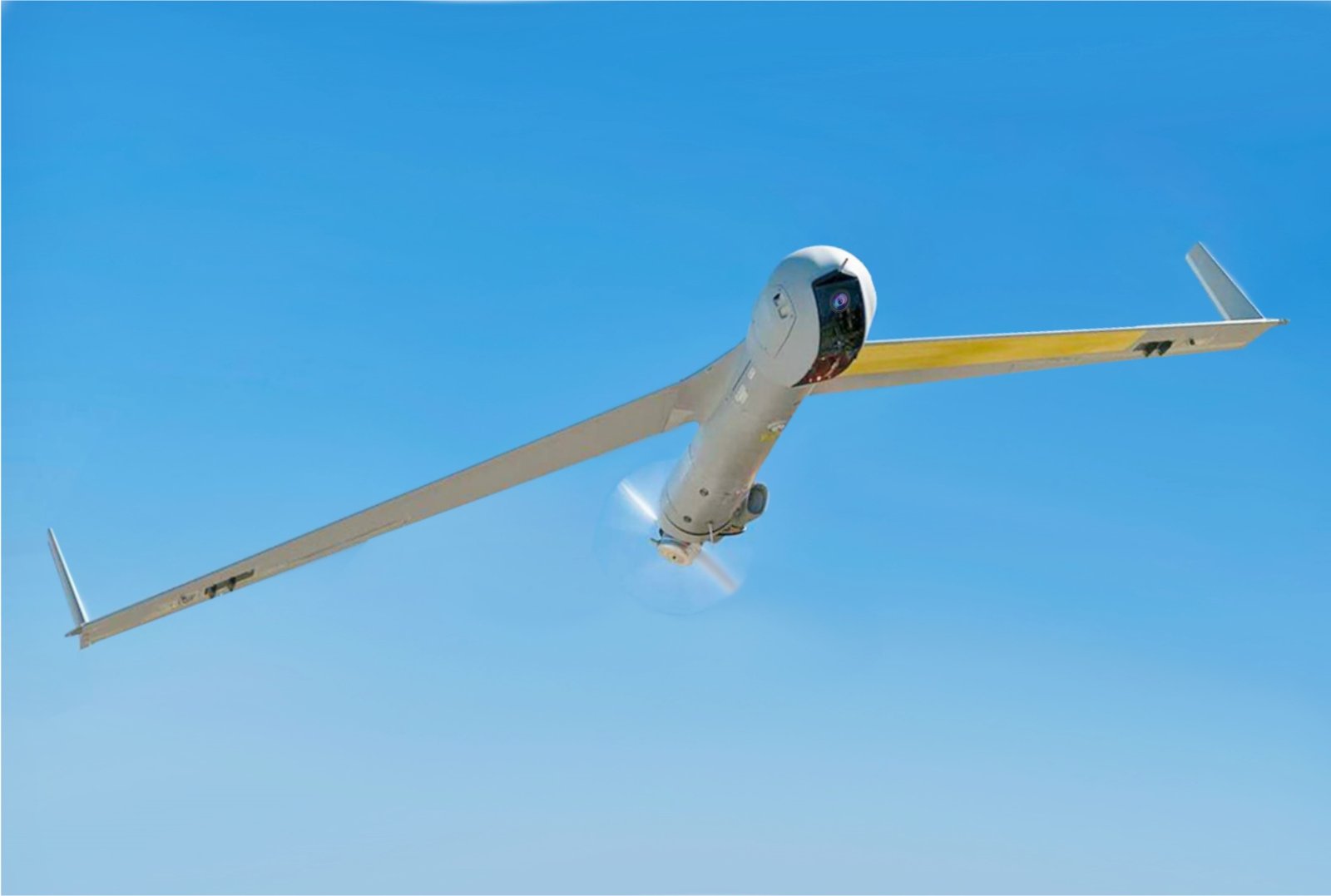
The Boeing Insitu MQ-27 ScanEagle is a small, long-endurance unmanned aerial vehicle (UAV) that emerged from a commercial project led by engineer Tad McGeer in the late 1990s. Originally developed as the SeaScan to assist tuna fishing fleets in locating fish and monitoring weather, the design was adapted for military use following a co-development agreement between Insitu and Boeing in February 2002. The aircraft conducted its first autonomous flight on June 20, 2002, and entered operational service in Iraq by August 2004.
Technically, the ScanEagle is characterized by its composite construction and a tailless design featuring a long swept wing. It is powered by a 3W-Modellmotoren (3W) two-stroke gasoline piston engine, producing between 1.3 and 1.5 horsepower, which drives a two-blade pusher propeller. To eliminate the need for runways, the system employs a pneumatic catapult for launch and a specialized "Skyhook" recovery system, where the aircraft is captured by a vertically suspended cable via a hook on its wingtip. This allows the UAV to be operated from small ships or remote land sites.
In military service, the ScanEagle has become a staple for tactical intelligence, surveillance, and reconnaissance (ISR). The U.S. Marine Corps contracted for the system in 2004 for use in Iraq and Afghanistan, while the U.S. Navy began shipboard operations in 2005. The U.S. Air Force also deployed the system to Iraq in 2006. Over time, the aircraft evolved into the MQ-27A (designated in May 2016) and the MQ-27B, the latter of which features improved sensors and higher payload capacity. By 2012, the fleet had accumulated 600,000 combat flight hours, a figure that later grew to over 1.6 million hours. Beyond the United States, the ScanEagle has been operated by numerous nations, including Poland—the first European owner—as well as Australia, Canada, Indonesia, and Lebanon.
Beyond combat, the ScanEagle achieved a significant regulatory milestone as the first drone to receive an FAA restricted category type certificate. Between 2013 and 2015, the ScanEagle X200 was used for FAA integration demonstrations, including railroad track inspections in New Mexico and ice floe monitoring in northern Alaska. One such X200 aircraft is preserved in the collection of the National Air and Space Museum.