
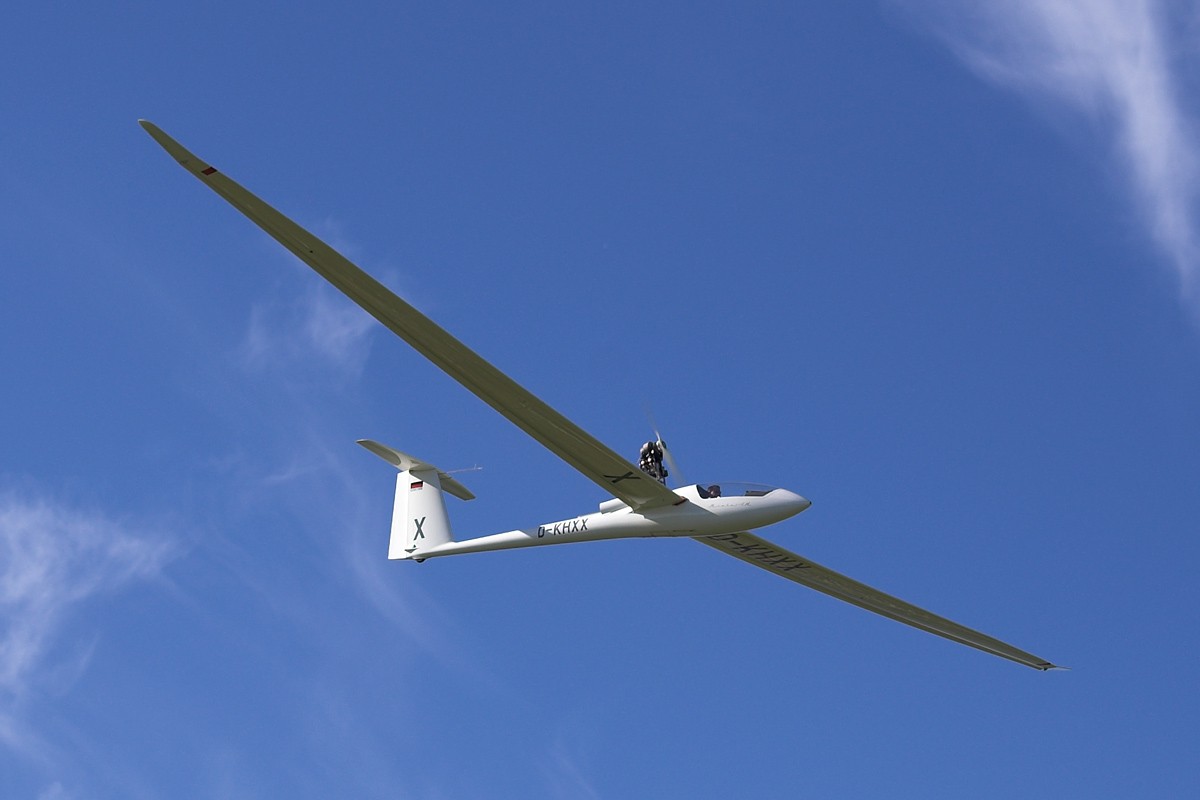
Design Philosophy and Development
Klaus Holighaus, Schempp-Hirth's legendary chief designer from 1964 until his death in 1994, conceived the Nimbus 4T as the ultimate expression of high-performance soaring technology. Building upon his successful Nimbus-3 series, which had captured World Championships in 1981, 1983, and 1985, Holighaus designed the Nimbus-4 family to push the boundaries of glider performance even further. The "T" designation indicated the aircraft's self-sustaining "Turbo" capability, featuring an innovative retractable propulsion system that preserved the aircraft's pure gliding characteristics while providing unprecedented operational flexibility.
The design incorporated several revolutionary features for its time. The 26.5-meter wingspan created an exceptional aspect ratio of 38.8, optimizing lift-to-drag performance across all flight conditions. The lengthened fuselage accommodated the rear-mounted engine installation, while the distinctive T-tail configuration improved elevator authority and reduced interference from the wing's wake. Construction utilized advanced fiber-reinforced plastic throughout, with full-span flight controls ensuring precise handling across the aircraft's extended wingspan.
Technical Innovation
The heart of the Nimbus 4T's self-sustaining capability lay in its SOLO 2350 engine installation. This 18-20 kilowatt two-stroke inline piston engine, manufactured by SOLO Motorsports GmbH, mounted in the rear fuselage with an electrically driven spindle system that extended the propeller pylon forward when needed. This ingenious arrangement allowed pilots to restart the engine in flight and climb to optimal soaring altitudes without requiring ground assistance or tow aircraft.
The engine's compact design and retraction mechanism represented a significant engineering achievement. When retracted, the propulsion system added minimal drag penalty, allowing the aircraft to achieve its impressive 60:1 glide ratio and minimum sink rate of just 0.38 meters per second. With power deployed, pilots could cruise at 142 kilometers per hour or reach maximum speeds of 285 kilometers per hour, providing remarkable versatility for cross-country soaring and competition flying.
Manufacturing and Production
Schempp-Hirth Flugzeugbau GmbH certified the Nimbus 4T on June 15, 1993, following extensive flight testing that began with the base Nimbus-4's maiden flight in 1990. Production took place at the company's historic Kirchheim unter Teck facility, where Schempp-Hirth had operated for over seven decades by the time the 4T entered service. The company, which celebrated its 75th anniversary around 2012, continued the German tradition of precision glider manufacturing under Klaus Holighaus's technical leadership.
Exactly 12 Nimbus 4T aircraft rolled off the production line during the aircraft's manufacturing run, which continued into the early 2000s. These 12 examples formed part of the broader Nimbus-4 family production, which totaled 44 single-seat variants and 100 two-seat models by 2010. The limited production numbers reflected both the aircraft's specialized high-performance mission and its substantial cost, targeting serious competition pilots and soaring enthusiasts who demanded maximum capability.
Operational Excellence
The Nimbus 4T found its home among elite competition pilots and soaring clubs worldwide, with registrations spanning from Germany's D-registration system to aircraft flying under British BGA numbers, American N-numbers, Australian VH registrations, and Japanese JA designations. The aircraft excelled in FAI Open Class competitions, where its combination of exceptional glide performance and self-launching capability provided significant strategic advantages.
Record-setting performances became synonymous with the Nimbus-4 family. In December 2006, a Nimbus-4DM variant achieved a remarkable 500-kilometer course speed of 306.8 kilometers per hour, demonstrating the design's competitive superiority. These achievements built upon Klaus Holighaus's legacy of championship-winning designs, extending Schempp-Hirth's dominance in international soaring competition well into the 1990s and beyond.
Legacy and Current Status
Today, approximately 5-10 Nimbus 4T aircraft remain potentially airworthy from the original production run of 12, though exact current flying numbers prove difficult to verify. The broader Nimbus-4 family continues to appear in active registrations, with examples still flying competitively into the 2020s. The aircraft's significance extends beyond mere production numbers, representing a pivotal moment in motor glider development when retractable self-sustaining systems matured into practical, reliable technology.
Schempp-Hirth continues operations today as Schempp-Hirth GmbH & Co. KG, maintaining glider production in Kirchheim and building upon the technical foundation Klaus Holighaus established. The Nimbus 4T's influence persists in modern high-performance sailplane design, where the principles of combining pure gliding capability with practical self-launching systems remain fundamental to contemporary competition aircraft development.