
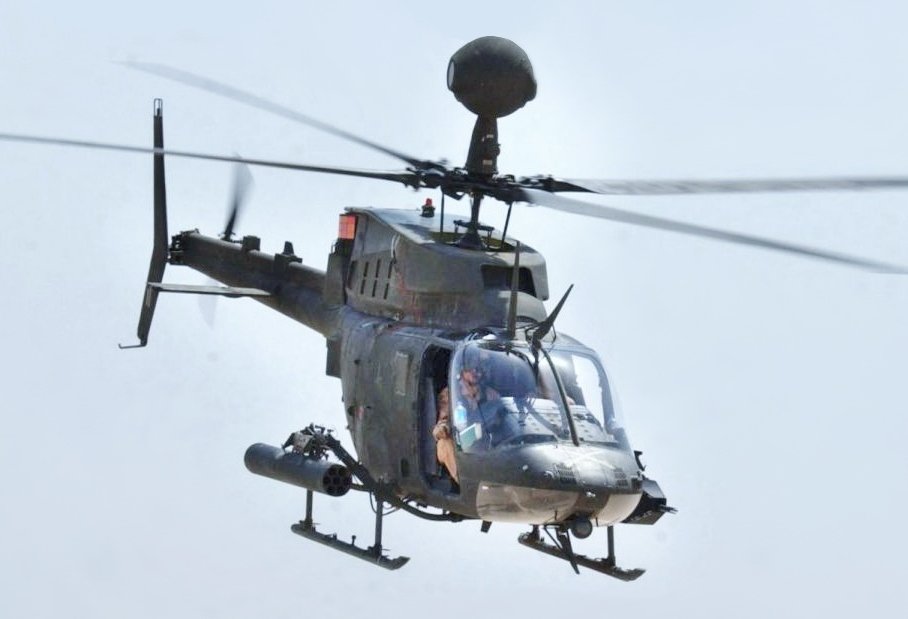
The Bell OH-58 Kiowa is a family of light observation and armed scout helicopters derived from the civil Bell 206 JetRanger. The aircraft's origins trace back to the U.S. Army's Light Observation Helicopter (LOH) competition in 1960–1961. While Bell's initial D-250 entry lost to the Hughes OH-6 Cayuse, Bell redesigned the proposal into the Model 206A JetRanger. Due to availability and cost issues with the OH-6, the U.S. Army ordered over 2,000 JetRangers in 1968, which entered service as the OH-58A Kiowa in May 1969.
Manufactured between 1966 and 1989, approximately 2,200 to 2,300 units were produced by Bell Helicopter, primarily at its Fort Worth, Texas plant. The aircraft is characterized by a compact, agile airframe and a "greenhouse" cockpit designed for maximum downward and lateral visibility, essential for artillery spotting and low-level scouting. The OH-58D Kiowa Warrior variant, which first flew on October 6, 1983, introduced significant upgrades, including a four-bladed main rotor and a mast-mounted sight (MMS) equipped with a thermal imager, day TV, and laser rangefinder, allowing the crew to observe targets from behind cover.
Powerplants for the Kiowa family are turboshaft engines from the Allison (later Rolls-Royce) T63/250 series. The OH-58A utilized the Allison T63-A-700, while the OH-58C used the T63-A-720. The OH-58D was powered by the Allison 250-C30R/3, providing approximately 650 shp. In terms of performance, the OH-58D can reach maximum speeds of approximately 149 mph and has a service ceiling between 15,000 and 19,000 feet.
Throughout its service life, the OH-58 was deployed in nearly every major U.S. conflict from 1969 onward. It arrived in South Vietnam in August 1969, where 45 aircraft were lost to combat and accidents. It later served in Operation Prime Chance (1987–1988) in the Persian Gulf, Operation Just Cause in Panama, and the Gulf War, where 115 OH-58Ds were deployed. The type saw extensive use in Afghanistan and Iraq, accumulating 820,000 combat hours by the end of 2013. The U.S. Army began phasing out the fleet in 2015, with the final aircraft retired in July 2020. Despite U.S. retirement, the Kiowa remains in service with the militaries of Greece, Taiwan, and Saudi Arabia.