
Market Dominance and Business Aviation Role
The Malibu Meridian filled a critical gap in the business aviation market that Piper had abandoned since discontinuing the twin-engine Cheyenne 400LS in 1991. By offering turboprop reliability and performance at a 2003 price of $1.75 million, the aircraft captured significant market share among owner-pilots seeking to step up from piston-engine aircraft. Piper secured 239 orders before production even began, delivering 98 aircraft in 2001 alone. The aircraft provided approximately 50 knots more cruise speed than its piston-powered Malibu Mirage predecessor while maintaining single-engine simplicity.
Development and Certification Journey
Piper launched the turboprop project in 1997 at the National Business Aviation Association Convention in Dallas, displaying a full-scale fuselage mockup. Chief among the design challenges was adapting the existing Malibu airframe for turboprop power, requiring strengthened wings with wingroot leading-edge gloves to increase wing area and reduce stalling speeds. Engineers increased the horizontal stabilizer area by 37 percent and reinforced tail surfaces to handle the increased power and torque.
The prototype N400PT, converted from a second Malibu Mirage, rolled out on August 13, 1998, achieving first flight eight days later on August 21, 1998. Three additional flight test aircraft followed, each dedicated to specific certification requirements. N401MM handled stability and autopilot testing, N402MM conducted performance and known-icing certification while serving as the marketing demonstrator, and N403MM focused on systems testing and flutter analysis. The comprehensive test program culminated in FAA Part 23 certification on September 27, 2000, followed by UK CAA approval on June 21, 2001.
Piper Aircraft Legacy
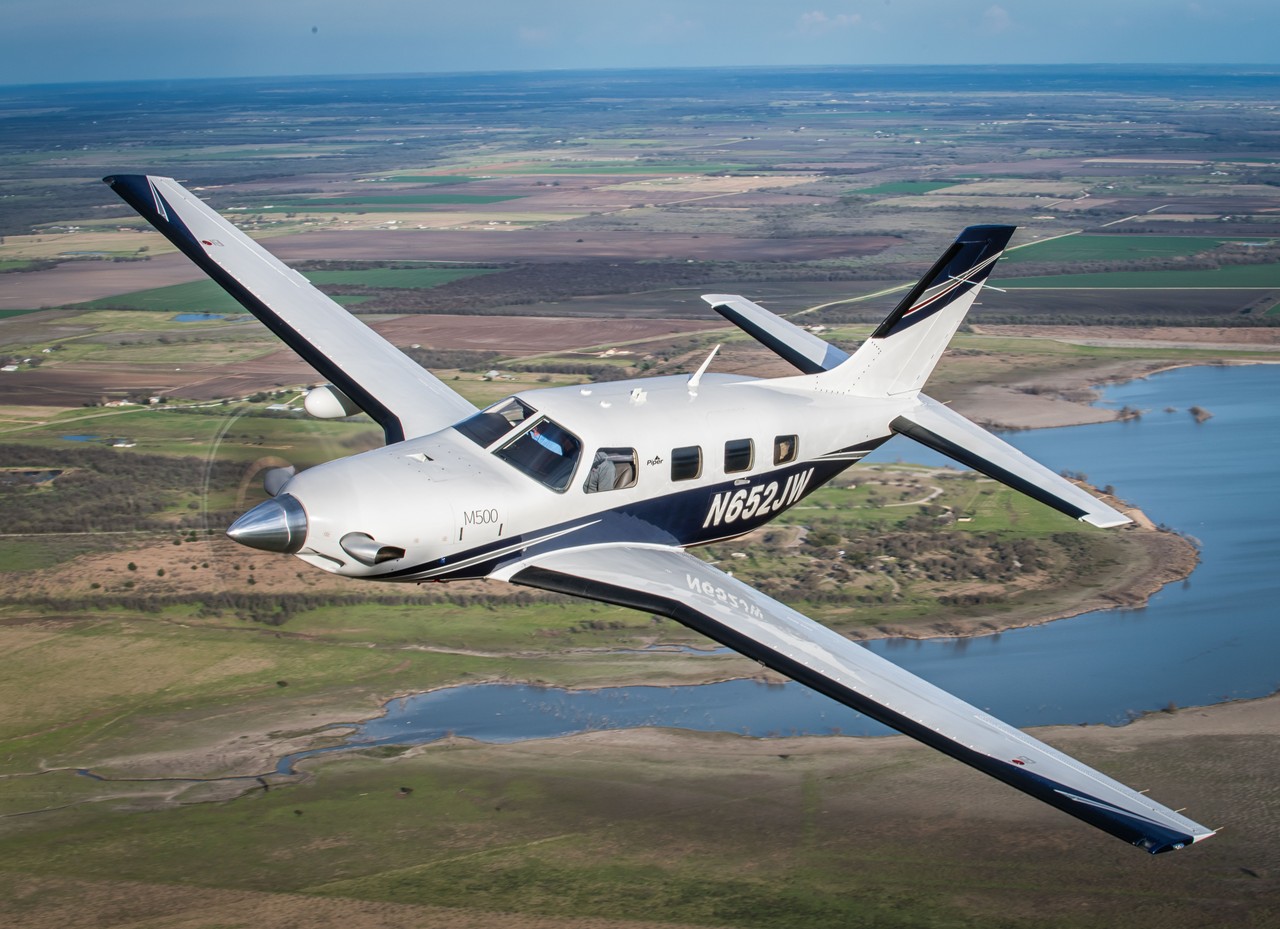
Piper Aircraft, founded in 1927 by William Piper, has remained one of general aviation's most enduring manufacturers. The company's Vero Beach, Florida facility has maintained continuous PA-46 family production for more than four decades since the original Malibu's 1983 certification. This remarkable longevity makes the PA-46 series one of aviation's most successful aircraft designs. Following various ownership changes, including periods under Bankers Trust and later New Piper Aircraft Corporation, the company continues operations today, having evolved the Meridian design into the current M500, M600, and M700 Fury variants.
Powerplant and Technical Innovation
The heart of the Meridian's performance lies in its Pratt & Whitney Canada PT6A-42A turboprop engine, thermodynamically rated at 1,029 shaft horsepower but flat-rated to 500 shaft horsepower for this application. This engine drives a Hartzell HC-E4N-3Q four-blade constant-speed reversible propeller, providing the aircraft with excellent short-field performance capabilities. The PT6A series, introduced in the 1960s, represents one of turbine aviation's most successful powerplant families, with thousands produced across numerous variants.
Fuel capacity totals 173 US gallons, with 170 gallons usable, while oil capacity reaches 3.0 US gallons. The aircraft's fully automatic bleed-air conditioning and pressurization systems maintain cabin comfort at the aircraft's maximum certified altitude. In late 2002, Piper achieved certification for increased maximum takeoff weight to 5,092 pounds, providing operators with a 15 percent increase in useful load.
Operational Characteristics
Pilots praise the Meridian for combining turboprop performance with single-engine simplicity, though the aircraft demands respect for its increased complexity compared to piston twins. The standard configuration accommodates a pilot plus five passengers in a club seating arrangement, though installing the optional entertainment center reduces passenger capacity to four. The pressurized cabin allows comfortable flight at altitudes where weather and air traffic control delays are minimized.
Cruise performance of 260 knots represents a significant improvement over piston-powered alternatives, while the turboprop engine provides enhanced reliability and reduced maintenance complexity compared to piston powerplants. The aircraft's range and speed capabilities make it suitable for transcontinental flights with appropriate fuel stops, positioning it perfectly for business travelers requiring efficient point-to-point transportation.
Production Legacy and Modern Evolution
Production ceased in 2015 after delivering hundreds of aircraft to operators worldwide. The first production delivery occurred in November 2000 to Richard Dumais of Richardson, Texas, launching what would become a successful production run spanning 15 years. Annual production varied significantly, with 98 deliveries in 2001, dropping to 25 in 2002, and just 17 in the first nine months of 2003 as the general aviation market contracted.
The PA-46-500TP's success provided the foundation for Piper's modern turboprop family. The company introduced the M600 in 2016 with extended range capabilities, followed by the high-performance M700 Fury, which achieved FAA certification on February 29, 2024. The M700 received additional certification for unpaved field operations in August 2024, demonstrating the continuing evolution of the Meridian's basic design philosophy. Today, hundreds of Meridians remain in active service worldwide, testament to the aircraft's successful combination of performance, reliability, and operational economy.