
Design and Development
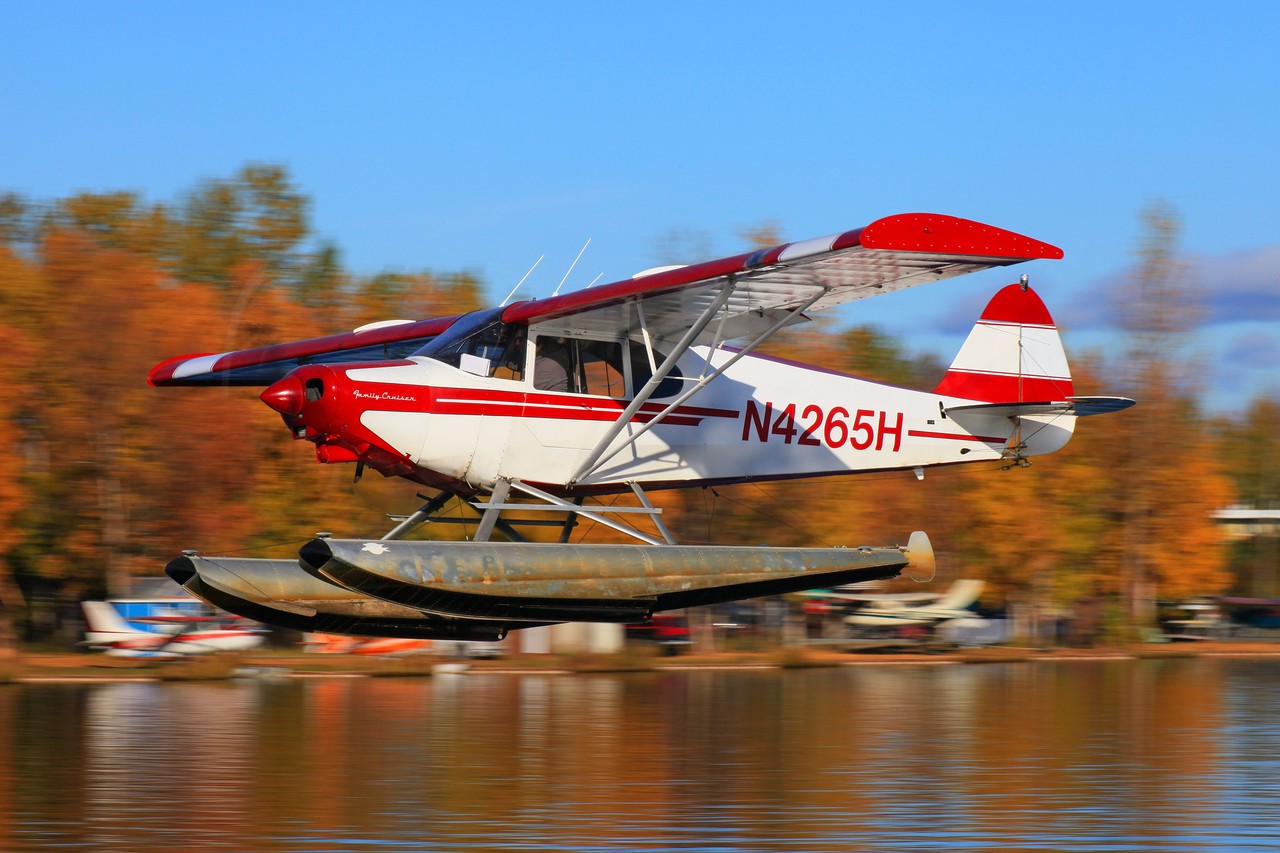
The PA-14 Family Cruiser emerged from Piper Aircraft's ambitious plan to capture the post-World War II family aviation market. The Piper design team developed the aircraft by significantly modifying their successful PA-12 Super Cruiser, widening the cabin by five inches at the instrument panel to accommodate four occupants rather than two. This modification transformed the aircraft into Piper's first production four-seat design, targeting families seeking affordable recreational flying.
The prototype completed its maiden flight on March 21, 1947, from Piper's Lock Haven facility. The aircraft retained the proven high-wing, fixed tailwheel configuration of its predecessor while incorporating slotted flaps and a two-spar all-metal wing structure. The widened fuselage featured welded steel tube construction with fabric covering, maintaining the rugged simplicity that characterized Piper designs of the era.
Engine and Performance
Powering the PA-14 was the newly developed Lycoming O-235-C1, a four-cylinder air-cooled horizontally-opposed engine producing 115 horsepower for takeoff and 105 horsepower continuously. This powerplant, manufactured by Lycoming Engines (a division of Avco), was paired with a fixed-pitch Sensenich two-bladed propeller, though early models featured a two-speed wooden propeller. The engine included an electric starter, a notable convenience feature for the era.
The O-235 engine series proved remarkably durable, remaining in production for over 75 years with tens of thousands manufactured across various variants. Many surviving PA-14s have been modified with more powerful 150 to 180 horsepower O-320 engines to improve performance characteristics.
Performance Characteristics
The Family Cruiser delivered respectable performance for its era, achieving a maximum speed of 123 mph and cruising at 110 mph. The aircraft demonstrated gentle handling characteristics with a stall speed of just 44 mph with flaps deployed. Its service ceiling reached 12,000 feet with a climb rate of 575 feet per minute, while maximum range extended to 500 miles.
With an empty weight of 1,020 pounds and maximum takeoff weight of 1,850 pounds, the PA-14 offered a useful load of 830 pounds. The aircraft's wing area of approximately 179 square feet utilized the USA 35B airfoil, contributing to its stable flight characteristics and short-field capabilities.
Production and Certification
Piper received Approved Type Certificate ATC-797 for the PA-14 on August 26, 1948, with production commencing in April 1948. Manufacturing continued until 1949, with exactly 238 aircraft completed at the Lock Haven, Pennsylvania facility. Some sources cite slightly different totals of 232 or 236 aircraft, but 238 represents the most widely accepted figure.
The limited production run reflected the challenging economic climate facing general aviation manufacturers in the late 1940s. Piper Aircraft itself faced severe financial difficulties during this period, entering receivership shortly after the PA-14's introduction before eventually recovering under new management.
Operational Service
The PA-14 found its primary market among private owners seeking four-seat family transportation. The aircraft proved particularly popular in Alaska, where its rugged construction and adaptability to skis or floats made it valuable for bush operations. Many Alaskan operators modified their aircraft with extended wings, 18-inch landing gear, and PA-18 tail assemblies to enhance short-field performance.
By April 2011, 126 PA-14s remained registered in the United States, with 81 of these based in Alaska. Canada maintained 13 registered examples, while smaller numbers operated in France, South Africa, and other countries. The aircraft's versatility and durability ensured continued operation more than six decades after production ended.
The Manufacturer Legacy
Piper Aircraft, founded in 1927 by William T. Piper as Taylor Brothers Aircraft Manufacturing Company, had established itself as a leading producer of light aircraft by the time of the PA-14's development. The company underwent several ownership changes throughout its history, including acquisition by Bangor Punta in 1969, a management buyout in 1987, and sale to New Piper Aircraft in 1995.
Today, Piper Aircraft continues operations from Vero Beach, Florida, maintaining its position as a significant general aviation manufacturer. The PA-14 represented an important milestone as the company's first four-seat production aircraft, bridging the gap between the successful two-seat trainers and the larger cabin-class aircraft that would follow.
Current Status and Legacy
The PA-14's brief production run and specialized role have made surviving examples increasingly rare and valuable. As of recent surveys, approximately 106 aircraft remain on the U.S. registry, with 76 of these based in Alaska where the type continues serving utility roles. Most surviving aircraft have undergone significant modifications to improve performance and adapt to modern operating requirements.
The Family Cruiser inspired several kit aircraft designs, including the Wag-Aero 2+2, which replicated the PA-14's configuration without flaps. While the PA-14's production ended in favor of the less expensive PA-16 Clipper, its legacy as Piper's first four-seat design established the foundation for the company's subsequent success in the family aircraft market.