
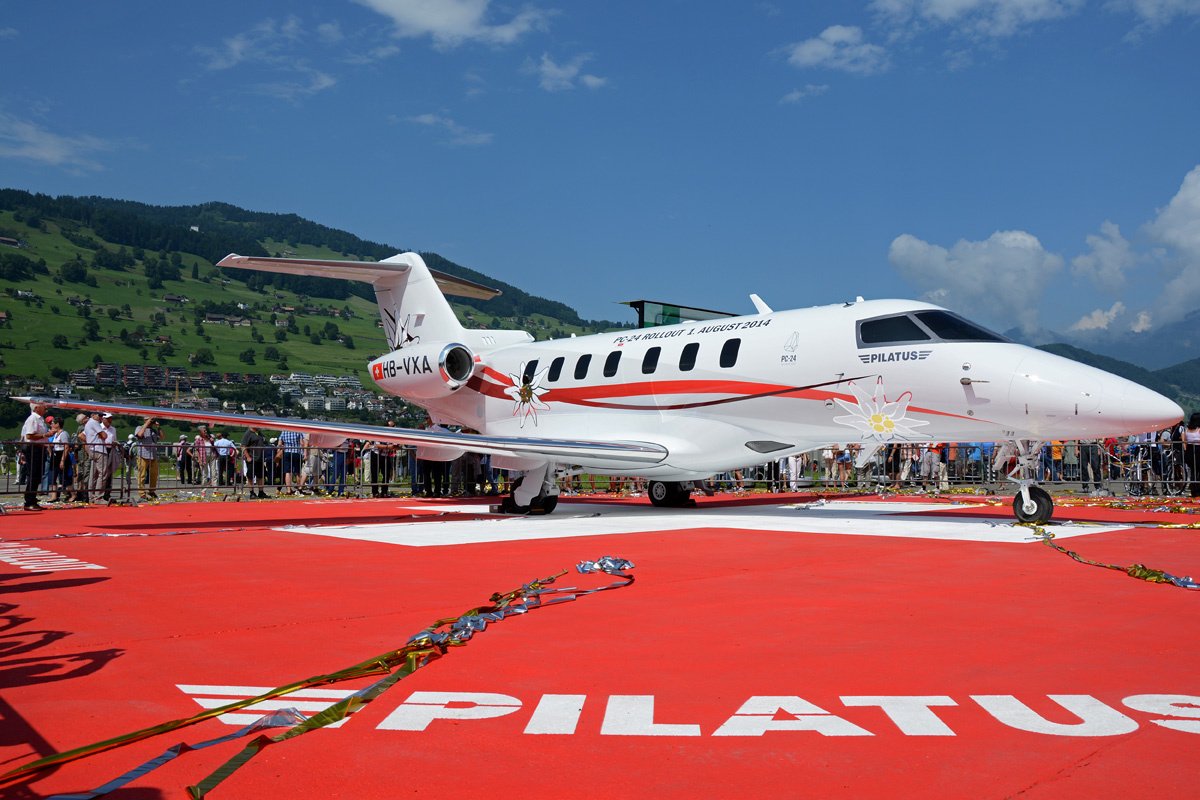
Market Breakthrough
When Pilatus opened the PC-24 order book on May 24, 2014, the aviation industry witnessed unprecedented demand for a business jet. Within 36 hours, 84 aircraft were sold—representing three years of planned production—forcing Pilatus to temporarily halt order-taking. This extraordinary reception validated the company's vision of creating a jet that could access remote destinations previously limited to turboprops while delivering true jet performance.
The Swiss Manufacturer
Pilatus Aircraft, established in 1939 to maintain Switzerland's air force fleet, evolved into one of aviation's most innovative manufacturers. Beginning aircraft production in 1942 with the SB-2 Pelikan designed for Alpine operations, Pilatus built its reputation on aircraft capable of operating from challenging terrain. The company's PC-12 turboprop, introduced in 1987, became a remarkable success with over 1,600 delivered by 2024. Despite this achievement, customers consistently requested greater speed and range, leading Pilatus to venture into the business jet market for the first time with the PC-24.
Revolutionary Design Philosophy
The PC-24's development team faced an unprecedented challenge: creating a 425-knot single-pilot twinjet with landing speeds and field performance rivaling turboprops. The design process, completed by 2009 after two years of intensive work, demanded innovative solutions to seemingly contradictory requirements. Engineers needed to maintain Pilatus's signature features—an airstair door, large aft cargo compartment, and flexible interior configuration—while achieving jet performance.
The solution involved revolutionary manufacturing techniques. Each wing skin is precision-machined from 3,975-pound aluminum billets into seamless 185-pound panels, eliminating traditional riveted construction. This process, while expensive, creates incredibly strong yet lightweight wing structures essential for short-field performance.
Operational Capabilities
The PC-24's double-slotted flaps and sophisticated lift-dump system automatically deploy four multifunction spoilers upon touchdown, enabling consistently short landing distances. This technology earned the aircraft steep approach certification from both European and American authorities, including approval for London City Airport's demanding 5.5-degree approach angle. More remarkably, the PC-24 received certification for operations on dirt and gravel runways—unprecedented for a business jet.
Powerplant Excellence
Two Williams International FJ44-4A-QPM turbofan engines provide 3,420 pounds of normal thrust each, expandable to 3,600 pounds for maximum takeoff performance. The engines incorporate Quiet Power Mode technology, allowing the right engine to operate in sub-idle mode while powering all aircraft systems during ground operations. Combined fuel consumption of 160 gallons per hour delivers exceptional efficiency for the performance class.
Performance Specifications
The PC-24 achieves a maximum cruise speed of 440 knots and climbs at 4,075 feet per minute to a service ceiling of 45,000 feet. With four passengers under NBAA IFR reserves, the aircraft delivers 2,030 nautical miles of range. These figures place it competitively among light jets while maintaining unique short-field capabilities no competitor can match.
Production Success
Following a comprehensive 3,000-hour flight test program using three prototypes, the PC-24 received simultaneous EASA and FAA type certification on December 7, 2017. The first customer delivery occurred in February 2018, marking Pilatus's successful entry into the business jet market. By 2019, aircraft pricing had increased from the original $9 million to $10.1 million, reflecting strong demand.
Modern Avionics
The PC-24 cockpit features four 12-inch displays integrated with synthetic vision technology, inertial reference systems, and autothrottle capability. Traffic Collision Avoidance System II and advanced graphical flight planning enhance safety and operational efficiency. These systems enable certified single-pilot operations, reducing operating costs for owner-operators.
Current Operations
Interior completion occurs at Pilatus's Colorado facility, while FlightSafety International provides pilot and technician training from its Dallas center. The aircraft serves corporate flight departments, charter operators, and private owners who require access to challenging airports conventional jets cannot reach. An upgraded variant introduced in October 2023 increased maximum payload and range capabilities, ensuring the PC-24's continued relevance in the evolving business aviation market.
The PC-24's success demonstrates that innovation in aircraft design continues to create new market segments, proving that specialized capabilities can command premium pricing when they solve real operational challenges for aircraft operators.