
Service History
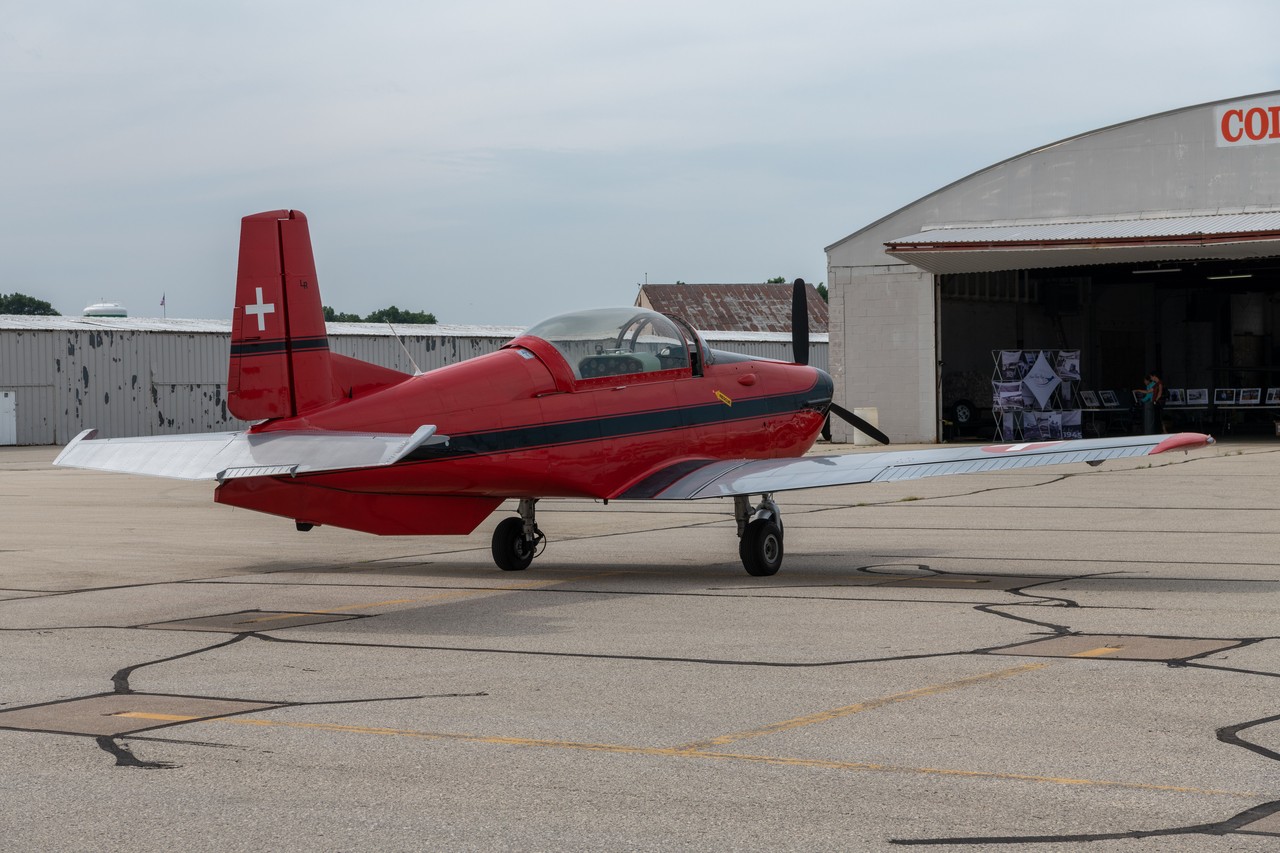
The P-3 became the Swiss Air Force's standard primary trainer, serving in this role until 1983 before continuing as a liaison aircraft for another decade. Of the 78 aircraft produced, 60 went to the Swiss Air Force as production models, while 12 pre-production aircraft served as evaluation platforms. The aircraft proved capable of primary and advanced training missions, including night flying, aerobatics, and instrument instruction.
Six civilian variants found their way to the Brazilian Navy, where they received the designations L-3, O-3, and later U-3. Swissair tested one P-3 for commercial pilot training at its Schweizerische Luftverkehrsschule but declined to exercise its purchase option, limiting the aircraft's civilian market penetration.
Operational Challenges and Solutions
Early operations revealed a dangerous tendency for the P-3 to enter flat spins, resulting in two fatal crashes. Engineers addressed this critical flaw by installing a ventral fin on aircraft A-858 for testing. The modification proved successful, and all Swiss P-3s subsequently received this enhancement, restoring confidence in the aircraft's safety profile and operational reputation.
The Manufacturer
Pilatus Aircraft was founded in 1952 specifically to develop the P-3 under the direction of Henry Fierz. The company established its manufacturing facility in Stans, Switzerland, where it continues operations today as one of the world's premier producers of propeller-driven trainers. The P-3 program provided crucial experience that would inform all subsequent Pilatus designs.
Engine and Technical Innovation
The production P-3 featured a Lycoming GO-435-C2-A2 six-cylinder horizontally opposed engine producing 190 kilowatts, driving a three-bladed Hartzell constant-speed propeller. The initial prototype's two-blade propeller and insufficient engine power necessitated the powerplant upgrade implemented in the second prototype, which flew in August 1954.
The aircraft's all-metal construction represented modern engineering for the 1950s, incorporating a retractable tricycle undercarriage that simplified ground handling compared to conventional tailwheel configurations. The tandem seating arrangement optimized the instructor-student relationship, with controls described as exceptionally precise, allowing both occupants to easily monitor each other's inputs.
Design Versatility
While primarily designed for training, the P-3 included provisions for light military applications. Underwing racks could accommodate practice bombs or rockets, while a machine gun pod could be mounted beneath the port wing. Although the Swiss Air Force purchased these armament kits, they were never operationally employed, reflecting the aircraft's peaceful training mission.
Production and Variants
Pilatus manufactured 78 P-3s across five distinct variants: one prototype (P-3-01), one military prototype (P-3-02), twelve pre-production aircraft (P-3-03), six civilian variants (P-3-04), and sixty production aircraft (P-3-05). This structured approach allowed for thorough testing and refinement before full-scale production commenced.
Legacy and Current Status
In 1993-1995, 65 ex-Swiss Air Force P-3s entered the civilian market following their military retirement. Approximately 30 aircraft remain airworthy in private ownership, testament to the type's robust construction and enduring appeal among vintage aircraft enthusiasts.
The P-3's most significant legacy lies in its role as the foundation for Pilatus's subsequent success. Experience gained from the P-3's development, including knowledge of its strengths and limitations, directly informed the design of the PC-7 trainer, which first flew in 1978. The PC-7 featured a turboprop engine, bubble canopy, and single-piece wing, becoming a major export success with over 600 examples produced. This lineage continued with the PC-7 Mk.II M beginning in 1994, establishing Pilatus as a dominant force in the international trainer market.
The P-3 thus represents more than a successful trainer aircraft; it launched a company and established design principles that would influence military pilot training worldwide for decades to come.