
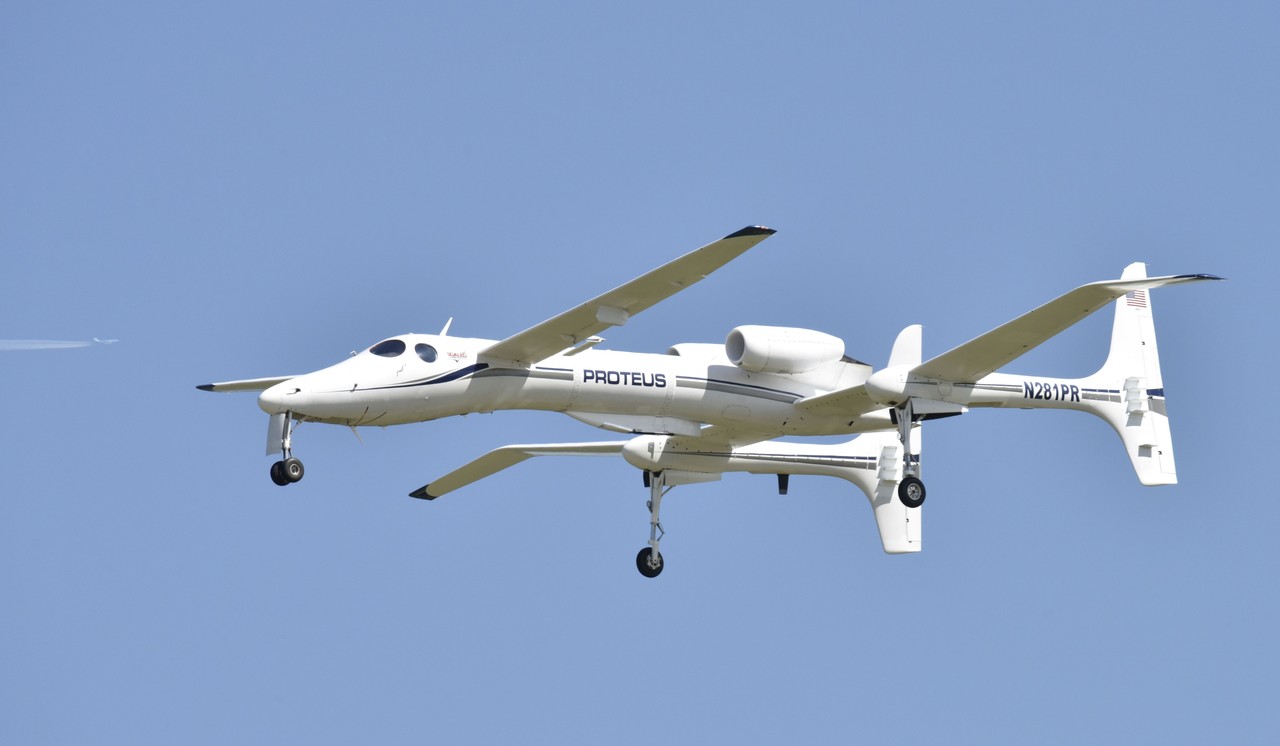
Revolutionary Stratospheric Platform
The Proteus emerged from a unique commercial vision in the late 1990s telecommunications boom. Angel Technologies Corporation contracted Scaled Composites to develop a stratospheric relay station that could hover above major cities, providing cellular coverage equivalent to hundreds of ground-based towers. This High Altitude Long Operation (HALO) concept required an aircraft capable of sustained flight above 50,000 feet for 14 to 18 hours while carrying substantial electronic payloads.
The Rutan Design Philosophy
Burt Rutan, founder and president of Scaled Composites, conceived the Proteus as part of NASA's Environmental Research Aircraft and Sensor Technology (ERAST) program. His tandem-wing design featured a forward canard and main wing configuration that provided exceptionally low wing loading for efficient high-altitude loiter. The carbon composite structure incorporated one fiberglass wingtip specifically designed for radio frequency transparency, allowing unobstructed signal transmission from onboard telecommunications equipment.
The aircraft's modular design centered on an interchangeable fuselage section that could accommodate different mission payloads. This flexibility proved prescient when the original telecommunications mission became commercially unviable, allowing the Proteus to transition seamlessly into a multi-mission research platform.
Record-Breaking Performance
Between October 25-27, 2000, the Proteus established multiple world records that remain unbroken as of 2025. The aircraft achieved a maximum altitude of 63,245 feet and demonstrated sustained horizontal flight at 62,385 feet. Even while carrying a 1,000-kilogram payload, it reached 55,994 feet, earning FAI Class C1-e Group 2 world records. These achievements validated the design's capability to operate effectively in the stratosphere, well above commercial air traffic and most weather phenomena.
The twin Williams International FJ44-2E turbofans provided the high-altitude performance necessary for these achievements. Williams International, established in 1955 and headquartered in Walled Lake, Michigan, designed these engines specifically for high-altitude operations, enabling the Proteus to maintain station-keeping capability at altitudes where conventional aircraft struggle to operate.
Scaled Composites Legacy
Founded by Burt Rutan in 1982, Scaled Composites pioneered rapid prototyping of unconventional aircraft designs using composite materials. The company's Mojave Air and Space Port facility became synonymous with aviation innovation, producing the Voyager (which completed the first non-stop global flight in 1986) and SpaceShipOne (the first privately-developed spacecraft in 2004). Northrop Grumman acquired Scaled Composites in 2007, continuing its experimental aircraft development mission.
The Proteus represented a culmination of Rutan's design philosophy: maximum capability with minimum complexity. The pressurized cockpit provided a "shirt-sleeve environment" for the two-person crew, eliminating the need for pressure suits during extended high-altitude missions. This crew comfort factor proved essential for the long-duration flights the aircraft was designed to perform.
Operational Versatility
Following the collapse of the commercial telecommunications market, the Proteus found new purpose as NASA's premier high-altitude research platform. By 2025, it had flown over 1,200 missions totaling more than 4,500 flight hours, carrying 35 different research payloads. This operational flexibility demonstrated the wisdom of Rutan's modular design approach.
The aircraft's international debut at the Paris Air Show showcased American high-altitude technology capabilities. Flying non-stop from Bangor, Maine, to Paris, the Proteus demonstrated its trans-oceanic range capability while drawing significant international attention to the emerging field of stratospheric platform technology.
Technological Pioneer
Former FAA Administrator Allan McArtor credited the Proteus with opening the "data carriage" aviation segment, establishing new regulatory frameworks for stratospheric operations. The aircraft pioneered optionally piloted flight controls, presaging today's unmanned aircraft systems. Its grid-stiffened pressure vessel construction techniques influenced subsequent high-altitude aircraft designs.
The Proteus proved that affordable stratospheric access was achievable through innovative design rather than massive government investment. This philosophy aligned with NASA's goal of demonstrating commercially viable high-altitude long-endurance capabilities for both scientific research and potential commercial applications.
Current Status and Legacy
As of 2025, the sole Proteus prototype (registration N281PR, construction number 001) remains an active research asset. Recent photographs from Nellis Air Force Base show the aircraft in static display with unique markings commemorating its service history. The aircraft celebrated its 25th flight anniversary in 2023, marking a quarter-century of continuous contribution to aerospace research.
The Proteus stands as testimony to the vision that stratospheric platforms could serve multiple roles in communications, research, and surveillance. While the original telecommunications business model proved premature, the aircraft's continued research contributions validate the underlying technological approach that prioritized altitude capability, endurance, and payload flexibility.