
Design and Development
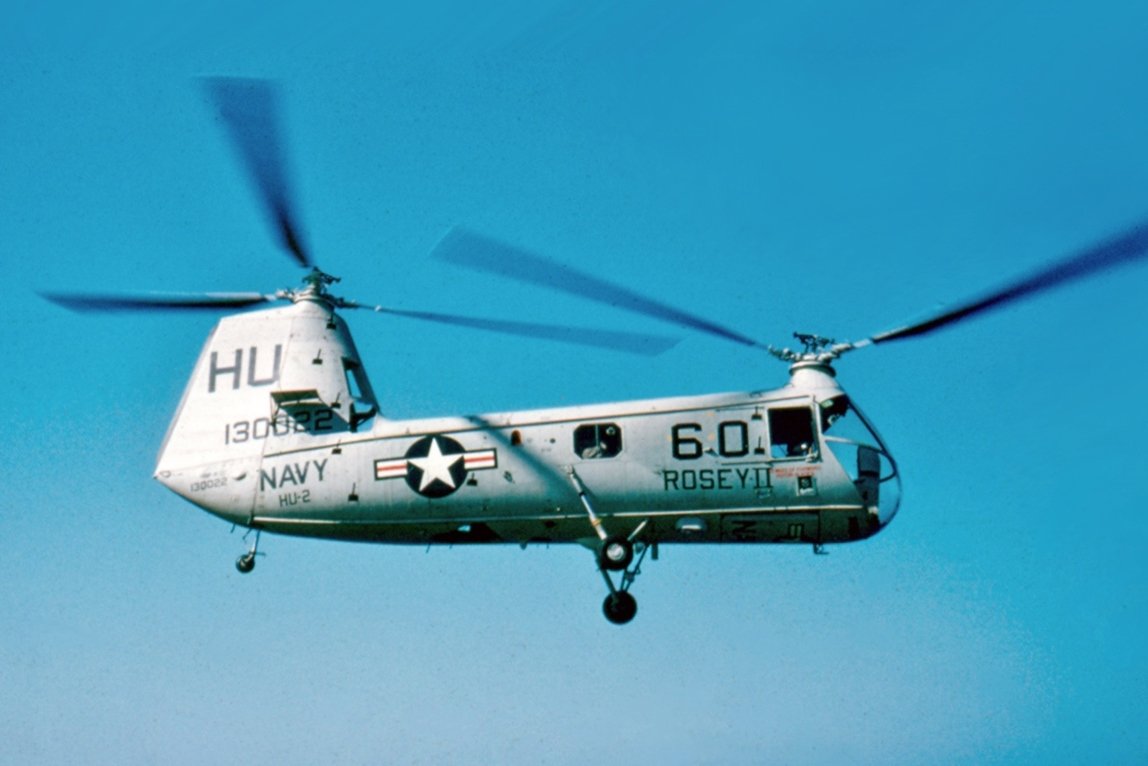
Designed under the leadership of Frank Piasecki, the HUP Retriever was developed to meet a 1945 U.S. Navy Bureau of Aeronautics requirement for a compact utility helicopter capable of operating from the restricted decks of aircraft carriers and major warships. The HUP-1 prototype first flew in 1948, introducing the world's first overlapping tandem-rotor configuration. This design utilized two three-bladed rotors that counter-rotated to cancel torque, eliminating the need for a tail rotor and allowing for a smaller overall footprint. The aircraft was engineered for durability, with a rugged structure built to withstand higher load factors than previous rotorcraft.
Technical Specifications
The HUP was powered by a single Wright-Continental R-975-42 air-cooled radial piston engine producing 525 hp. This engine drove the tandem rotors via dual transmissions. A representative HUP-3 model featured an empty weight of 1,913 kg (4,214 lb) and a useful load of 811 kg (1,786 lb), with a total capacity for six persons. Performance figures for the HUP-3 include a maximum speed of 185 km/h (115 mph) and a range of 574 km (357 miles). Notably, the HUP-3 was the first production helicopter to be equipped with an automatic pilot system, although the system was noted for its lack of reliability in service. For rescue operations, the aircraft featured a specialized rescue hoist lowered through a floor hatch wide enough to accommodate a loaded stretcher.
Production and Service History
Production took place at Piasecki's facility in Morton, Pennsylvania, between approximately 1949 and July 1954, with a total of 339 aircraft manufactured. The U.S. Navy was the primary operator, utilizing the HUP for search-and-rescue (SAR), plane-guard, and general transport. The U.S. Army operated the H-25A "Army Mule" variant for ambulance and light cargo duties. Other international operators included the French Navy, which operated 15 HUP-2s, and the Royal Canadian Navy (RCN), which operated three HUP-3s. The RCN aircraft were notably used for Arctic patrol and survey work between 1955 and 1957.
Some HUP-2S variants were further specialized for anti-submarine warfare (ASW) using AN/AQS-4 dipping sonar. Following the 1962 tri-service redesignation, the HUP-2 and HUP-3 became the UH-25B and UH-25C, respectively. The type was retired from French service by 1965 or 1966, and RCN operations ended in February 1964.
Legacy
The Retriever's impact on naval aviation was significant; at its peak, it was deployed on every active U.S. aircraft carrier, drastically improving reaction times for recovering downed pilots. Its overlapping tandem-rotor layout paved the way for later, larger aircraft such as the Boeing Vertol CH-46 and CH-47. Preserved examples can be found at the National Naval Aviation Museum, the Canada Aviation and Space Museum, and The Helicopter Museum.