
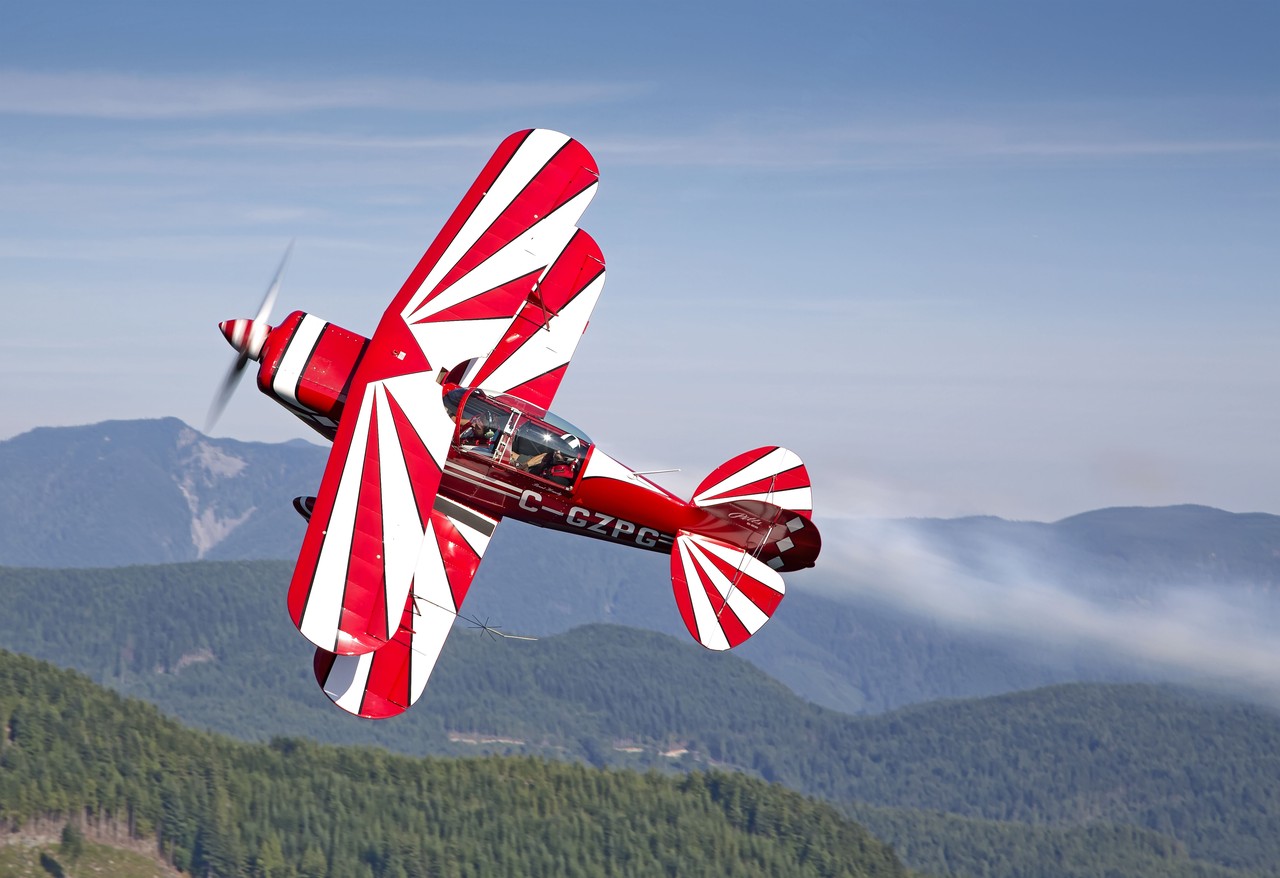
Competition Dominance
The Pitts S-2 Special transformed competitive aerobatics by providing certified flight schools with their first legitimate unlimited aerobatic trainer. The United States Aerobatic Team achieved victory at the 1972 World Championships flying S-2s, establishing the aircraft's reputation as the definitive competition machine. Throughout the 1960s and 1970s, Pitts aircraft dominated world aerobatic competitions, with the S-2's two-seat configuration enabling professional instruction in unlimited maneuvers that single-seat aircraft could not provide.
Notable aerobatic performers including Betty Skelton and Caro Bayley popularized the type at airshows across America. The aircraft's superior roll rate of over 400 degrees per second and ability to sustain prolonged negative-g maneuvers gave pilots unprecedented capabilities in competition sequences.
The Designer and Development
Curtis Pitts began developing his original single-seat S-1 design in 1943-1944, continuously refining the concept over two decades. Recognizing the commercial potential for aerobatic instruction, Pitts scaled up his proven design into the tandem two-seat S-2 configuration. The prototype first flew in mid-1966 and made its public debut at the EAA Fly-In in Rockford, Illinois.
Pitts incorporated several innovative features specifically for unlimited aerobatics. The inverted fuel and oil systems enabled sustained negative-g flight, while the lightweight fabric-and-tube construction maintained structural integrity under extreme loads. Despite the added weight of the second seat and longer fuselage, the S-2 retained the exceptional roll and loop rates that made the single-seat version famous.
Manufacturing Evolution
Factory production began in 1971 under Aerotek, a partnership between Curtis Pitts, Herb Anderson, and Doyle Child, operating from the former Call Air facility in Afton, Wyoming. The company produced 259 S-2A aircraft powered by 200-horsepower Lycoming AEIO-360 engines before transitioning to the more powerful S-2B variant.
In 1977, Curtis Pitts sold his interests to Doyle Child, who subsequently sold the operation to Frank Christensen in 1981. Under Christen Industries, production continued with the S-2B model, powered by a 260-horsepower Lycoming AEIO-540-D4A5 engine. A total of 196 S-2B aircraft were manufactured before Aviat Aircraft acquired the type certificates in March 1991.
Engine and Technical Innovation
The S-2A's 200-horsepower Textron Lycoming AEIO-360 flat-six engine provided exceptional reliability in aerobatic applications. The fuel-injected, inverted-capable powerplant enabled continuous negative-g flight operations that carbureted engines could not sustain. Later S-2B models featured the more powerful 260-horsepower AEIO-540-D4A5, driving a McCauley two-blade fixed-pitch propeller.
The aircraft's dimensions reflected its specialized role: 17 feet 9 inches in length with a 20-foot wingspan and height of approximately 7 feet 6 inches. Empty weight ranged from 1,000 to 1,225 pounds depending on variant, with maximum takeoff weights between 1,650 and 1,950 pounds.
Performance Characteristics
Pilots praised the S-2's exceptional handling qualities and performance envelope. Maximum speeds reached 157 to 180 mph depending on engine configuration, with service ceilings exceeding 16,000 feet. The aircraft's climb rate of 2,500 to 3,000 feet per minute provided rapid altitude recovery between maneuvers.
The tandem seating arrangement placed the instructor in the rear seat with full flight controls, enabling effective training in advanced aerobatic sequences. Range of 300 to 400 miles allowed for cross-country flights between competitions and airshows.
Certification Achievement
The S-2 achieved a historic milestone by becoming the first aerobatic biplane certified under FAR Part 23 Acrobatic Category regulations in nearly 35 years. This certification opened commercial flight training opportunities previously unavailable to aerobatic schools, fundamentally changing how unlimited aerobatics were taught in the United States.
Legacy and Preservation
Hundreds of S-2 aircraft remain airworthy worldwide, continuing to compete in aerobatic contests and perform at airshows. Aviat Aircraft maintains support for the type despite ending production of the S-2B line. The original 1966 prototype, registered N22Q, resides in the EAA Aviation Museum in Oshkosh, Wisconsin, donated by Curtis Pitts in 1977.
The S-2 Special established the template for modern aerobatic aircraft design, proving that unlimited competition machines could achieve both certification and commercial viability. Its influence extends throughout contemporary aerobatic aviation, where its descendants continue competing at the highest levels of international competition.