
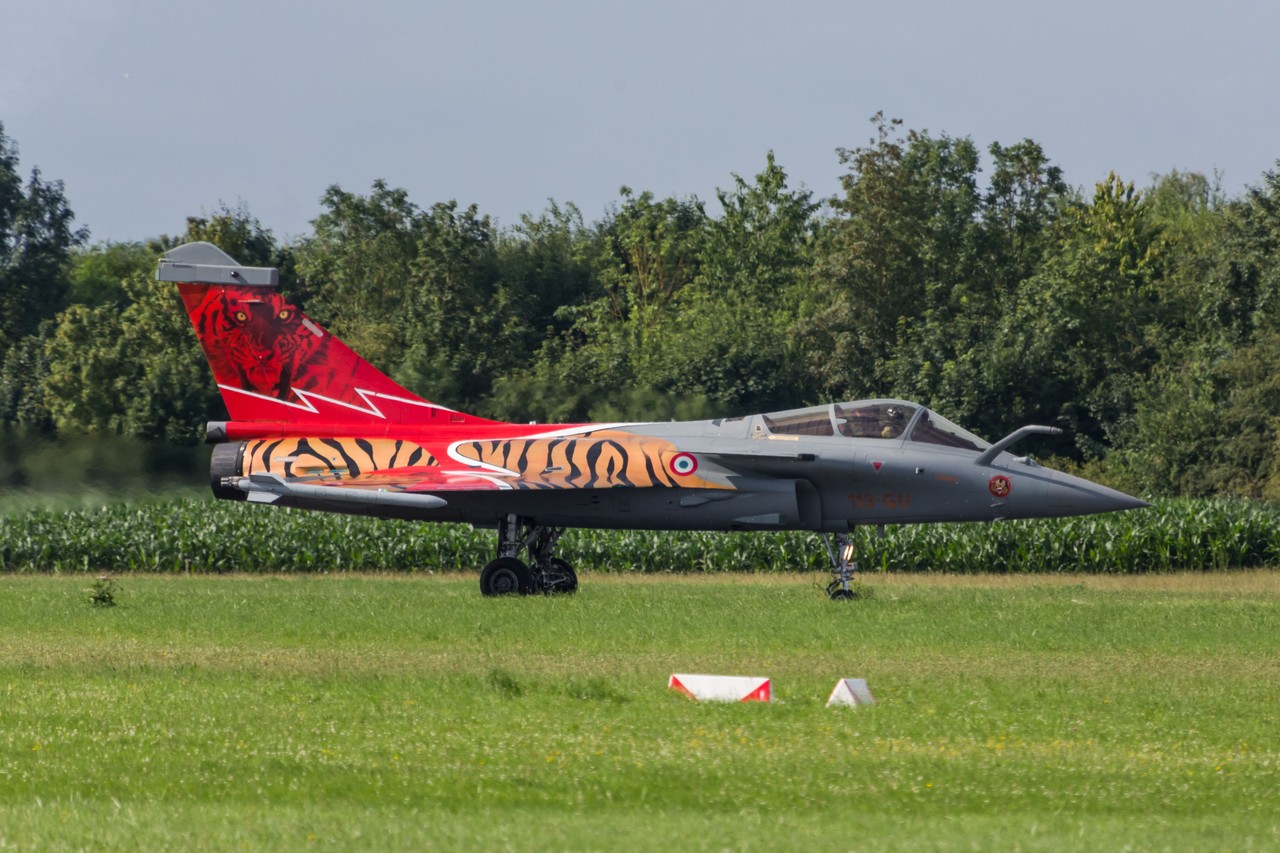
Development and Design Philosophy
The Rafale emerged from France's determination to maintain aerospace independence during the 1980s. Initially participating in the collaborative Future European Fighter Aircraft program alongside the UK, Germany, Italy, and Spain, France withdrew in the early 1980s due to disagreements over workshare distribution and differing operational requirements. Prime Minister Jacques Chirac formally announced France's commitment to independent development in June 1987, setting the stage for one of the most ambitious single-nation fighter programs of the modern era.
Dassault Aviation designed the Rafale as an "omnirole" fighter, capable of executing air superiority, ground attack, reconnaissance, and nuclear strike missions from a single airframe. The canard delta wing configuration, combined with fly-by-wire flight controls, provides exceptional maneuverability across all flight regimes. Test pilot Guy Mitaux-Maurouard conducted the maiden flight from Dassault's Istres facility, reaching 36,000 feet and Mach 1.3 during the one-hour inaugural sortie.
Production and Variants
Dassault developed three primary variants to meet French military requirements. The single-seat Rafale C serves as the Air Force's primary air-to-air platform, while the two-seat Rafale B handles strike and reconnaissance missions. The carrier-capable Rafale M operates from France's nuclear-powered aircraft carrier Charles de Gaulle, featuring strengthened landing gear, a tailhook, and corrosion-resistant materials for maritime operations.
Production began formally in December 1992 but faced significant delays due to post-Cold War budget reductions. The program was suspended in November 1995 when defense spending cuts eliminated approximately $340 million from the 1994 budget. Manufacturing resumed in January 1997 with an initial order for 48 aircraft, followed by additional batches totaling 180 units for French forces by 2009.
Service Entry and Operational History
The Rafale entered French Navy service in 2004, followed by Air Force operations in 2006—a decade later than originally planned. Despite the delayed introduction, the aircraft quickly proved its versatility in combat operations. French Rafales have conducted missions over Afghanistan, Libya, Mali, Iraq, and Syria, demonstrating the aircraft's ability to operate in diverse threat environments.
The twin Snecma M88 turbofan engines provide exceptional performance, generating 17,000 pounds of thrust each with afterburning. This powerplant enables supercruise capability—sustained supersonic flight without afterburners—while maintaining fuel efficiency for extended-range missions. The engines incorporate advanced materials and digital controls, contributing to the aircraft's reputation for reliability in harsh operating conditions.
Advanced Technology Integration
Dassault equipped the Rafale with cutting-edge avionics developed primarily by French companies. The RBE2 active electronically scanned array radar, manufactured by Thales, provides simultaneous air-to-air and air-to-ground capabilities with exceptional detection ranges. The Optronique Secteur Frontal infrared search and track system offers passive target acquisition, while the SPECTRA electronic warfare suite provides comprehensive threat detection and countermeasures.
Direct voice input allows pilots to control aircraft systems through spoken commands, reducing workload during high-stress combat situations. The glass cockpit features color multifunction displays presenting tactical information in an intuitive format, enabling single-pilot operation of complex missions previously requiring two-person crews.
International Success
After years of limited export success, the Rafale achieved significant international sales beginning in the 2010s. Egypt became the first export customer, ordering 24 aircraft delivered between 2015 and 2019. Qatar followed with 36 units, while India's air force received 36 Rafales between 2020 and 2022, with naval variants on order.
The Indian Air Force formally accepted its first Rafale on October 8, 2019, during a ceremony at Dassault's Bordeaux facility attended by Defense Minister Rajnath Singh. Aircraft RB-001, named in honor of Air Chief Marshal R.K.S. Bhadauria, represented a crucial capability enhancement for Indian forces facing regional security challenges.
Manufacturing Excellence
Dassault Aviation has maintained continuous production since 1997, delivering over 260 aircraft by 2024. Current production rates reach 26 units annually, with plans to increase to 36 aircraft per year by 2028. The company established international manufacturing partnerships, including fuselage production in India through Tata Advanced Systems, scheduled to begin in fiscal year 2028.
Legacy and Future Development
The F4 standard, introduced in 2025, enhances networking capabilities and integrates next-generation weapons systems. These improvements ensure the Rafale remains competitive against emerging threats through the 2040s. As one of only four operational European fighter aircraft, alongside the Eurofighter Typhoon, Saab Gripen, and BAE Hawk, the Rafale demonstrates that medium-sized nations can successfully develop world-class combat aircraft through focused investment and technological innovation.