
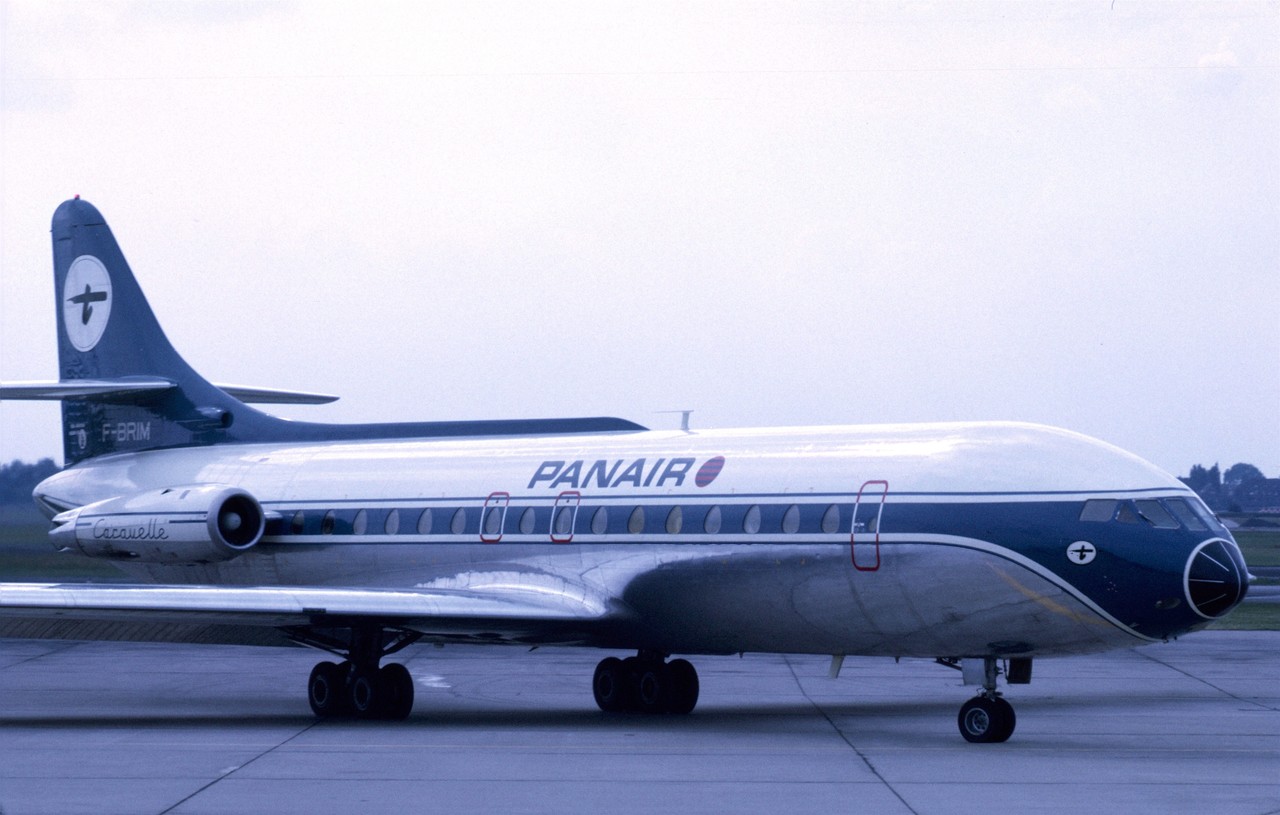
Revolutionary Design Innovation
The Caravelle emerged from the visionary work of chief engineer Pierre Satre, who began development in 1952 with the initial X-200 project concept. Originally conceived as a trijet powered by SNECMA Atar engines, Satre's team revised the design to the X-210 configuration featuring twin Rolls-Royce Avon turbojets mounted at the aircraft's rear. This groundbreaking rear-engine placement represented an aeronautical first that would influence an entire generation of jet airliners including the Douglas DC-9, BAC One-Eleven, and Hawker Siddeley Trident.
The prototype's maiden flight on May 27, 1955, lasted 41 minutes with a crew of five: pilots Pierre Nadot and André Moynot, mechanic Jean Avril, radio operator André Préneron, and future Airbus founder Roger Beteille. The aircraft's innovative design incorporated a licensed de Havilland Comet nose and cockpit section, paired with Sud Aviation's own fuselage and the revolutionary aft-mounted engine configuration that provided exceptional wing cleanliness and reduced cabin noise.
Commercial Success and Market Penetration
The Caravelle achieved what no European airliner had accomplished before: genuine commercial profitability. With a break-even point projected at 200 units, the program ultimately delivered 282 aircraft, making it the first profitable European jetliner in history. Air France inaugurated commercial service in 1959, followed shortly by SAS, which received certification in May 1959.
More than 100 airlines worldwide operated the Caravelle, with notable penetration into the competitive American market through United Airlines' order for 20 aircraft. European carriers including KLM, Swissair, and Air Inter formed the backbone of Caravelle operations, utilizing the type primarily on short and medium-haul routes where its efficiency advantages were most pronounced. The aircraft's capacity ranged from 80 passengers in the early Series III to 140 in the final Super Caravelle 12 variant.
The Manufacturer's Evolution
Sud Aviation originated as SNCASE (Sud-Est) in France's post-World War II nationalized aviation industry. The company merged with Sud-Ouest in 1957 to form Sud Aviation, which continued Caravelle production until the program's conclusion. In 1970, Sud Aviation was reorganized into Aérospatiale, which later merged into the European Aeronautic Defence and Space Company (EADS) in 2000, now known as Airbus. This corporate evolution represents the continuous thread of European aerospace consolidation that began with the Caravelle's success.
Manufacturing took place exclusively in Toulouse, France, establishing that city as a major European aerospace center long before Airbus selected it for A300 production. The Caravelle production line operated from 1956 to 1973, with the final aircraft, a Series 12 registered F-BTOE (construction number 280), delivered to Air Inter.
Engine Technology and Variants
Early Caravelle variants utilized twin Rolls-Royce Avon RA.26 Mk.521 axial-flow turbojets, each producing 10,000 pounds of thrust. These reliable powerplants, manufactured from 1950 to 2009 with over 26,000 units produced across all variants, provided the foundation for the Caravelle's initial success. Later variants, including the 10B Super Caravelle, transitioned to more powerful Pratt & Whitney JT8D-1 low-bypass turbofans generating 14,000 pounds of thrust, while the final Series 12 employed JT8D-9 engines producing 14,500 pounds of thrust.
The aircraft featured several innovative technical solutions beyond its engine placement. The Series VI-R introduced thrust reversers and spoilers, enhancing operational flexibility. All variants maintained a crew requirement of two to three personnel, with maximum speeds approaching 950 kilometers per hour, ranges of approximately 2,100 kilometers, and service ceilings around 12,000 meters.
Legacy and Historical Impact
The Caravelle's influence extended far beyond its production numbers. As the world's first successful short-to-medium range jet airliner, it pioneered an entire market segment while demonstrating European capability in advanced aerospace technology. The rear-engine configuration became standard for numerous subsequent designs, validating Satre's innovative approach.
Commercial service continued until September 2004, when the last operational Caravelle completed its final flight in Gisenyi, Rwanda, ending nearly five decades of airline service. Today, no Caravelles remain in active service, though several survive in museums. The Pima Air & Space Museum in Tucson, Arizona, preserves Caravelle VI-R N1001U (serial number 86), providing future generations insight into this groundbreaking aircraft that helped launch the jet age in European aviation.