
Development and Design Philosophy
The Firebird emerged from a February 9, 2009 proposal by Rick Crooks to Scaled Composites, envisioning a medium-altitude long-endurance platform that could bridge the gap between traditional manned aircraft and unmanned aerial vehicles. Burt Rutan, nearing the end of his legendary career, oversaw the design as one of his final projects before retiring in April 2011. The aircraft's optionally piloted vehicle concept allowed operators to choose between manned and unmanned modes depending on mission requirements, regulatory constraints, or operational conditions.
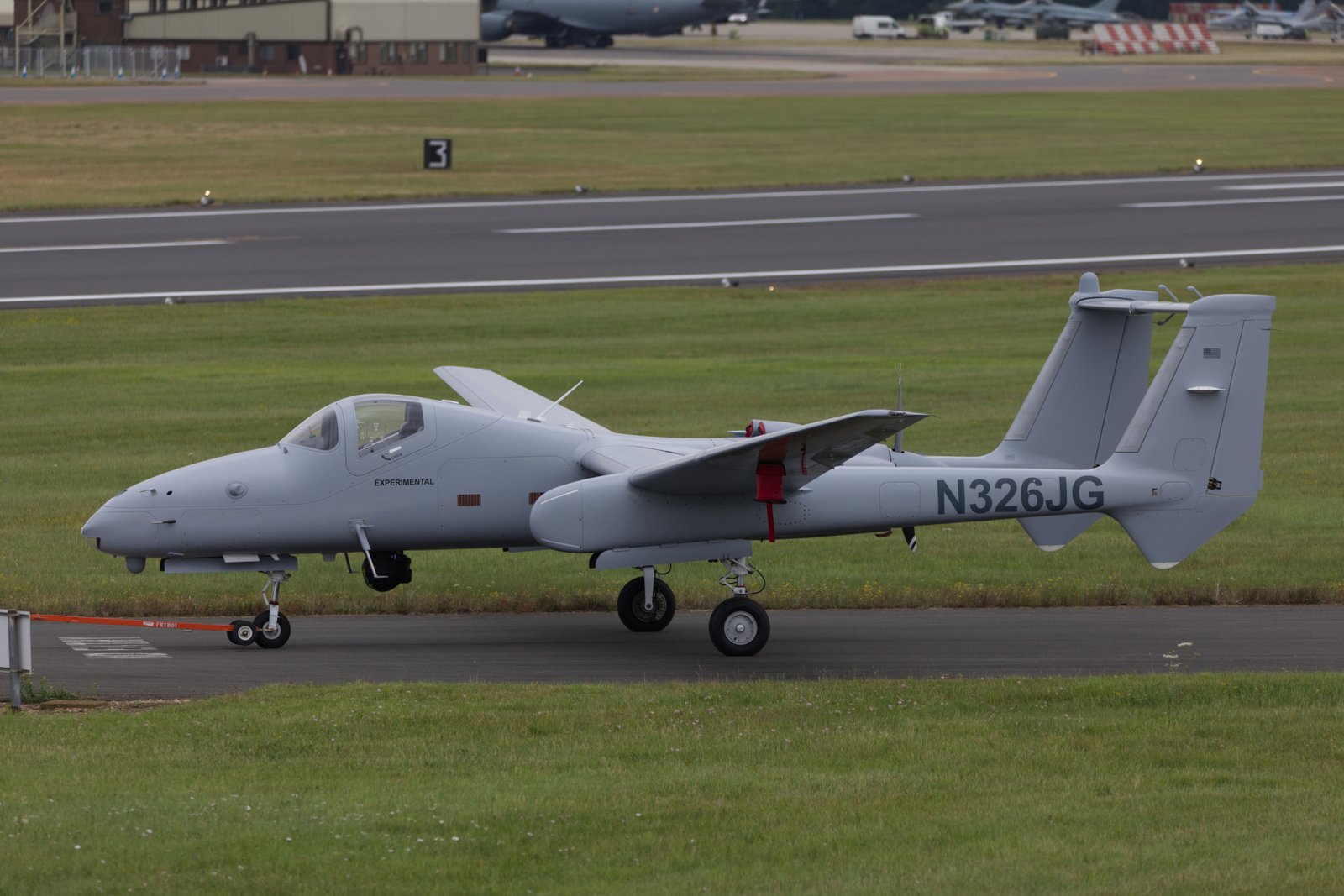
The design team incorporated several innovative features into the twin-boom configuration. The shoulder-mounted wings featured inboard level sections transitioning to outboard dihedral, while tricycle landing gear integrated directly into the wingtips and booms. This arrangement provided structural efficiency while accommodating the aircraft's impressive payload capacity of 1,240 pounds and enabling rapid payload switching capabilities.
The Manufacturer and Corporate Evolution
Scaled Composites, founded by Burt Rutan in 1982, had established itself as the premier developer of experimental composite aircraft before Northrop Grumman acquired the company for $100 million in 2007. The Firebird represented a natural evolution of Scaled's expertise in unconventional aircraft design, manufactured at their Mojave, California facility. Northrop Grumman, formed in 1994 through the merger of Northrop Corporation and Grumman, planned to transition any future production to larger facilities in Palmdale, California or Moss Point, Mississippi.
Flight Testing and Capabilities
The first Firebird took to the skies on February 9, 2010, exactly one year after the initial concept proposal. The decision to conduct initial flights with a pilot aboard accelerated the testing program by bypassing the regulatory delays typically associated with unmanned aircraft development. This strategic approach allowed the team to validate the aircraft's flight characteristics and systems more rapidly than a purely unmanned development path would have permitted.
During its testing phase, the Firebird demonstrated remarkable versatility and endurance. The aircraft participated in the October 2010 multi-sensor demonstration in Sacramento, California, followed by the May 23 to June 3, 2011 Empire Challenge exercise. Perhaps most impressively, the aircraft achieved a 45-hour endurance flight in April 2020, surpassing its design specification of 40 hours and demonstrating the reliability of its Lycoming powerplant.
Engine and Performance Specifications
The heart of the Firebird's exceptional endurance capability lay in its Lycoming TEO-540 turbocharged flat-six engine, producing 350 horsepower while maintaining fuel efficiency critical for long-duration missions. This powerplant, based on the O-540 design dating to 1957, provided the reliability necessary for extended operations at altitudes up to 30,000 feet. The engine drove a multi-bladed propeller, enabling the aircraft to achieve maximum speeds of 230 miles per hour while maintaining the fuel economy essential for its 40-hour mission profile.
The aircraft's 5,000-pound maximum takeoff weight included substantial payload capacity, allowing operators to configure the platform with over 30 different payload combinations tested during the development program. This flexibility made the Firebird suitable for diverse intelligence, surveillance, and reconnaissance missions while maintaining its optional manned capability.
Variants and International Interest
A second variant with an expanded wingspan of 79.2 feet first flew in March 2018, providing additional fuel capacity and payload options compared to the original 65-foot wingspan configuration. This larger version maintained the same basic design philosophy while offering enhanced performance for specific mission profiles.
International interest in the platform culminated in the aircraft's European debut at the Royal International Air Tattoo at RAF Fairford, UK in July 2019. The demonstration showcased the Firebird's capabilities to potential export customers and highlighted its competitive position against larger, more expensive platforms like the RQ-4 Global Hawk.
Production Limitations and Legacy
Despite its technical achievements, only two Firebird prototypes were constructed between 2009 and 2018. The program faced challenges securing export customers, leading to Northrop Grumman's announcement in April 2022 that production would be suspended, though the company indicated the aircraft remained available for interested customers. Grand Sky Development and Tenax Aerospace had committed to deliveries planned for late 2021, though the status of these arrangements remains unclear.
The Firebird's legacy extends beyond its limited production numbers. As one of Burt Rutan's final designs, it demonstrated the viability of low-cost, flexible optionally piloted vehicles in an era increasingly dominated by either purely manned aircraft or expensive unmanned systems. At least one aircraft, designated "Old School," returned to flight operations on October 4, 2024, after years in storage, proving an 11-hour endurance capability and continuing to serve as a testbed for unmanned aircraft systems payloads.
The Firebird's influence on the hybrid manned-unmanned market continues as aerospace manufacturers recognize the operational and regulatory advantages of optionally piloted platforms, validating Rutan's forward-thinking approach to 21st-century aviation challenges.