
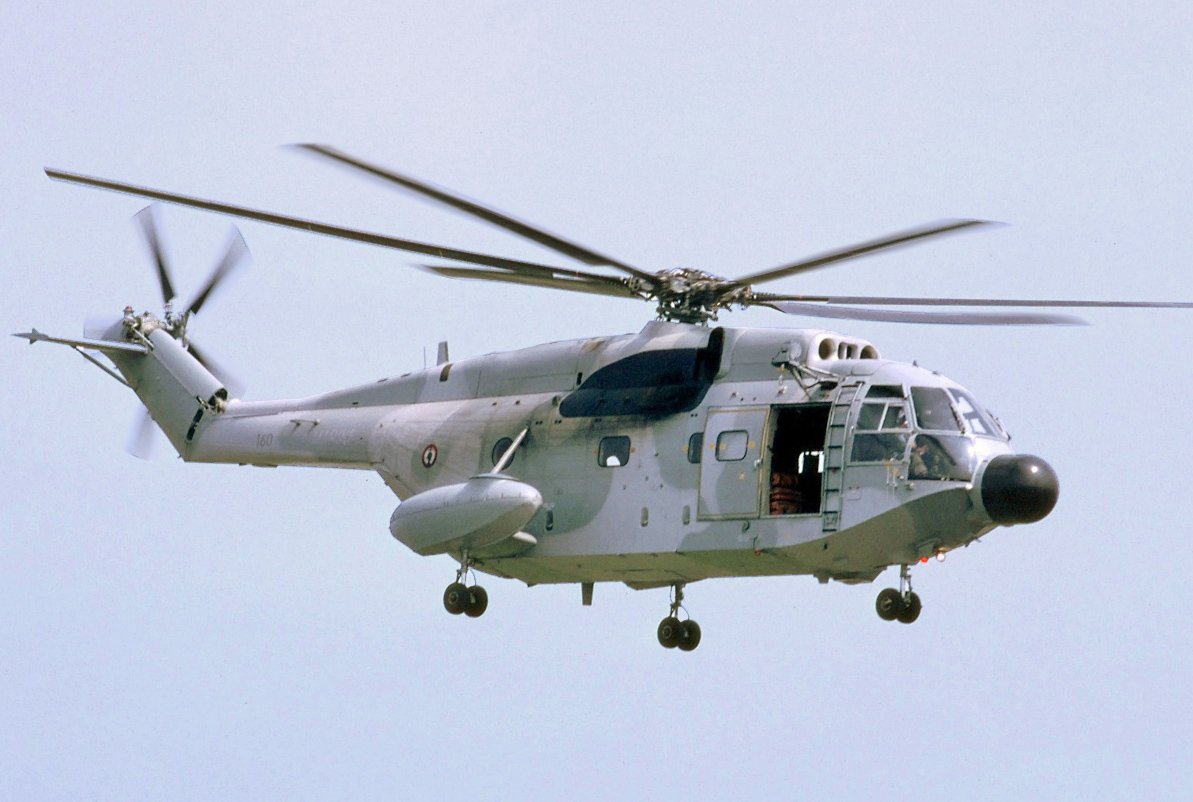
The Aérospatiale SA 321 Super Frelon was a large, triple-engine heavy-lift helicopter developed in France during the late 1950s. Originating as the SE 3200 Frelon, the aircraft was designed by SNCASE and Sud Aviation. The first prototype took flight on 7 December 1962, and the type entered serial production in September 1964. A total of 110 aircraft were manufactured, a figure that includes two prototypes and four pre-series machines. Production continued until the final aircraft was delivered to Libya, with the overall production span occurring between 1962 and 1981.
Manufacturing was handled by Sud Aviation, a company formed on 1 March 1957 through the merger of SNCASE and SNCASO. While the aircraft is frequently associated with the Aérospatiale name due to later corporate identity changes, the production line remained in France. Technically, the Super Frelon was powered by three Turbomeca turbomotors. It was designed to meet diverse French military requirements: the Army utilized the aircraft for cargo, search-and-rescue, and the transport of ammunition, casualties, and assault troops, while the Navy employed it for maritime patrol, mine laying, and anti-submarine warfare.
In French service, the helicopter was operated by several units, including Flottille 20S, 32F, and 33F, as well as Escadrille 27S and the Centre d’essais en vol at Brétigny-sur-Orge. The aircraft saw extensive international combat service. During the Six-Day War in June 1967, Israeli Super Frelons transported commandos during the seizure of Sharm el-Sheikh. Iraqi operators utilized the type during the Iran–Iraq War, equipping them with Exocet anti-ship missiles to attack offshore platforms—a combination that remained effective into the Gulf War. Additionally, the aircraft was used by South Africa for reprisals and anti-guerrilla operations in Angola, and saw service in the conflict in ex-Yugoslavia.
Commercial success was limited, with only two civilian examples sold; one of these served as a VIP transport for the French Air Force from 1970 to 1971. Civilian applications included rescue at sea, civil-defense support, and pollution response. In terms of capacity, the aircraft could carry 27 soldiers and two pilots, or 15 wounded personnel and two medical attendants. It featured an internal cargo volume of 22 m³, a side-mounted winch capable of lifting 275 kg, and a sling capacity of 5,000 kg.
The Super Frelon maintained a remarkably long tenure with the French Navy, serving for over 40 years. The type was finally withdrawn from service in 2010, with the last aircraft flying to the CAEA on 5 May 2010. Today, the legacy of the SA 321 is preserved in several museums, including the Musée de l’air et de l’espace at Le Bourget, the Musée de l’aéronautique navale at Rochefort, and the Musée de l’aviation légère de l’armée de Terre et de l’hélicoptère at Dax.