
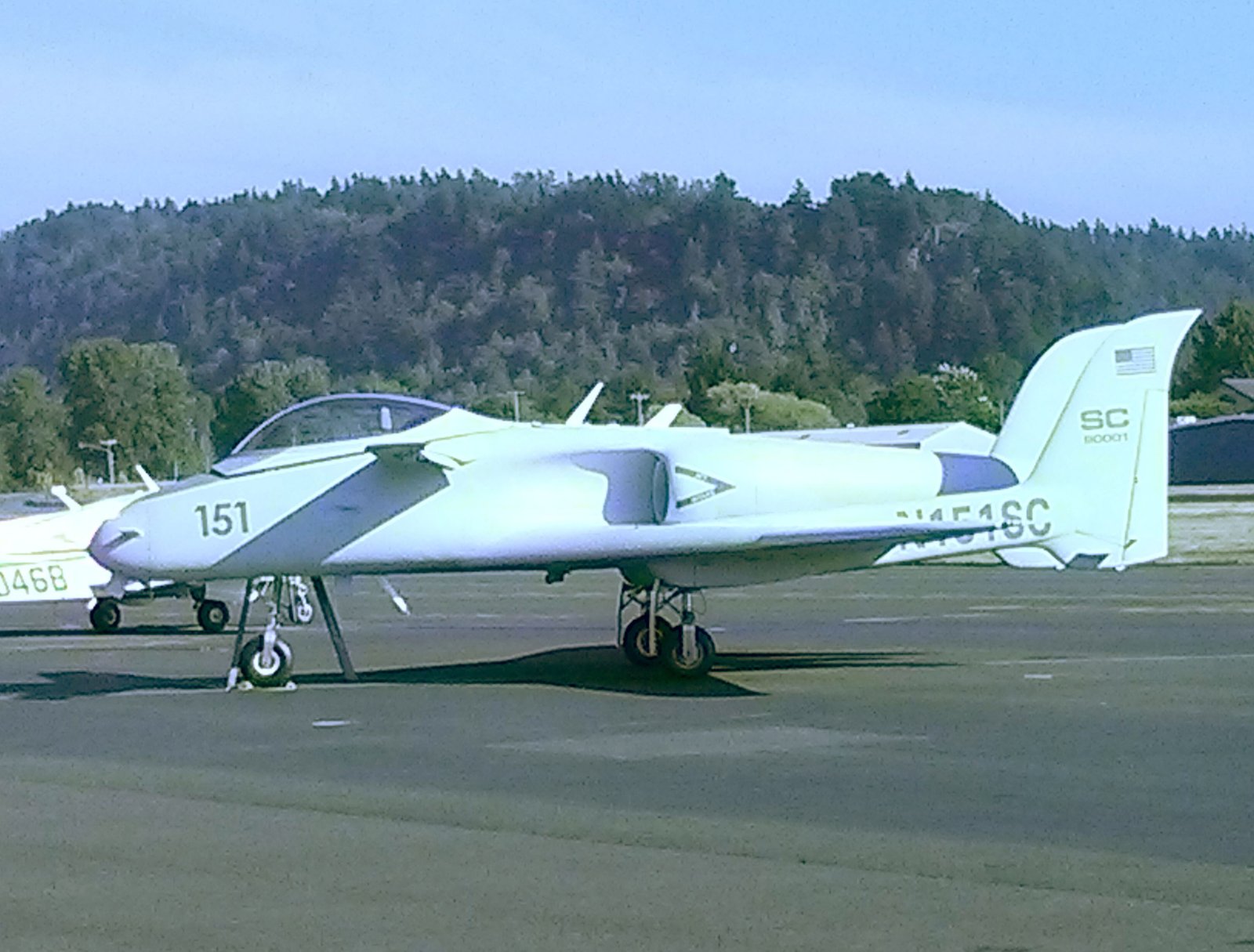
The Scaled Composites ARES, designated as Model 151, is a one-off experimental aircraft developed as a proof-of-concept for a low-cost battlefield attack platform. The project originated from a 1981 study conducted by U.S. Army aviators Jim Kreutz and Milo Burroughs, who sought a Low Cost Battlefield Attack Aircraft (LCBAA) to address gaps in close air support (CAS) and counter Soviet helicopter capabilities. Scaled Composites responded to this requirement with a design initially termed the Light Attack Turbofan Single (LATS), which was later renamed ARES, standing for Agile Responsive Effective Support.
Designed and built in Mojave, California, the ARES first flew in February 1990. While some corporate records list the first flight as February 16, other sources and a post from Scaled Composites identify February 19, 1990, as the date the aircraft took to the air, piloted by test pilot Doug Shane. The aircraft was engineered for high agility and survivability in low-altitude environments, featuring a departure-free handling characteristic that resisted spins and stalls even at full aft stick. A defining technical feature is its asymmetric layout; the single Pratt & Whitney JT15D turbofan engine is offset to allow for the installation of a side-mounted 25 mm GAU-12/U five-barrel Gatling cannon. The inlets and ducting were specifically arranged to ensure that recoil and gun gases did not disrupt the engine's airflow.
In 1991, under a contract with the U.S. Air Force, the ARES underwent weapons testing with the GAU-12/U cannon, which yielded outstanding results in November of that year. Despite this success, the aircraft was never adopted for operational military service and remained a private demonstrator. Its technical specifications include a wingspan of 35 feet, a length of 29 feet 5.25 inches, and a maximum takeoff weight ranging between 6,100 and 6,500 pounds. The JT15D engine provides approximately 2,900 to 2,950 lbf of thrust, enabling a maximum speed of 466 mph at 25,000 feet and a service ceiling of 35,000 feet.
Beyond its military research, the ARES gained a brief pop-culture appearance in the 1992 film Iron Eagle III, where it was painted to resemble a fictional Messerschmitt Me 263. To date, the single prototype has flown more than 430 hours. It continues to be operated by Scaled Composites in Mojave as an active research testbed available for future experimental projects.