
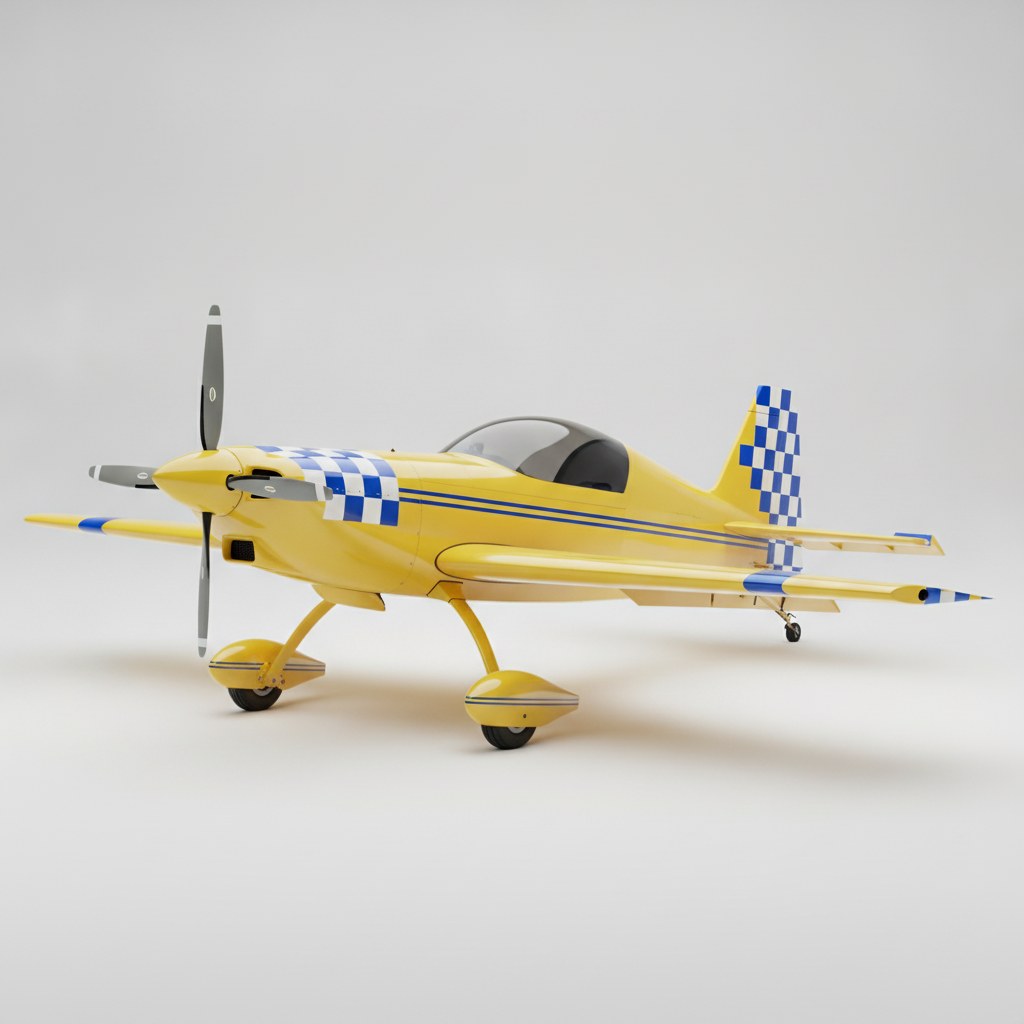
Design Philosophy and Development
The SLICK 540 emerged from the specialized world of radio-controlled 3D aerobatics, where extreme maneuverability takes precedence over scale appearance or conventional flight characteristics. Andrew Jesky led the design team at AJ Aircraft, conducting hundreds of prototype flights with multiple test pilots to refine the aircraft's capabilities for advanced aerobatic maneuvers in confined spaces.
The design objectives centered on creating an aircraft capable of performing knife-edge flight, precision spins, stationary hovers, and rolling harriers—maneuvers that demand oversized control surfaces and exceptional responsiveness. Unlike scale reproductions of full-size aircraft, the SLICK 540 prioritizes function over form, with control surface areas that would be impractical on manned aircraft but essential for radio-controlled 3D flight.
Manufacturing and Production
Two primary manufacturers dominate SLICK 540 production. AJ Aircraft of Canada, established around 2008, celebrated its tenth anniversary in 2018 with the release of the 104-inch 10th Anniversary model. The company specializes in advanced composite construction, utilizing full carbon-Kevlar fuselages with integrated stringers for maximum durability during high-stress aerobatic maneuvers.
Aerobeez of the United States produces the 87-inch 30% scale variant, designed for 50-55cc gasoline engines with an all-up weight of approximately 16-17 pounds. Their almost-ready-to-fly kits include Two Brothers servo installations and are optimized for immediate flight line deployment.
Production numbers remain undisclosed across manufacturers, typical of the specialized radio-controlled aircraft market where volume production figures are rarely published. Models have been documented in continuous production since at least 2018, with ongoing availability in multiple size configurations.
Technical Innovation
The SLICK 540 incorporates several advanced construction techniques uncommon in traditional radio-controlled aircraft. AJ Aircraft's models feature carbon-Kevlar fuselage construction with pre-glued and sealed control surface hinges, eliminating a common failure point during aggressive 3D maneuvers. The company's proprietary one-piece cowl design reduces weight by approximately one-quarter pound compared to traditional split cowl arrangements.
Motor box reinforcements, dedicated tail servo compartments, and integrated exhaust pipe tunnels demonstrate the purpose-built nature of the design. Airfoil-section landing gear provides additional structural integrity while maintaining the clean lines necessary for precision aerobatics.
Size Variants and Specifications
The 51-inch wingspan variant targets pilots operating in space-constrained environments, utilizing electric powerplants with high-performance motor, electronic speed control, and battery combinations. Despite its compact dimensions, the aircraft retains the oversized control surfaces essential for 3D aerobatics.
The 87-inch Aerobeez model represents the middle ground, offering 30% scale proportions with 50-55cc gasoline power for extended flight sessions. This configuration appeals to pilots seeking the presence of a larger aircraft without the ground handling challenges of the largest variants.
AJ Aircraft's 104-inch 10th Anniversary model stands as the flagship of the line, incorporating the company's most advanced construction techniques and materials. The prototype's successful demonstration flights at Joe Nall 2018 validated the design's capability for sustained 3D operations.
Performance Characteristics
The SLICK 540's performance envelope extends far beyond conventional radio-controlled aircraft capabilities. Extended knife-edge flight—where the aircraft flies on its side with wings perpendicular to the ground—requires precise control authority that the oversized rudder and elevator surfaces provide. Stationary hovering, where the aircraft maintains position while pointing vertically upward, demands instant throttle response and exceptional control throw capability.
Rolling harrier maneuvers, combining forward flight with continuous rolling motion, showcase the aircraft's ability to maintain controlled flight throughout its entire performance envelope. These capabilities require intermediate to advanced pilot skills, as the aircraft's responsiveness can overwhelm inexperienced operators.
Current Status and Legacy
Both major manufacturers remain active in SLICK 540 production, with no reported facility closures or product discontinuations. The design continues to appear at major radio-controlled flying events, where demonstration flights highlight the evolving capabilities of modern 3D aerobatic aircraft.
The SLICK 540 represents the evolution of radio-controlled aerobatics from scale reproductions toward purpose-built performance aircraft. Its emphasis on advanced materials, pre-assembly quality, and extreme capability gaps previously filled by scaled-up versions of full-size aerobatic designs. While museum preservation remains unlikely given the hobby-focused nature of radio-controlled aircraft, the design's influence continues through ongoing production and active participation in the competitive 3D aerobatics community.