
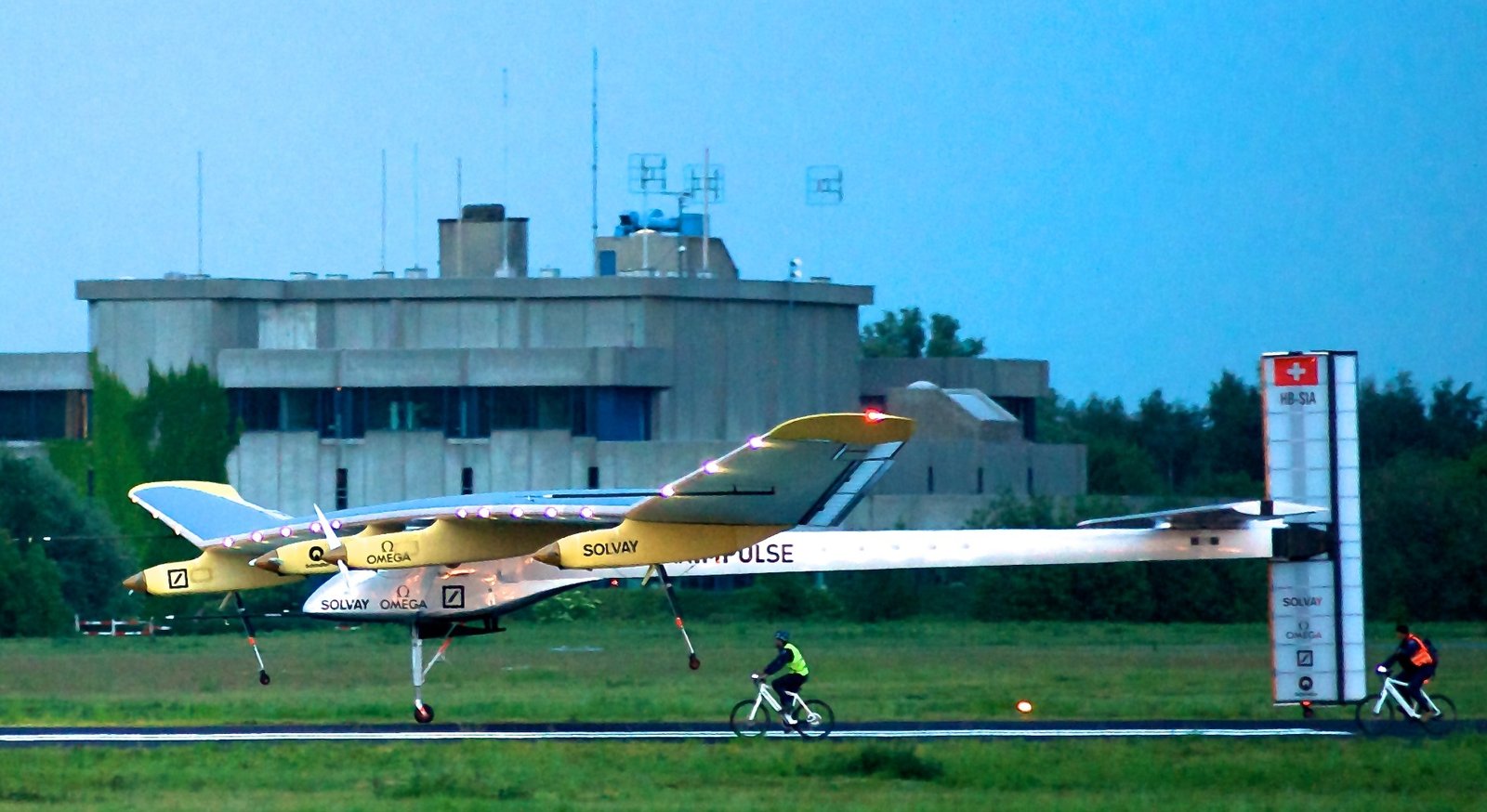
Revolutionary Achievement in Aviation
The Solar Impulse 1 fundamentally changed aviation's understanding of what was possible with renewable energy. During its July 2010 night flight, the aircraft became the first solar-powered plane to fly through an entire night using only battery power charged by the sun during the previous day. This 26-hour, 10-minute endurance flight demonstrated that solar aviation could transcend the limitations of daylight hours, establishing eight world records in the process.
Technical Innovation and Design
Bertrand Piccard conceived the Solar Impulse project in 1999, working alongside technical leader André Borschberg to create an aircraft that defied conventional aviation wisdom. The design team faced the extraordinary challenge of building an aircraft with the wingspan of an Airbus A340 while maintaining the weight of a small car. The resulting aircraft stretched 208 feet from wingtip to wingtip yet had a gross weight of just 3,500 pounds.
The wing structure incorporated 11,628 photovoltaic cells across 200 square meters of surface area, generating a peak output of 45 kilowatts during optimal sunlight conditions. Four brushless electric motors, each producing 10 horsepower and built by Swiss company Etel with the same precision as motors used in space exploration, turned 11-foot diameter propellers at speeds between 200 and 4,000 rpm through specialized reducers.
Engineering Challenges and Solutions
The aircraft's energy efficiency exceeded any previous aircraft design, requiring an average of only 6 kilowatts of power—roughly equivalent to the Wright brothers' 1903 Flyer. Advanced lithium-polymer batteries weighing 880 pounds provided energy storage with a density of 243 watt-hours per kilogram, enabling the aircraft to maintain flight when solar cells produced no power.
The non-pressurized cockpit severely constrained pilot comfort due to battery placement requirements. The instrument panel displayed critical information including engine RPM, temperature readings for all four motors, bank angle, and side slip indicators, allowing the single pilot to monitor the complex solar-electric propulsion system during flight.
Test Flight Program and Achievements
Following its December 2009 first flight, Solar Impulse 1 embarked on an ambitious test program that validated solar aviation concepts. The aircraft achieved a maximum altitude of 30,180 feet and demonstrated a flight range of 694 miles during single missions. In May 2011, it completed the first international solar-powered flight between Switzerland and Belgium, proving the aircraft could handle cross-border operations.
The most significant achievement came during test flights through Europe and North Africa between 2011 and 2012, when the aircraft set a distance record with a 958-mile flight leg. These flights operated at cruise speeds of 43 miles per hour with a takeoff speed of just 22 miles per hour, demonstrating the aircraft's remarkable low-speed handling characteristics.
The Solar Impulse Organization
Rather than emerging from a traditional aircraft manufacturer, Solar Impulse represented a collaborative effort involving 80 technology partners across multiple industries. The project operated more as a research and development initiative than a conventional aircraft program, bringing together expertise in photovoltaics, battery technology, lightweight materials, and aerodynamics.
Bertrand Piccard, grandson of stratosphere balloon pioneer Auguste Piccard and son of deep-sea explorer Jacques Piccard, applied his family's tradition of pushing technological boundaries to aviation. His partnership with former Swiss Air Force pilot André Borschberg combined visionary leadership with practical engineering expertise essential for the project's success.
Performance and Operational Characteristics
Pilots found Solar Impulse 1 presented unique operational challenges due to its extreme design parameters. The aircraft's 21-kilowatt-hour battery capacity required careful energy management throughout each flight, with pilots monitoring power generation and consumption continuously. The service ceiling of 27,900 feet provided adequate altitude for weather avoidance, while the theoretical maximum altitude of 39,000 feet offered additional operational flexibility.
The aircraft's structural design emphasized weight reduction over conventional strength margins, requiring pilots to avoid turbulence and limit maneuvering loads. Flight operations typically occurred during stable weather conditions to protect the delicate solar cell arrays and minimize structural stress on the carbon fiber framework.
Legacy and Current Status
Following its final flights, Solar Impulse 1 was displayed at New York's JFK Airport before being disassembled in August 2013 and transported via Cargolux Boeing 747 to Dübendorf Air Base in Switzerland. The aircraft now rests in storage, preserved as a testament to renewable energy aviation achievements.
The success of Solar Impulse 1 directly enabled development of Solar Impulse 2, which completed the first round-the-world solar flight between 2015 and 2016. The original aircraft's proof-of-concept flights validated solar aviation technology and influenced subsequent electric aircraft development programs worldwide, establishing that revolutionary technology could achieve previously impossible aviation feats through innovative engineering and lightweight materials.