
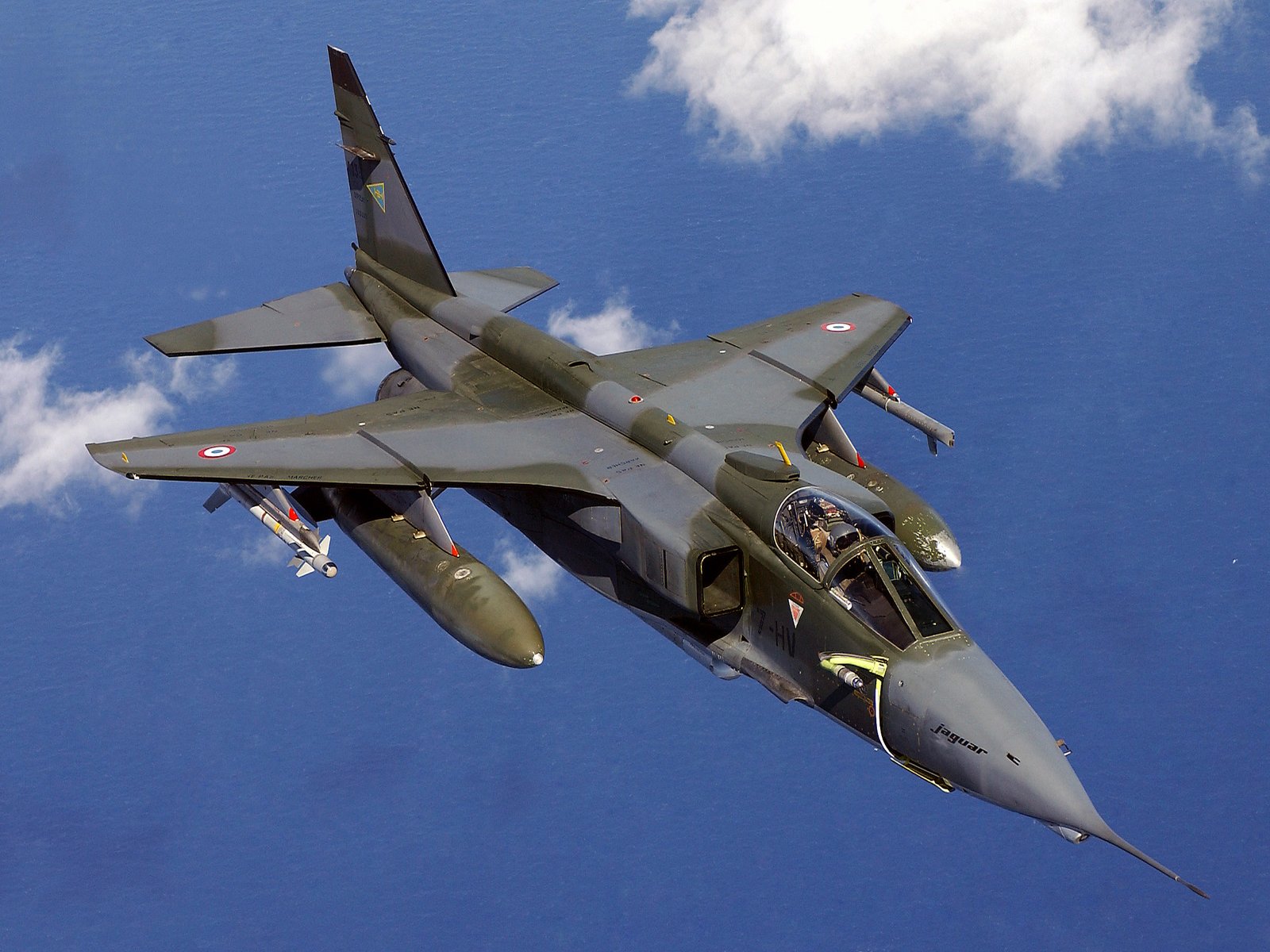
The SEPECAT Jaguar was developed as a collaborative effort between the United Kingdom and France, produced through the SEPECAT joint venture formed by the British Aircraft Corporation (BAC) and Breguet Aviation. Originally conceived as a light attack aircraft and trainer, the design evolved into a single-seat supersonic strike fighter capable of nuclear delivery, alongside a two-seat trainer variant. The aircraft first took flight on 8 September 1968, reflecting Cold War requirements for high-speed, low-level interdiction and reconnaissance.
Production was carried out by SEPECAT in France and the United Kingdom, with original manufacturing concluding in 1985. A significant portion of the aircraft's industrial life was extended through license production by Hindustan Aeronautics Limited (HAL) in India, which continued manufacturing the type until 2008. Globally, production figures are widely cited at 573 aircraft. Regarding the corporate lineage of the manufacturers, Dassault Aviation remains in business as the successor to Breguet Aviation, and HAL continues to operate today, while the British Aircraft Corporation no longer exists as an independent entity.
Technically, the Jaguar is powered by two afterburning turbofans developed jointly by Rolls-Royce and Turbomeca. The standard Adour Mk.102 engines provide 22.75 kN of dry thrust and 32.5 kN with afterburner, while the Indian Air Force variants utilize the Adour Mk 811. The aircraft is characterized by a length of 55 ft 3 in, a wingspan of 28 ft 6 in, and a maximum speed of approximately 1,699 km/h. It can carry a payload of up to 4,500 kg and is typically armed with two 30 mm DEFA cannons, as well as various rockets, bombs, and missiles.
In military service, the Jaguar operated in diverse roles including close air support, ground attack, and armed reconnaissance. It was utilized by the French Air Force (until 2005), the Royal Air Force (until 2007), the Royal Air Force of Oman, and was exported to Nigeria and Ecuador. Combat history includes participation in the Gulf War (Operation Desert Storm) by French and British forces, as well as operations in Iraq, Bosnia, Chad, Mauritania, and Pakistan. While retired from European service, the aircraft has remained a staple of the Indian Air Force.