
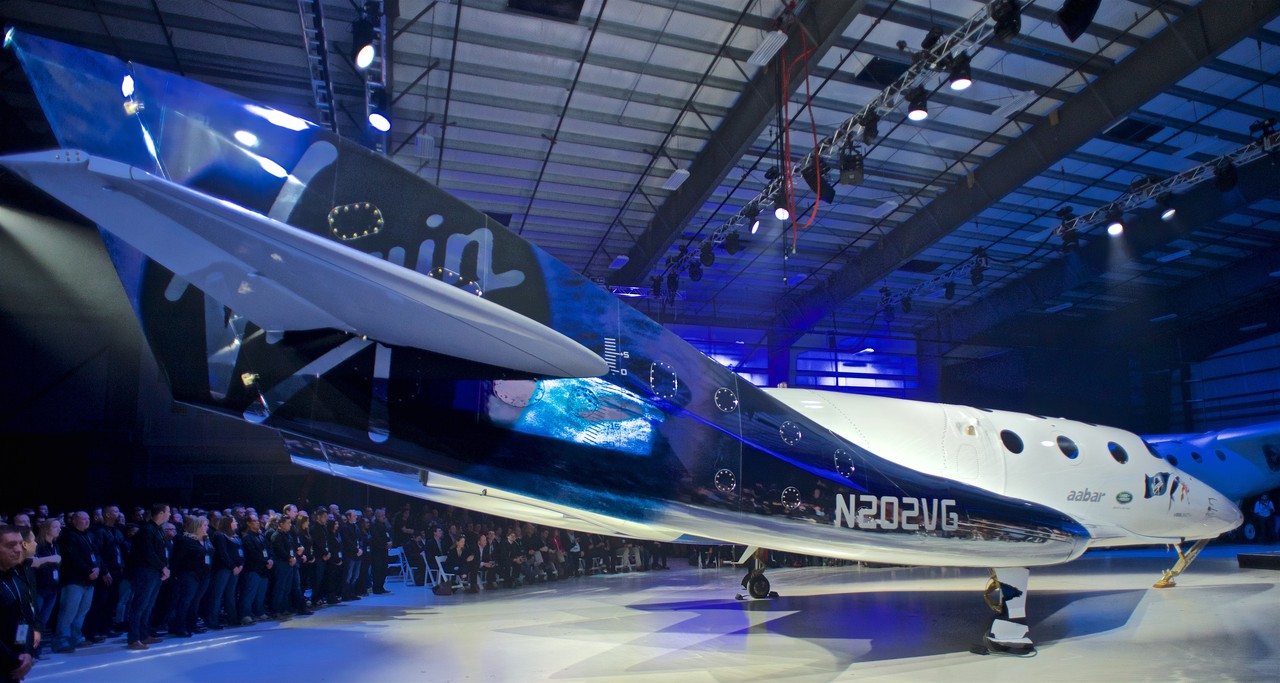
Development and Design
Burt Rutan's team at Scaled Composites developed SpaceShipTwo as the successor to their groundbreaking SpaceShipOne, which had won the $10 million Ansari X Prize in 2004 by becoming the first private spacecraft to reach 100 kilometers altitude. The design objectives for the larger SS2 included carrying six paying passengers on suborbital flights, accommodating scientific payloads, and establishing a reliable commercial space tourism operation for Virgin Galactic.
The aircraft incorporates Rutan's signature innovative approach, featuring a unique "feathering" reentry system where the twin tail booms and rudders rotate upward to 65 degrees. This configuration increases drag and provides inherent stability during the critical reentry phase, allowing the vehicle to descend safely through the atmosphere before gliding to a runway landing like a conventional aircraft.
Production and Testing
Scaled Composites began SS2 production around 2009-2010, with the company building only one complete vehicle - VSS Enterprise. Manufacturing took place at Scaled's facility at Mojave Air and Space Port in California. The aircraft was publicly unveiled on December 7, 2009, generating significant media attention as the world's first commercial passenger spacecraft.
VSS Enterprise conducted its maiden flight on October 10, 2010, with test pilots Peter Siebold and Michael Alsbury at the controls during a 13-minute glide test. The first powered flight occurred on April 29, 2013, when pilots Mark Stucky and Michael Alsbury ignited the RocketMotorTwo engine for 16 seconds, reaching 56,000 feet and Mach 1.22.
Engine and Propulsion
SpaceShipTwo utilizes the RocketMotorTwo (RM2), a hybrid rocket engine initially developed by Sierra Nevada Corporation as a subcontractor from 2009 to early 2014. The hybrid design combines nitrous oxide as an oxidizer with polyamide plastic fuel, producing 270 kN (61,000 pounds) of thrust. The engine enables the aircraft to achieve supersonic flight within eight seconds of ignition.
Virgin Galactic terminated Sierra Nevada's contract in May 2014 and developed an in-house engine version. Ground testing had demonstrated burn durations exceeding 60 seconds by May 2014, proving the engine's capability for the suborbital mission profile.
The Manufacturer
Scaled Composites was founded in 1982 by legendary aircraft designer Burt Rutan. The company was acquired by Beech Aircraft Corporation in 1985 following their collaboration on the Starship project. Through subsequent corporate mergers, Scaled eventually became a subsidiary of Northrop Grumman, where it remains today as a premier experimental aircraft manufacturer.
The company gained international recognition in 2004 when SpaceShipOne completed the first private manned spaceflight, reaching 100 kilometers altitude on June 21, 2004. This achievement demonstrated that private companies could successfully develop spacecraft capabilities previously limited to government agencies.
Operational History and Setbacks
SpaceShipTwo's test program faced significant challenges. A tragic nitrous oxide explosion at Mojave in July 2007 killed three Scaled Composites workers and injured others, leading to California safety citations in January 2008. This accident highlighted the inherent dangers of rocket propellant handling and led to enhanced safety protocols.
The program suffered its most devastating setback on October 31, 2014, when VSS Enterprise broke apart during a powered test flight, killing co-pilot Michael Alsbury and seriously injuring pilot Peter Siebold. The accident investigation revealed that the feathering system had been activated prematurely during the flight, leading to structural failure.
Commercial Service and Legacy
Despite the setbacks, Virgin Galactic continued development with VSS Unity, built by The Spaceship Company (TSC), Virgin's subsidiary that acquired Scaled's SpaceShipTwo program in 2012. The $250,000 ticket price positioned suborbital flights as luxury experiences for wealthy customers and researchers.
Testing resumed with VSS Unity achieving notable milestones, including a flight on April 5, 2018, that reached 84,271 feet and Mach 1.87 during a 30-second burn with pilots Mark Stucky and Dave Mackay. While no commercial passenger operations had begun by 2018, the program continued advancing toward operational status.
Technical Specifications and Performance
SpaceShipTwo measures 18 meters (59 feet) in length with an 8.2-meter (27-foot) wingspan and stands 4.6 meters (15 feet) tall. The passenger cabin spans 3.7 meters (12 feet) in length with a 2.3-meter (7 feet 7 inches) diameter, providing space for six passengers and scientific equipment.
The operational profile begins with WhiteKnightTwo carrying SS2 to approximately 50,000 feet before release. The rocket engine then propels the vehicle to its target altitude of 100 kilometers, providing passengers with several minutes of weightlessness and spectacular views of Earth's curvature before the feathered descent and runway landing.
SpaceShipTwo's significance extends beyond its technical achievements, representing a fundamental shift toward commercial space access and inspiring a new generation of private aerospace companies to pursue ambitious spaceflight goals.