
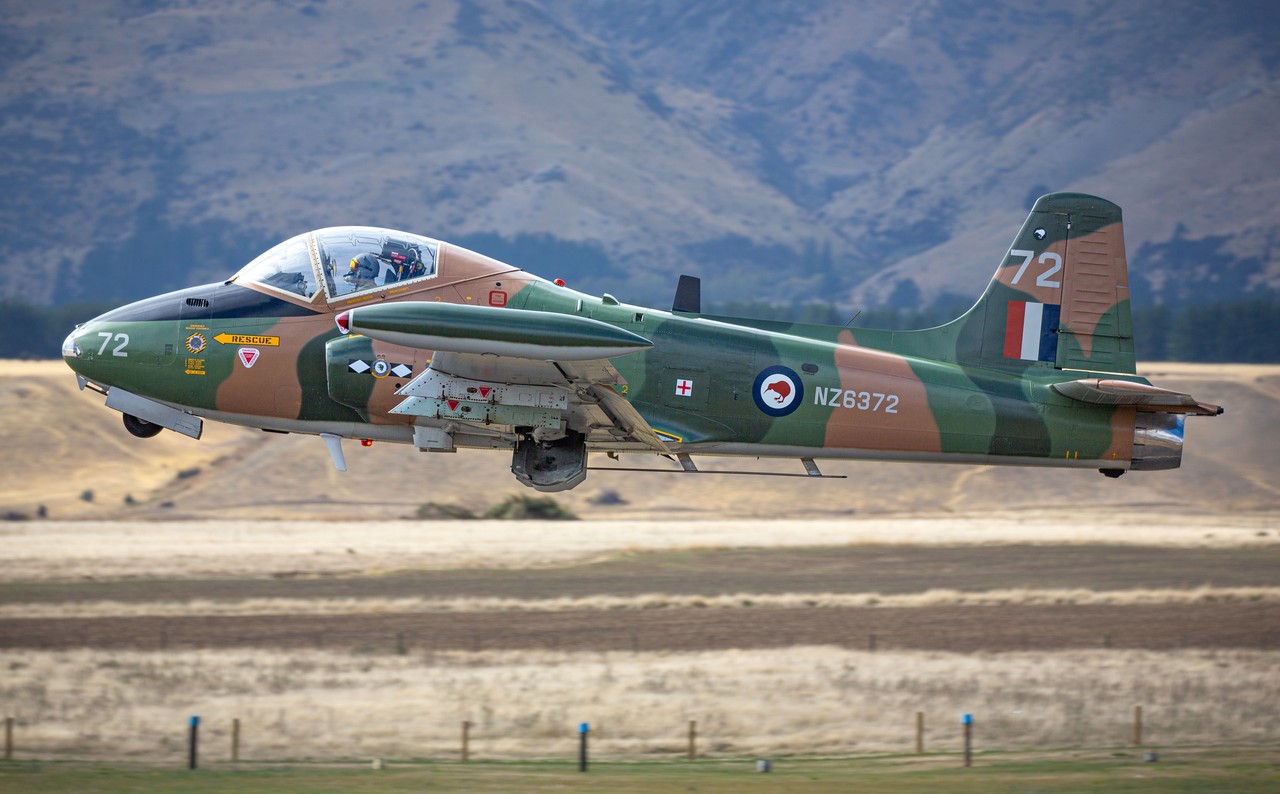
Service History
The Strikemaster filled a crucial niche for air forces requiring affordable jet-powered training combined with light attack capability. Of the 146 aircraft manufactured, 136 were delivered as Mk 80 series variants and 10 as Mk 90 series. The Royal Saudi Air Force became the largest operator, receiving its first aircraft on August 26, 1968, and eventually taking delivery of 47 Mk 80 and 80A variants. Other significant operators included Oman, which deployed the type operationally during the Dhofar Rebellion, and Singapore, which operated the Mk 84 variant until the 2010s.
Combat Operations
The aircraft proved its combat effectiveness during the Dhofar Rebellion in Oman from 1969 to 1976. The Royal Air Force of Oman began strike operations in October 1969, conducting ground attack missions against insurgent forces. Despite losing three aircraft during the conflict, the Strikemaster demonstrated the viability of using jet trainers in counter-insurgency operations. Ecuador and Yemen also employed the type in various conflicts, though specific operational details remain limited.
The Manufacturer
British Aircraft Corporation developed the Strikemaster as part of its diverse military aircraft portfolio. BAC had been formed on January 1, 1961, through the merger of English Electric Aviation, Vickers-Armstrongs Aircraft, and Hunting Aircraft. The company's acquisition of Hunting Percival proved particularly valuable, bringing the proven Jet Provost lineage that formed the foundation for Strikemaster development. BAC operated from 1960 to 1977, also producing notable aircraft including the Lightning interceptor and VC10 airliner before merging with Scottish Aviation and Hawker Siddeley to form British Aerospace in 1977. British Aerospace later became BAE Systems in 1999 following its merger with Marconi Electronic Systems.
Engine and Technical Innovation
The Strikemaster was powered by variants of the Rolls-Royce Viper turbojet, typically the Mk 535 or higher-thrust versions that provided significantly more power than the Viper Mk 202 used in the base Jet Provost. This engine upgrade enabled the aircraft's 518 mph maximum speed and improved performance at low altitudes. The Viper series, originally developed by Armstrong Siddeley before Rolls-Royce's acquisition, proved exceptionally reliable and rugged compared to contemporary powerplants. Over 5,000 Viper engines were produced across all variants during a production run spanning from 1951 into the 1980s.
Key design improvements over the basic Jet Provost included a reinforced airframe structure, four underwing hardpoints capable of carrying bombs, rockets, or additional fuel tanks, and conformal wingtip fuel tanks. The pressurized cockpit featured side-by-side ejection seats inherited from the Jet Provost T.4 configuration, allowing the aircraft to serve effectively in both training and operational roles.
Production and Variants
Manufacturing initially took place at Warton Aerodrome before final assembly operations transferred to Hurn Airport in the late 1970s. The two prototype aircraft, which first flew on October 26, 1967, led to production variants tailored for specific customer requirements. The Mk 80 and 80A served with Saudi Arabia, while South Yemen operated four Mk 81 aircraft. Other variants included the Mk 82 for Oman, Mk 83 for Kenya, and Mk 84 for Singapore. Each variant incorporated modifications to meet individual operator specifications while maintaining the basic airframe and systems architecture.
Legacy and Current Status
Production ceased in 1984 after 16 years, with the final aircraft completing a relatively modest production run compared to other military trainers of the era. By the 2010s, most military operators had retired their fleets due to wing fatigue issues and parts availability challenges. New Zealand's experience with structural fatigue led to operational restrictions, while accidents including a civilian crash on October 5, 2006, that killed two people, highlighted ongoing safety concerns with aging airframes.
Today, only a small number remain airworthy into the 2020s, primarily in private hands or with specialized training organizations like Blue Air Training and Global Aviation. Museums worldwide preserve examples of this significant counter-insurgency aircraft, including Singapore's Mk 84 (construction number 138/1921). The Strikemaster's legacy lies in demonstrating how relatively simple, cost-effective jet aircraft could provide developing nations with modern air power capabilities during the Cold War era.