
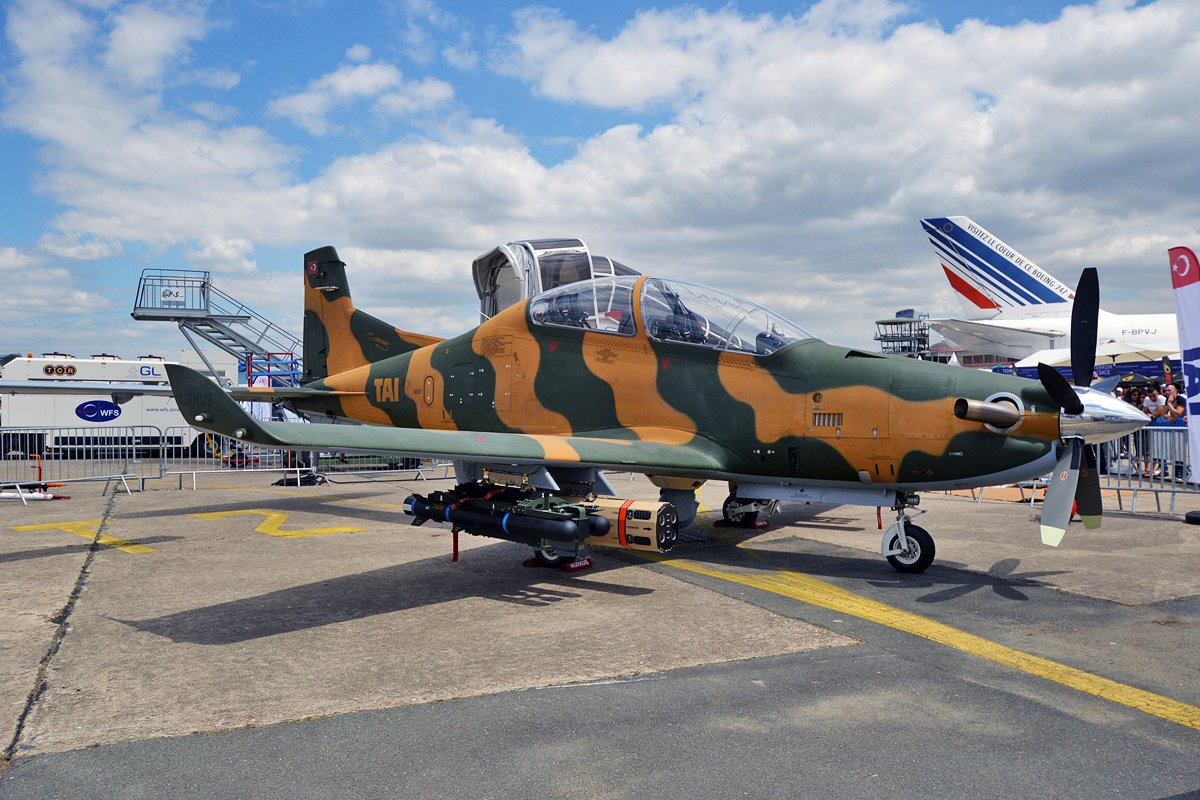
The TAI Hürkuş is a tandem two-seat, low-wing turboprop aircraft developed by Turkish Aerospace Industries (TAI) to serve as a basic trainer and light attack platform. The program originated from a March 2006 contract between TAI and Turkey's defense procurement agency (then the Undersecretariat for Defence Industries, or SSM). While conceptually developed from the KAI KT-1, the Hürkuş is an indigenous Turkish design intended to reduce reliance on foreign training aircraft. The first prototype was rolled out in June 2012 and completed its maiden flight on August 29, 2013, in Ankara.
Designed for versatility, the aircraft features a pressurized cockpit equipped with Martin-Baker ejection seats, an environmental control system, and onboard oxygen generation (OBOGS) to simulate a jet-like training environment. Its modern digital glass cockpit is specifically designed to facilitate the transition of student pilots to advanced fighter aircraft. The Hürkuş achieved EASA CS-23 certification on July 11, 2016, followed by Turkish DGCA certification, which paved the way for series production at TAI's Ankara campus.
Power is provided by a single Pratt & Whitney Canada PT6A-68T turboprop engine, producing 1,600 shp and driving a five-bladed Hartzell HC-B5MA-3 propeller. In its baseline trainer configuration, the aircraft reaches a maximum cruise speed of 574 km/h, a service ceiling of 34,700 ft, and a maximum range of 1,478 km. The Hürkuş-C variant is specifically reinforced for light attack and ISR roles, featuring an electro-optical/infrared (EO/IR) turret and five external hardpoints capable of carrying up to 650 kg of precision munitions, including laser-guided 2.75-inch rockets and smart micro-munitions.
Operational service includes the Turkish Air Force, which has 55 Hürkuş-II units on order, and the Turkish Land Forces, which planned the acquisition of 24 Hürkuş-II aircraft. Export customers include the Niger Air Force (Hürkuş-B) and the Chadian Air Force (Hürkuş-C), with Libya reporting an order for 10 Hürkuş-C aircraft. Operational reports indicate the aircraft has logged over 1,000 hours in real-world counter-insurgency and asymmetric warfare missions in Africa. Further evolution continues with the Hürkuş-II, which performed its first flight between December 29 and 30, 2024.