
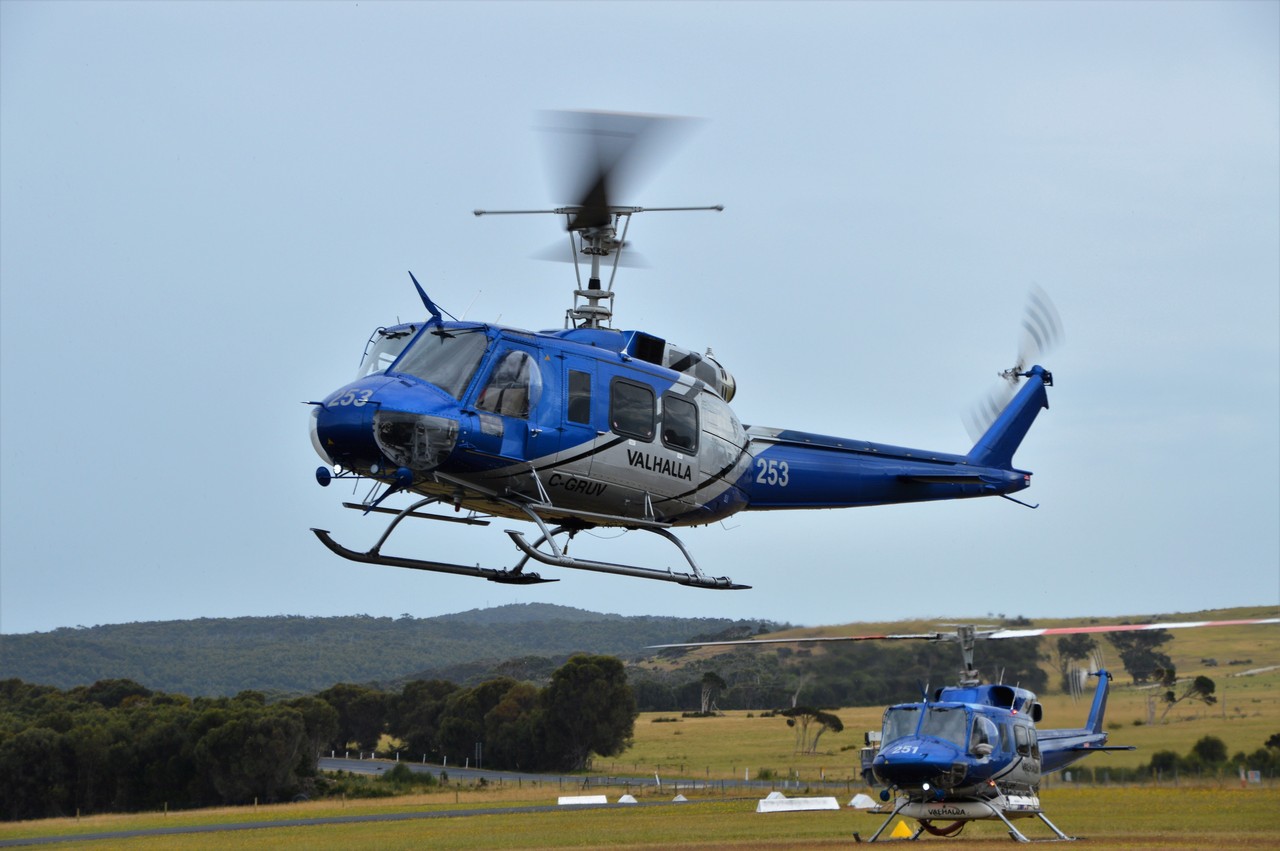
Service History
The UH-1A entered U.S. Army service in 1959 and quickly proved its worth as a versatile utility aircraft. By fall 1962, UH-1As were deployed to Vietnam, where they pioneered the air mobility tactics that would define modern helicopter warfare. The aircraft served primarily with assault helicopter companies, including the 173rd Assault Helicopter Company known as the "Robin Hoods." One notable example, serial number 65-10091, arrived in Vietnam in September 1966 and later found its way to the Smithsonian National Museum of American History.
Wartime Operations
In Vietnam, the UH-1A performed multiple critical roles including troop transport, medical evacuation, reconnaissance, and search-and-rescue missions. As a troop transport, it could carry six fully equipped soldiers, while in the medevac configuration it accommodated four stretchers plus a medical attendant. Early experiments with the XH-1A variant in 1960 tested grenade launcher installations, foreshadowing the helicopter's evolution into dedicated gunship variants. The UH-1A's turbine engine provided superior reliability in the hot, humid conditions of Southeast Asia compared to piston-powered predecessors.
The Manufacturer
Bell Helicopter traces its origins to 1935 when Lawrence Dale Bell founded Bell Aircraft Corporation. Following World War II, the company transitioned from fixed-wing aircraft to rotorcraft, becoming a pioneer in helicopter development. The UH-1A represented Bell's breakthrough into turbine-powered helicopters, designated as the company's Model 204. In 1982, Textron Inc. acquired Bell, and the company continues operations today as Bell Textron Inc., still producing modern variants like the UH-1Y Venom for the U.S. Marine Corps.
Engine and Technical Innovation
The UH-1A's most significant advancement was its Lycoming T53-L-1 turboshaft engine, producing 770 shaft horsepower. This powerplant, manufactured by Lycoming Engines (a division of Avco), became the first widely adopted turbine engine for U.S. Army helicopters. The T53 family would eventually see production of over 12,000 units across three decades, with variants serving through the 1980s. The engine provided 25 percent more power than equivalent piston engines while offering simpler maintenance and superior performance in high-altitude, high-temperature conditions.
Design Philosophy
Bell's design team created the UH-1A in response to a 1952 U.S. Army requirement for a utility helicopter to replace the aging H-13 Sioux. The pod-and-boom configuration allowed easy access for maintenance while maximizing cabin space. Skid landing gear enabled operations from rough, unprepared surfaces. At 31 feet 3 inches in fuselage length with a rotor diameter of 44 feet and standing 14 feet 6 inches tall, the UH-1A struck an optimal balance between capability and compactness.
Performance Characteristics
Pilots appreciated the UH-1A's straightforward handling characteristics and reliable performance. The helicopter achieved a maximum speed of 130 knots (150 mph) with a range of 251 nautical miles. Its service ceiling of 19,500 feet provided operational flexibility across diverse terrain. The two-person crew configuration—pilot and co-pilot—allowed for training flights and reduced single-pilot workload during demanding missions.
Production and Variants
Bell manufactured exactly 182 UH-1A helicopters between 1959 and 1961, following an initial U.S. Army contract awarded in 1959. Additional variants included 14 TH-1A dual-control trainers and experimental XH-1A aircraft for weapons testing. The UH-1A's success led to improved variants with more powerful engines, including the UH-1B with the T53-L-5 producing 960 horsepower.
Legacy and Impact
The UH-1A launched a helicopter dynasty that would see over 16,000 UH-1 family aircraft built through 1987. Bell produced 10,005 UH-1 variants from 1957 to 1975, with 9,216 delivered to the U.S. Army alone. The "Huey" nickname, derived from the original HU-1 designation, became synonymous with the Vietnam War and helicopter warfare itself. During that conflict, over 3,300 UH-1 family helicopters were lost to enemy action and accidents out of approximately 7,000 deployed.
Continuing Service
Hundreds of UH-1 family helicopters remain in service worldwide with military and civilian operators. Countries including Japan and the Czech Republic continue placing new orders for updated variants. The UH-1A's pioneering role in establishing turbine-powered helicopter operations created the foundation for modern rotorcraft doctrine, from air mobility and medevac operations to the attack helicopter concepts that followed. Museums worldwide display UH-1 variants, ensuring the aircraft's historical significance remains visible to future generations.