
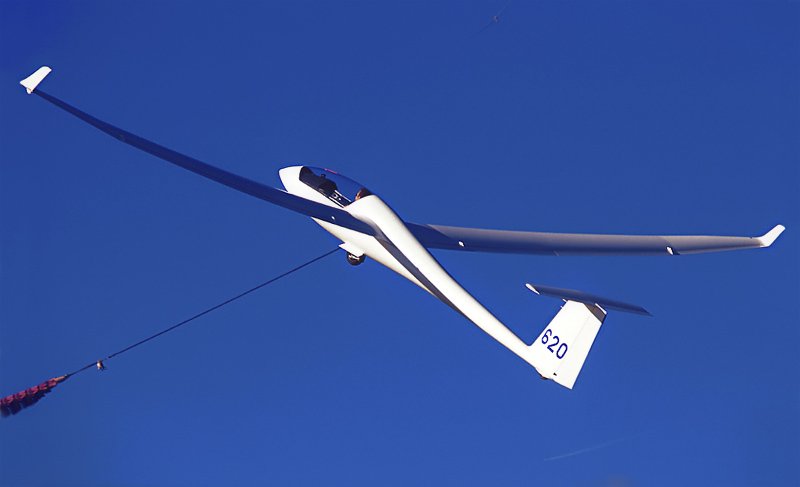
The Modern Competition Glider
The Ventus 3T dominates international gliding competitions and cross-country soaring records, serving pilots who demand maximum performance in the Standard Class category. Its advanced composite construction and refined aerodynamics enable sustained flight at altitudes exceeding 20,000 feet while maintaining exceptional handling characteristics that allow pilots to exploit the smallest thermal updrafts for hours-long flights covering hundreds of kilometers.
Design Excellence Under Klaus Holighaus
The Ventus series emerged from the innovative mind of Klaus Holighaus, who joined Schempp-Hirth as an engineer in 1965 before becoming CEO in 1972 and owner in 1977. Holighaus revolutionized sailplane design by pioneering the use of composite materials, building on the company's 1967 introduction of the world's first fiberglass glider. His racing experience as a competitive pilot directly influenced the Ventus 3T's design objectives, creating an aircraft optimized for the demanding requirements of world championship competition.
The Ventus 3T incorporates wing optimization techniques developed from earlier Schempp-Hirth designs like the Standard Austria SH, featuring refined airfoil sections that maximize lift-to-drag ratios across a wide speed range. The retractable undercarriage system eliminates parasitic drag during flight, while the composite fuselage provides exceptional structural strength at minimal weight.
Schempp-Hirth: Eight Decades of Innovation
Schempp-Hirth Flugzeugbau GmbH traces its origins to January 4, 1935, when Martin Schempp established "Sportflugzeugbau Göppingen Martin Schempp" in Göppingen, Germany, with assistance from Wolf Hirth. The company relocated to Kirchheim unter Teck in 1937-1938 and officially became Schempp-Hirth on January 15, 1938, when Wolf Hirth acquired a 50 percent shareholding.
By 1936, the company achieved remarkable production efficiency, completing gliders like the Gö-1 "Wolf" every 14 days, ultimately building over 100 units by 1945. The iconic Gö-3 "Minimoa" reached 110 units and became legendary for its distinctive gull-wing design that continues to influence aviation aesthetics today.
During World War II from 1939 to 1945, Schempp-Hirth contributed to the war effort by manufacturing wooden subassemblies for Messerschmitt Me-109 fighters and Me-321/323 "Gigant" transport aircraft, while also producing training gliders like the Habicht. Post-war restrictions halted glider production from 1945 to 1951, forcing the company to manufacture furniture for survival.
Following Klaus Holighaus's death on August 9, 1994, the company passed to his family. Since 2015, Ralf Holighaus and Tilo Holighaus have jointly managed operations with Brigitte Holighaus, maintaining the company's position as a world leader in high-performance sailplane manufacturing with approximately 100 employees.
Technical Specifications and Performance
The Ventus 3T measures approximately 7.6 meters in length with a height of 1.6 meters when the landing gear is retracted. Its 15-meter wingspan places it squarely in the Standard Class category, allowing it to compete in the most prestigious international competitions. The aircraft's composite construction combines carbon fiber and fiberglass components to achieve an optimal strength-to-weight ratio.
Performance specifications include a maximum speed of 300 kilometers per hour and a best glide ratio of 50:1, meaning the aircraft can travel 50 meters forward for every meter of altitude lost in still air. This exceptional efficiency enables pilots to cover vast distances while soaring on thermal currents and ridge lift.
Pilot Experience and Handling
Pilots praise the Ventus 3T for its responsive controls and predictable handling characteristics across the entire flight envelope. The aircraft's advanced wing design provides excellent penetration in headwinds while maintaining gentle stall characteristics that inspire confidence during low-speed thermal flying. Competition pilots particularly value the glider's ability to accelerate quickly between thermals while maintaining energy efficiency.
The cockpit accommodates a single pilot in a semi-reclined position optimized for long-distance flights. Instrumentation typically includes variometers, GPS navigation systems, and flight computers that help pilots maximize performance during cross-country flights and competitions.
Production and Current Status
Schempp-Hirth continues active production of the Ventus 3T at their Kirchheim unter Teck facility, though specific production numbers for this variant are not publicly disclosed. The company has manufactured thousands of gliders throughout its history, with the Ventus series representing decades of continuous refinement and improvement.
Hundreds of Ventus series sailplanes remain active in gliding clubs and private ownership worldwide, regularly participating in national and international competitions. The aircraft serves pilots pursuing world records, championship titles, and recreational cross-country soaring adventures across six continents.
The Ventus 3T's legacy extends beyond its immediate performance capabilities, representing the culmination of Schempp-Hirth's pioneering work in composite sailplane construction that began in 1967. This technological foundation continues to influence modern glider design and has enabled safer, faster long-distance soaring that pushes the boundaries of what is possible in motorless flight.