
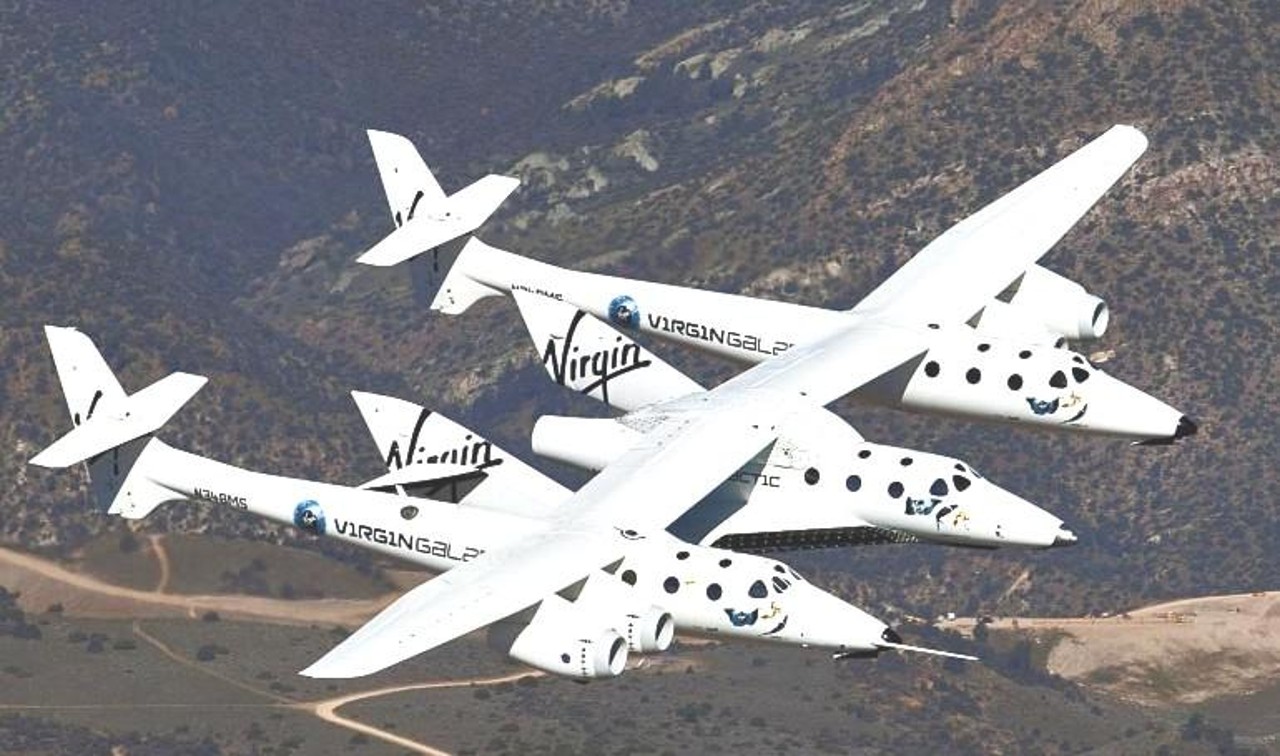
Revolutionary Space Tourism Platform
White Knight Two emerged as the cornerstone of Virgin Galactic's suborbital space tourism program, establishing an entirely new category of commercial aviation. The aircraft has successfully launched multiple SpaceShipTwo flights carrying paying passengers to the edge of space, achieving altitudes above 50 miles where occupants experience several minutes of weightlessness and witness the curvature of Earth against the black of space. By 2009, Virgin Galactic had sold more than 280 tickets for these edge-of-space flights, each priced at $250,000, demonstrating unprecedented commercial demand for suborbital spaceflight.
The mothership's operational profile differs dramatically from conventional aircraft. During a typical mission, White Knight Two climbs to approximately 50,000 feet while carrying SpaceShipTwo suspended beneath its center wing section. At release altitude, SpaceShipTwo separates and ignites its rocket motor, accelerating to Mach 3+ and climbing to space while White Knight Two returns to Mojave for landing. This air-launch system provides significant advantages over ground-based rockets, including reduced fuel requirements, weather flexibility, and reusability.
The Visionary Behind the Design
Burt Rutan, the legendary aerospace engineer who founded Scaled Composites in 1982, led White Knight Two's design team. Rutan had previously created SpaceShipOne, which won the $10 million Ansari X Prize in 2004 by completing two crewed suborbital flights within two weeks. His unconventional approach to aircraft design emphasized lightweight composite construction and innovative configurations that challenged traditional aerospace thinking.
Rutan conceived White Knight Two as part of the Tier 1b system, a scaled-up version of his X Prize-winning Tier 1 architecture. The twin-fuselage configuration served multiple purposes: the starboard fuselage replicates SpaceShipTwo's cockpit environment for pilot training, while the port fuselage houses flight controls and systems. This design also provides structural mounting points for the suspended spacecraft while maintaining aircraft balance and control.
Manufacturing and Corporate Evolution
Scaled Composites constructed exactly two White Knight Two airframes at their Mojave, California facility between 2007 and 2010. The first aircraft, designated VMS Eve (tail number N348MS), was unveiled on July 28, 2008, and completed its maiden flight four months later. The second airframe was planned as VMS Spirit of Steve Fossett, honoring the adventurer who died in a 2007 aircraft accident.
In 2007, Virgin Galactic and Scaled Composites formed The Spaceship Company as a joint venture to oversee production and operations. Virgin Galactic later acquired full control, absorbing manufacturing capabilities and operational responsibilities. This corporate evolution reflected the program's transition from experimental research to commercial operations.
Advanced Powerplant Configuration
White Knight Two's four Pratt & Whitney Canada PW308 turbofan engines represent a significant upgrade from its predecessor's twin-engine layout. Each PW308 produces 6,900 pounds of thrust, providing the total 27,600 pounds of thrust necessary to lift the combined weight of mothership and spacecraft to operational altitude. The high-bypass turbofan design offers excellent fuel efficiency and reliability at extreme altitudes.
The engines mount on underwing pylons in a conventional arrangement, contrasting with the original White Knight's Pratt & Whitney Canada PW308 installation. This powerplant selection enables White Knight Two to reach its 70,000-foot service ceiling while maintaining sufficient power margins for safe spacecraft separation and return flight.
Flight Testing and Operational Milestones
White Knight Two's flight test program achieved several significant milestones demonstrating its capabilities. The third test flight on March 27, 2009, lasted 2.5 hours and reached 18,000 feet while achieving speeds of 140 knots. The 25th flight on March 22, 2010, marked a historic achievement when White Knight Two carried VSS Enterprise to 45,000 feet during a 2 hour 54 minute mission, proving the integrated system's readiness for operational missions.
These test flights validated the aircraft's handling characteristics and system integration while building pilot proficiency. The twin-fuselage configuration initially presented unique challenges, requiring pilots to adapt to different flight dynamics compared to conventional aircraft. However, the design proved stable and predictable throughout the flight envelope.
Unprecedented Composite Construction
White Knight Two earned distinction as the world's largest all-composite aircraft, pushing the boundaries of advanced materials application in aerospace. The carbon fiber construction provides exceptional strength-to-weight ratios essential for high-altitude operations while carrying external loads. Scaled Composites' expertise in composite manufacturing, developed through decades of experimental aircraft programs, proved crucial in achieving the structural requirements.
The 141-foot wingspan and 78-foot 9-inch length create an impressive physical presence, yet the composite construction keeps operational weight within manageable limits. This advanced materials approach enables the aircraft to function effectively in the thin atmosphere at operational altitudes while maintaining structural integrity during spacecraft separation events.
Current Operations and Future
As of 2024, at least one White Knight Two remains active in Virgin Galactic's fleet, continuing to support regular passenger flights to space. The program has successfully transitioned from experimental testing to routine commercial operations, validating Rutan's revolutionary air-launch concept. Virgin Galactic has also introduced next-generation mothership variants, building upon White Knight Two's pioneering foundation to expand suborbital spaceflight capabilities and capacity.