
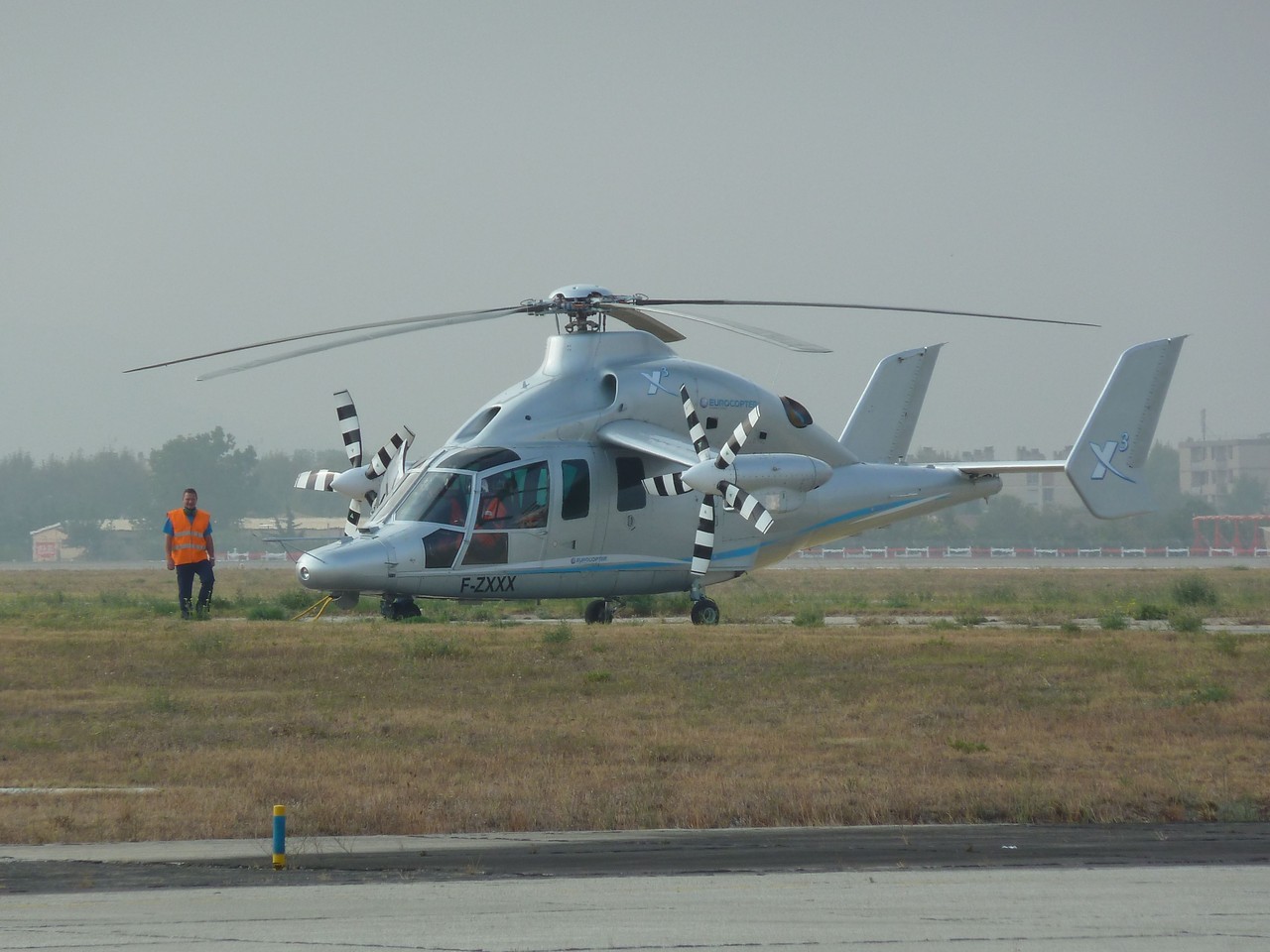
Technology Demonstration Platform
The X3 program emerged in the early 2000s as Eurocopter's ambitious answer to the Bell-Boeing CV-22 Osprey, designed to prove that compound helicopters could compete with tiltrotor aircraft in the high-speed vertical lift market. Unlike traditional helicopters limited by retreating blade stall, the X3's innovative design used side-mounted propellers to provide forward thrust while the main rotor handled vertical lift, eliminating speed barriers that had constrained rotorcraft for decades.
Record-Breaking Performance
During its 3.5-year test program, the X3 shattered speed expectations for helicopter-based aircraft. On May 12, 2011, the prototype demonstrated 232 knots using less than 80 percent of available power, proving substantial performance reserves remained untapped. The aircraft achieved its crowning achievement on June 7, 2013, reaching 255 knots in level flight at 10,000 feet during a 40-minute test flight over southern France, followed by 263 knots in a shallow dive. These records surpassed the Sikorsky X2's previous unofficial marks and established the X3 as the fastest compound helicopter ever flown.
Hybrid Design Innovation
Engineers built the X3 around a heavily modified Eurocopter EC155 airframe, integrating twin five-bladed propeller systems mounted on stubby wings alongside the fuselage. The configuration retained the main rotor's five-blade system for vertical operations while the wing-mounted propellers provided forward thrust and lift augmentation during high-speed flight. For record attempts, technicians fitted drag-reducing fairings around the rotor head and landing gear, optimizing the aircraft for maximum velocity.
Powerplant and Technical Specifications
Two Rolls-Royce Turbomeca RTM322 turboshaft engines powered the X3, each delivering 2,270 shaft horsepower through a sophisticated transmission system. These engines, variants of powerplants used in NH90 helicopters, incorporated Full Authority Digital Engine Control systems adapted specifically for the X3's high-speed requirements. The substantial power output enabled the aircraft to maintain its 252 mph cruising speed while reaching a service ceiling of 12,500 feet.
The Manufacturer's Legacy
Eurocopter, the helicopter division of European Aeronautic Defence and Space Company, developed the X3 as part of their "high-speed, long-range hybrid helicopter" or H³ concept program. In 2014, the company became Airbus Helicopters, continuing as one of the world's major rotorcraft manufacturers. The X3 represented Eurocopter's technological ambitions during a period when the company sought to challenge American dominance in high-speed vertical lift aircraft development.
Testing and International Recognition
Throughout 199 test flights accumulating 155 flight hours, the X3 demonstrated remarkable versatility and performance. In summer 2012, Eurocopter brought the prototype to the United States for demonstration flights, allowing commercial and military operators to experience the aircraft firsthand during 55 additional flight hours. The American Helicopter Society recognized the program's achievements by awarding the X3 development team the Howard Hughes Award for 2012.
Single Prototype Program
Unlike conventional aircraft development programs leading to production, Eurocopter built only one X3 prototype, treating the project as a pure technology demonstrator rather than a path to serial manufacturing. After completing its test program without advancing to production planning, the prototype concluded its active flying career having proven that compound helicopter designs could achieve previously impossible speeds while maintaining full rotorcraft capabilities.
Museum Display and Legacy
The sole X3 prototype now serves as a permanent museum exhibit, initially displayed at the Musée de l'Air et de l'Espace in Le Bourget alongside the Concorde and Mirage IV. In 2017, curators transferred the aircraft to the Musée de l'Aviation in Saint-Victoret near Marseille, where visitors can examine this pioneering example of high-speed rotorcraft technology. The X3's achievements continue influencing contemporary vertical takeoff and landing aircraft development, proving that hybrid configurations can overcome traditional helicopter speed limitations while maintaining operational flexibility.