
The Franco-German Vision
The Tiger emerged from Europe's determination to reduce dependence on American military hardware during the Cold War era. In 1984, France's Aérospatiale and Germany's Messerschmitt-Bölkow-Blohm launched a joint venture to create an advanced attack helicopter capable of countering Soviet armor threats. The program faced immediate challenges, with costs forcing cancellation in 1986, but European governments relaunched development in 1987 with renewed commitment to produce five flying prototypes.
The collaboration proved groundbreaking for European aerospace integration. When Eurocopter formed in 1992 as a merger of the French and German helicopter divisions, the Tiger became its flagship program, demonstrating that complex multinational defense projects could succeed despite political and technical hurdles.
Combat Debut and Operational History
The Tiger first entered combat in Afghanistan during 2009, when three French HAP variants deployed for reconnaissance and fire support missions. These initial combat operations validated the helicopter's advanced systems under battlefield conditions, with the aircraft logging thousands of operational hours supporting NATO forces. German UHT variants followed, providing reconnaissance capabilities and armed escort duties for transport helicopters in hostile environments.
French Tigers subsequently participated in operations over Libya in 2011, where their precision-guided munitions and advanced sensors proved invaluable for close air support missions. German forces deployed Tigers to Mali, where the aircraft's sophisticated mast-mounted sight system allowed crews to conduct surveillance operations while remaining concealed behind terrain features.
By 2019, the combined Tiger fleet had accumulated more than 115,000 flight hours across all variants and operators, demonstrating the aircraft's reliability in diverse operational environments from European training ranges to harsh combat zones in Africa and Southwest Asia.
Manufacturing Excellence
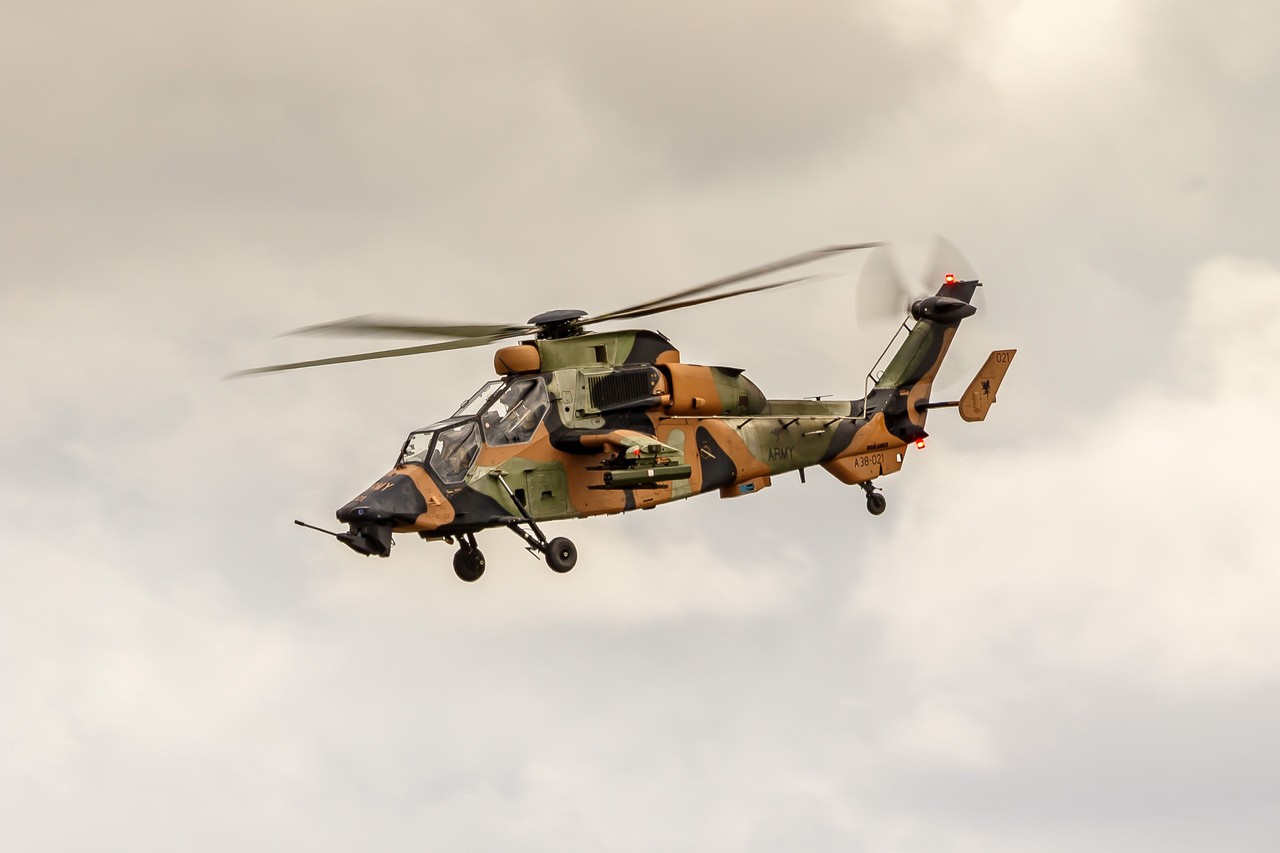
Eurocopter established production lines in both France and Germany, reflecting the binational nature of the program. This dual-line approach ensured industrial participation from both partner nations while maintaining quality standards across manufacturing sites. Australia negotiated local assembly for its 22 ARH variants, with the final aircraft delivered in December 2011 after a decade-long procurement process that began with contract signature on December 21, 2001.
Serial production commenced in March 2002, with the first operational deliveries reaching the French Army on March 18, 2005, followed closely by initial German deliveries on April 6, 2005. Spain joined the program later, ordering the more powerful HAD variant equipped with enhanced engines and armor protection.
Technical Innovation
The Tiger's revolutionary airframe construction utilized 80 percent composite materials, primarily carbon fiber reinforced polymer and Kevlar, with only 11 percent aluminum and 6 percent titanium. This extensive use of composites provided significant weight savings while enhancing ballistic protection and reducing radar cross-section compared to conventional aluminum construction.
The MTR390 engine represented another multinational achievement, developed jointly by MTU Aero Engines, Turbomeca, and Rolls-Royce specifically for the Tiger program. Each engine produces 1,000 kilowatts in standard configuration, enhanced to 1,341 shaft horsepower in the HAD variant to accommodate increased armor and weapons loads.
Advanced avionics distinguished the Tiger from earlier attack helicopters. The TopOwl helmet-mounted sight system provided unprecedented situational awareness, while the mast-mounted sight enabled crews to observe and engage targets while maintaining aircraft concealment. Forward-looking infrared sensors, Doppler radar, and ring laser gyroscopes created an integrated sensor suite rivaling the most advanced military aircraft.
Variants and Capabilities
Four distinct variants emerged to meet different national requirements. The French HAP focused on combat support and reconnaissance, carrying a chin-mounted 30-millimeter gun turret and various rocket and missile combinations. The HAD variant incorporated additional armor and more powerful engines for enhanced survivability in high-threat environments.
Germany's UHT variant emphasized multi-role capabilities, optimized for both anti-tank missions and reconnaissance duties. The aircraft carries PARS 3 LR missiles for long-range precision strikes against armored targets. Australia's ARH variant combined reconnaissance capabilities with armed helicopter functionality, featuring specialized communications equipment for coordination with ground forces.
Corporate Evolution
Eurocopter operated from 1992 until 2014, when parent company restructuring transformed it into Airbus Helicopters. This transition reflected broader consolidation within European aerospace, as Airbus Group sought to streamline operations and eliminate duplicate corporate structures. Airbus Helicopters continues Tiger production and support today, maintaining the technical expertise developed over three decades of program evolution.
Operational Legacy
The Tiger achieved its primary objective of establishing European independence in attack helicopter capabilities. Four nations operate the type, with France and Germany each ordering 80 aircraft, though German requirements later reduced to 57 helicopters in March 2013 due to budget constraints. Spain operates HAD variants, while Australia's 22 ARH helicopters provided valuable service before replacement decisions in August 2019.
Despite program costs reaching €3.3 billion for 160 Franco-German aircraft, the Tiger demonstrated that European cooperation could produce world-class military systems. The helicopter's combat record in Afghanistan, Libya, and Mali validated design decisions made decades earlier, proving the aircraft's effectiveness in modern battlefield environments.