
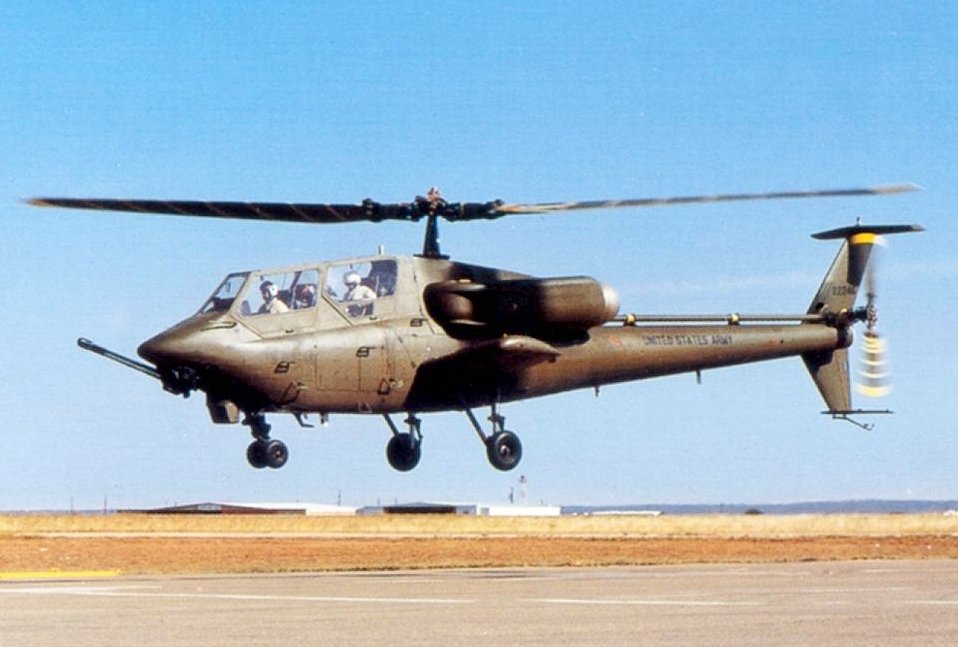
The Bell YAH-63, designated as the Bell Model 409, was developed as a contender for the United States Army's Advanced Attack Helicopter (AAH) program. Initiated by a request for proposals in November 1972, the AAH program sought a specialized, all-weather anti-armor aircraft capable of destroying enemy armor and providing close air support. In June 1973, Bell and Hughes were selected as the finalists, with Bell awarded a contract to produce two prototype aircraft.
Drawing design influence from the privately developed Model 309 KingCobra, the YAH-63 featured a very slim fuselage, reported to be only 42 inches wide, to minimize its frontal profile and reduce exposure to enemy fire. A notable departure from conventional attack helicopter layouts was its tandem cockpit arrangement; the pilot was seated in the front and the weapons operator in the rear. This configuration was intended to optimize the pilot's visibility during low-altitude "nap-of-the-earth" flight while providing the gunner with an elevated position for better sensor and weapon visibility. The aircraft utilized a conventional two-blade main rotor and a tricycle landing gear system consisting of a nosewheel and two main gear units.
Power was provided by twin General Electric T700 free-turbine turboshaft engines, as mandated by the Army's specifications. For armament, the YAH-63 was designed to carry a single 30 mm cannon in a chin turret and up to 16 anti-tank missiles, specifically the AGM-114 Hellfire or TOW variants.
The first YAH-63 prototype, serial number 73-22246, made its maiden flight on October 1, 1975. However, the prototype program faced setbacks when this first aircraft crashed during a test flight in June 1976. On December 10, 1976, the U.S. Army officially selected the Hughes YAH-64 (which became the AH-64 Apache) as the winner of the competition. The Army cited the YAH-63's two-bladed rotor and tricycle landing gear as being less survivable than the four-blade rotor and gear arrangement of the Hughes design. Following the decision, both prototypes were returned to Bell for disposal. While the YAH-63 never entered operational service, it remains a significant example of Bell's effort to evolve the Cobra lineage into a modern, heavily armed attack platform.