
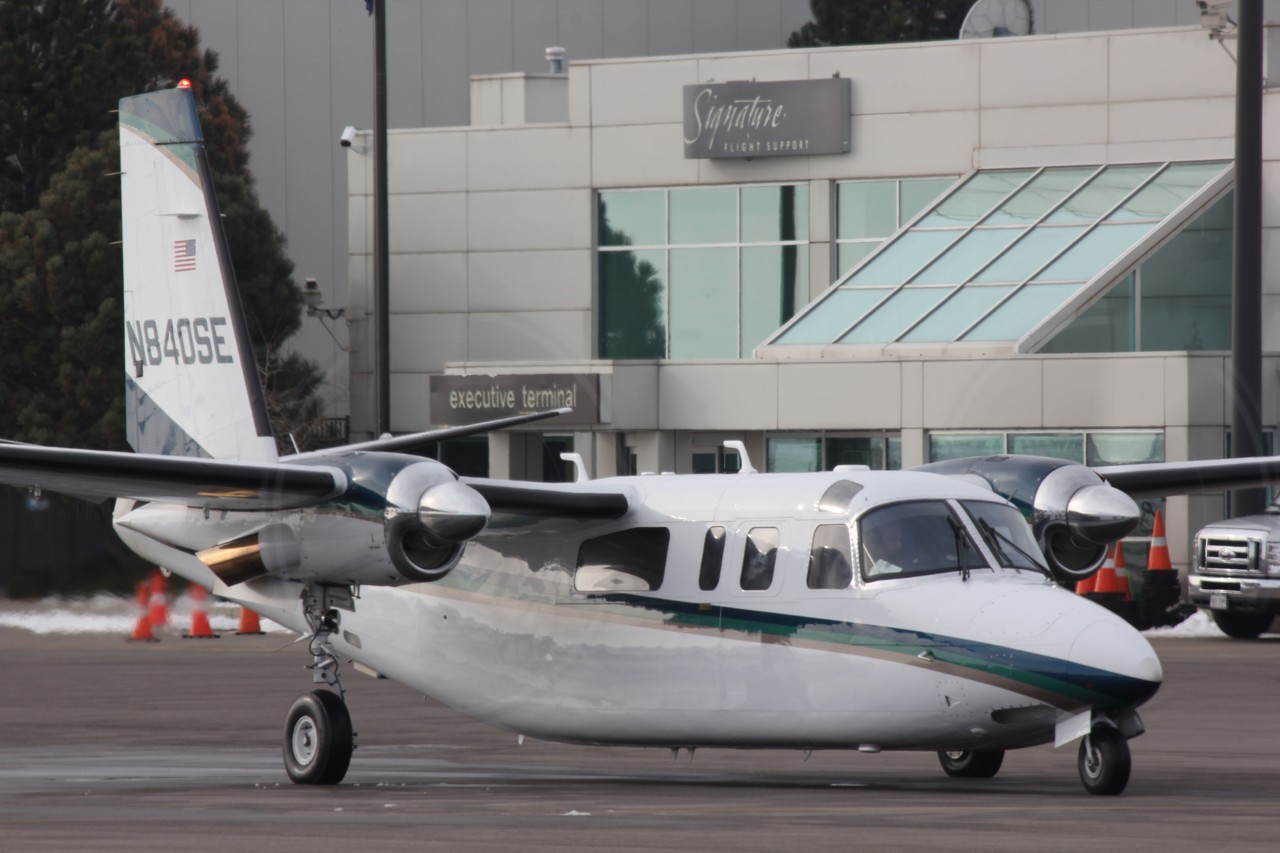
Market Dominance in Executive Aviation
The Turbo Commander 690 series established itself as a dominant force in the corporate aviation market throughout the 1970s and 1980s. As part of the broader Twin Commander family, which achieved total turbine variant sales of 2,122 aircraft, the 690 carved out a specific niche for operators requiring reliable turboprop performance with exceptional short-field capabilities. The aircraft excelled in obstacle-clearance takeoffs from fields as short as 1,666 feet and landing distances of just 1,600 feet when utilizing full reverse thrust procedures.
Manufacturing Heritage
The 690's development traced back to Aero Design and Engineering Company, founded in 1944 near Oklahoma City at what is now Wiley Post Airport. This company underwent significant corporate transformations that shaped the aircraft's identity. Rockwell-Standard acquired the operation in 1958, leading to the company's renaming as Aero Commander Inc. in late 1960. The aircraft subsequently bore the Rockwell Turbo Commander designation until Gulfstream American purchased North American Rockwell in 1981, creating yet another corporate identity shift.
The manufacturer's evolution from piston-powered designs proved crucial to the 690's success. Earlier Commander variants had established the company's reputation, including the groundbreaking 680E, which earned distinction as the world's first pressurized light twin. The transition to turbine power began with the 680T model in 1964, setting the stage for the more advanced 690 series certification in July 1971.
Engine Technology and Reliability
Twin Garrett AiResearch TPE331 turboprop engines powered the 690 series, each driving three-blade constant-speed reversible-pitch propellers manufactured by Hartzell. The original 690 model utilized 717-shaft-horsepower engines, while the 690A introduced in 1973 featured the more powerful 251K variant. The 690B, entering production in 1978, maintained 700 shaft horsepower while incorporating additional refinements.
A critical factor in the aircraft's long-term success involved engine reliability improvements. Early turbine Commanders suffered from prohibitively short Time Between Overhauls of just 600 hours, later extended to 2,000 hours with overhaul costs reaching $150,000 per engine. The mature TPE331 engines in later 690 variants achieved an impressive 5,400-hour TBO, fundamentally transforming the aircraft's operating economics and making long-term ownership financially viable.
Design Evolution and Performance
The 690A incorporated significant airframe improvements over the original model, including a 30-inch center wing section extension, increased rudder area, an enlarged dorsal fin, and a longer tail cone. These modifications enhanced stability and performance while maintaining the aircraft's renowned short-field characteristics.
Performance specifications positioned the 690B as a formidable competitor in its class. The aircraft achieved a maximum speed of 330 miles per hour, cruised at 321 miles per hour, and demonstrated an initial climb rate of 2,849 feet per minute. With a service ceiling of 33,000 feet and range of 1,458 nautical miles, the 690B could access high-altitude airways while maintaining transcontinental capability. The cabin pressurization system maintained 5.2 psi differential pressure, ensuring passenger comfort during high-altitude operations.
Operational Characteristics
Pilots appreciated the 690's docile handling characteristics and robust construction. The aircraft's high-wing configuration provided inherent stability, while the reversible-pitch propellers offered exceptional control during ground operations. Fuel consumption of approximately 600 pounds per hour balanced performance with operating costs, particularly given the extended engine TBO intervals.
The 690B was marketed in two distinct variants: the Executive I with comprehensive standard avionics, and the Executive II, which allowed customers to specify custom avionics packages and interior configurations. This flexibility attracted diverse operators ranging from corporate flight departments to charter services.
Notable Service Record
International operations extended the 690's reach beyond North American markets. Australian registration records document Model 690 VH-BSS, construction number 11044, which entered service on November 9, 1973. This aircraft's operational history ended tragically when it crashed into the sea 18 kilometers southeast of Sydney on January 14, 1994, illustrating both the aircraft's global presence and the inherent risks of aviation operations.
Production Legacy and Revival
Production continued through the 1980s, with the aircraft maintaining its reputation for reliability and performance. However, aging aircraft presented maintenance challenges that concerned operators during the late 1980s and early 1990s. Twin Commander's acquisition of the type certificate in December 1989 addressed these issues through improved parts availability and comprehensive maintenance support programs.
This corporate intervention proved crucial for the 690's continued viability. The new support structure, combined with the mature TPE331 engines' proven 5,400-hour TBO, restored confidence in the platform and enabled many aircraft to continue productive service well into the 21st century. The 690 series ultimately demonstrated that well-engineered turboprop designs could achieve remarkable longevity when supported by dedicated manufacturers committed to maintaining aging fleets.