
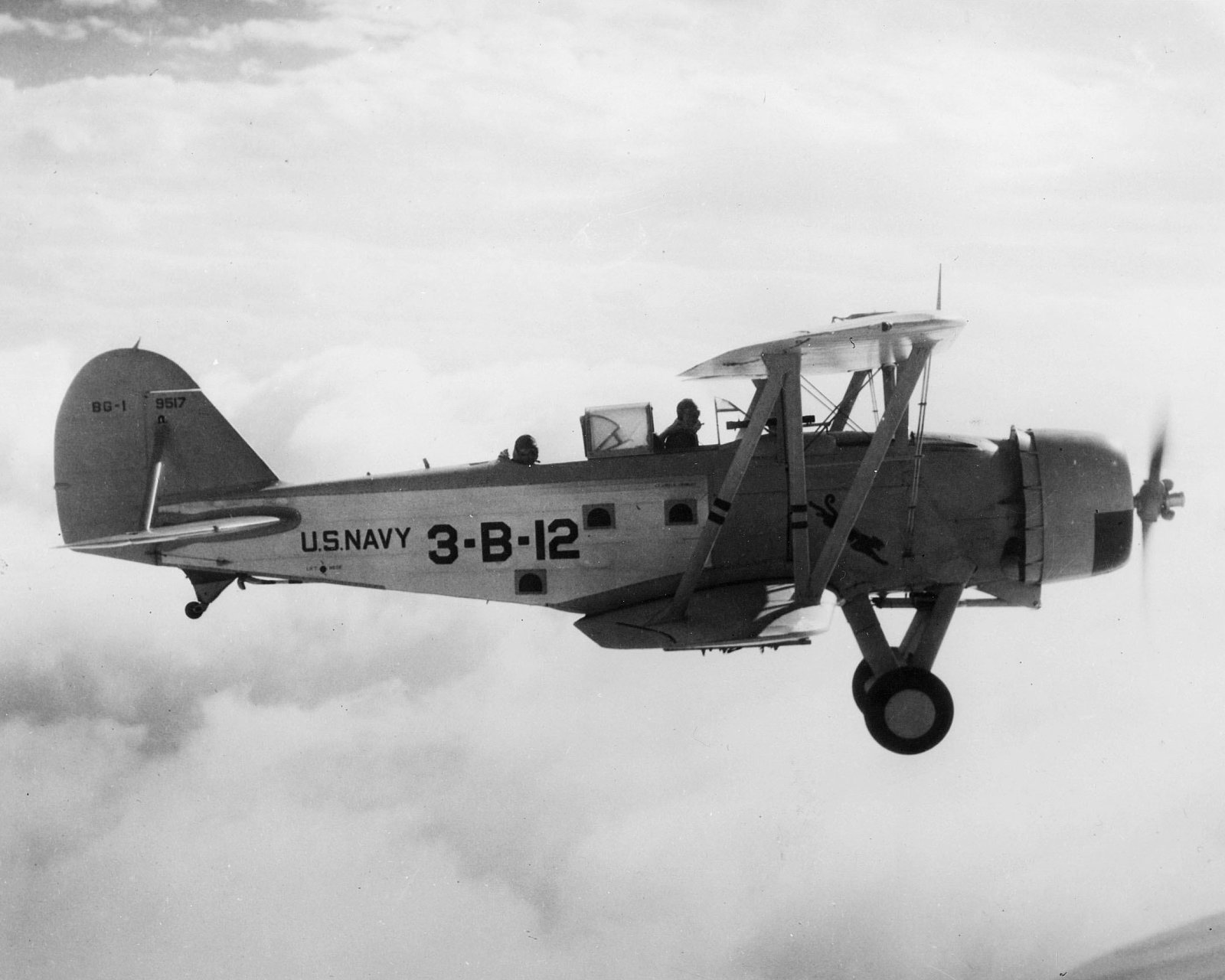
The Great Lakes BG was a carrier-based biplane dive bomber developed in the early 1930s for the U.S. Navy. It holds a distinct place in the history of the Great Lakes Aircraft Company as the only original combat type the firm designed and produced; other naval aircraft manufactured by the company, such as the TG-1 and TG-2, were license-built derivatives of the Martin T4M.
Great Lakes was awarded the contract for the BG on June 13, 1932. The prototype, designated the XBG-1, was an open-cockpit aircraft that made its first flight in the summer of 1933. During Navy trials, the XBG-1 notably outperformed the more expensive XB2Y-1 biplane from Consolidated Aircraft. Following these tests, the production version, the BG-1, entered production in November 1933. Unlike the prototype, the BG-1 featured a glazed canopy over both crew positions to improve visibility and protection. A further advanced prototype, the XB2G-1, was also developed; it featured a more bulbous fuselage, an internal bomb bay, and mechanically retractable landing gear that folded into circular recesses, though this version did not enter production.
All BG aircraft were manufactured at the company's plant in Cleveland, Ohio, located on the former Glenn L. Martin factory site. The U.S. Navy accepted a total of 61 aircraft. The BG was powered by a single 750 hp Pratt & Whitney R-1535-82 air-cooled, 14-cylinder, twin-row radial piston engine. In terms of performance, the aircraft had a range of 550 statute miles and was capable of delivering a bomb load of up to 1,000 lbs.
In operational service, the BG-1s equipped carrier air groups on the USS Lexington (CV-2) and USS Ranger (CV-4) until 1938, while the U.S. Marine Corps continued to operate the type into 1940. The aircraft remained in squadron use until June 1941, eventually being phased out as newer monoplane designs entered service. There is no documented evidence of the BG seeing active combat during World War II. The Great Lakes Aircraft Company ceased all production in 1935 and closed its doors by 1936 due to the Great Depression, leaving the BG as its final major military contribution.