
Service History
The Citation V established itself as a cornerstone of corporate aviation during its production run from 1989 to 2011. With 774 aircraft delivered, it became one of the most successful midsize business jets of its era, primarily serving corporate operators and fractional ownership companies rather than scheduled airlines. The aircraft's 2,400-nautical-mile range made it particularly valuable for transcontinental business travel, while its eight-passenger capacity struck an optimal balance between operating costs and utility.
The Citation family, anchored by successful models like the Citation V, achieved over 7,000 deliveries across all variants, setting unprecedented sales records for non-military jet aircraft. This success fundamentally transformed business aviation by making jet travel accessible to a broader range of corporations and high-net-worth individuals.
The Manufacturer
Cessna Aircraft Company, founded in 1927 by Clyde Cessna in Wichita, Kansas, had already established itself as a pioneer in light aircraft manufacturing with iconic models like the Cessna 172 before entering the jet market. The company's first business jet, the Citation I, debuted in 1972, launching what would become the most successful business jet family in aviation history.
Financial turbulence in the 1990s led to Cessna's acquisition by Textron Inc. in 1992. Under Textron ownership, the company continued Citation development and production, eventually becoming Textron Aviation. This corporate evolution ensured continuity in Citation manufacturing and support, with Textron Aviation remaining a major force in business aviation today.
Engine & Technical Innovation
The Citation V's powerplant consisted of two Pratt & Whitney Canada JT15D-5A turbofan engines, each producing 2,500 pounds of thrust. These engines represented a significant advancement in small turbofan technology, offering 50 percent better fuel efficiency compared to contemporary engines powering competitors like Learjet aircraft. The JT15D series, produced from the early 1970s through the 2000s, powered over 3,000 Citation aircraft across multiple variants.
Pratt & Whitney Canada, originally established in 1928 as a de Havilland Canada subsidiary before becoming independent in 2007, designed the JT15D series specifically for the emerging business jet market. The engines' low fuel consumption, reduced noise signature, and exceptional reliability became defining characteristics that enabled Citation's market dominance.
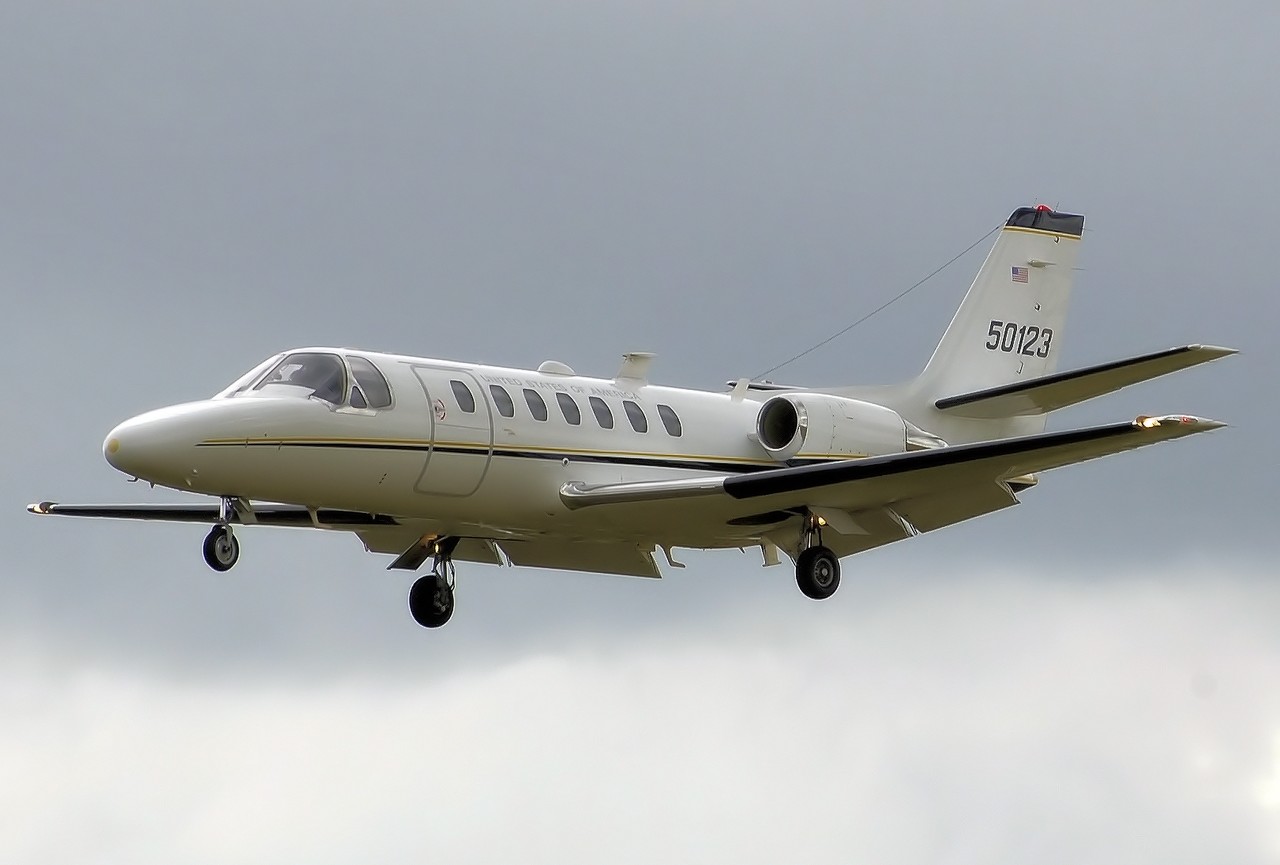
Cessna's engineering team developed the Citation V as a stretched evolution of the Citation II (Model 550), incorporating several key improvements. The fuselage received increased height for better cabin headroom, while wing modifications enhanced aerodynamic efficiency. The resulting cabin measured 17.3 feet in length, 4.8 feet in width, and 4.7 feet in height, providing comfortable accommodations for eight passengers plus two crew members.
Design Evolution
The Citation V's development began with clear objectives: create a midsize business jet offering superior performance, efficiency, and passenger comfort compared to the Citation II. The first prototype, based on a stretched Citation S/II airframe, completed its maiden flight on August 10, 1987. After extensive testing and refinement, the Federal Aviation Administration granted certification on December 9, 1988.
Key design innovations included the more powerful JT15D-5A engines that provided improved climb performance and cruise speeds, a larger fuselage cross-section for enhanced passenger comfort, and wing modifications that optimized efficiency in the light jet segment. The aircraft achieved a maximum takeoff weight of 7,200 kilograms and demonstrated exceptional short-field performance with takeoff distances of just 3,182 feet.
Performance Characteristics
Pilots appreciated the Citation V's forgiving handling characteristics and robust performance envelope. The aircraft achieved cruise speeds of approximately 459 knots true airspeed and could operate at altitudes up to 45,000 feet, placing it well above most weather and air traffic congestion. Its transcontinental range capability of 2,400 nautical miles enabled nonstop flights across North America and similar distances internationally.
The twin-engine configuration provided redundancy and safety margins that became hallmarks of the Citation family. Standard crew requirements called for two pilots, though the aircraft's systems were designed for single-pilot operation with appropriate training and certification.
Production Legacy
Cessna manufactured the Citation V at its Wichita, Kansas facilities throughout the aircraft's 22-year production run. The model spawned several variants, including the Citation Ultra in 1994 and Citation Encore in 2000, which featured upgraded engines producing up to 3,040 pounds of thrust. These evolutionary improvements extended the aircraft's market relevance and appeal.
As of recent data, many of the 774 Citation V aircraft produced remain in active service, supported by ongoing maintenance programs and occasional avionics upgrades. The aircraft's strong resale values and continued operational utility demonstrate the soundness of its original design philosophy and construction quality. The Citation V's success bridged the gap between earlier Citation models and modern variants, exemplifying evolutionary design principles that characterized business jet development through the 1990s and 2000s.