
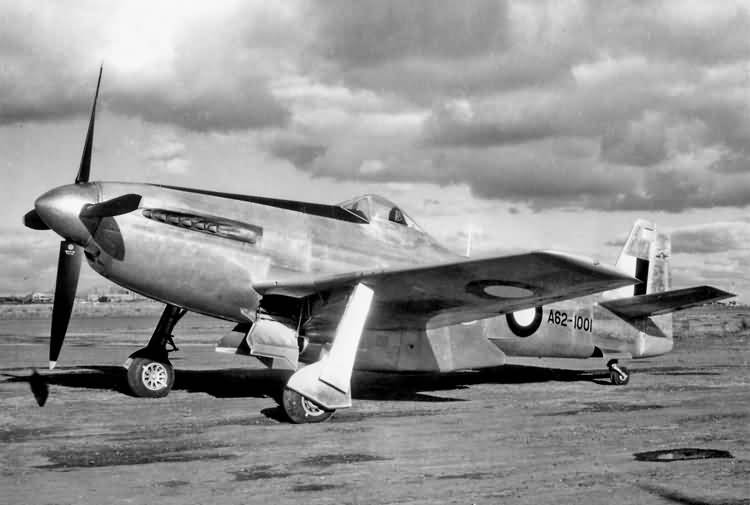
Design and Development
Initiated in response to RAAF Specification 2/42, the CA-15 was designed as a high-performance, long-range interceptor to provide Australia with an indigenous top-tier fighter. Design work began in 1943 under the leadership of chief designer Fred David, who had previously designed the CAC Boomerang. The project received strong support from CAC General Manager Sir Lawrence Wackett, who ensured the aircraft's development continued even after official cancellation in September 1944 to validate the extensive aerodynamic research conducted by the team.
While the original design called for a Pratt & Whitney R-2800 radial engine, supply difficulties forced a shift to a liquid-cooled Rolls-Royce Griffon V-12. The development process was further complicated when CAC was directed to license-build the North American Mustang in 1943, which diverted critical resources and lowered the CA-15's priority. Despite these hurdles, a single prototype, RAAF serial A62-1001, was constructed at the CAC factory in Fishermen’s Bend, Port Melbourne, Victoria.
Technical Specifications and Performance
The CA-15 was an all-metal, low-wing monoplane featuring a retractable tailwheel undercarriage. It was powered by a Rolls-Royce Griffon 61 engine producing approximately 2,035 hp (1,518 kW) at take-off, driving a five-blade constant-speed propeller. The aircraft incorporated advanced laminar-flow wing concepts, allowing it to reach a maximum speed of 448 mph (721 km/h) at 26,400 ft and a service ceiling of 39,900 ft. Its initial rate of climb was recorded at 4,900 ft/min. For long-range operations, it featured an internal fuel capacity of 312 U.S. gallons, which, when paired with two drop tanks, extended its maximum range to 2,540 miles.
Testing and Legacy
The sole prototype first flew on March 4, 1946, piloted by Jim Schofield. In 1948, the aircraft was sent to the RAAF No. 1 Aircraft Performance Unit at Laverton, Victoria, for evaluation. Although it demonstrated exceptional speed and power, the rapid emergence of jet fighters made the piston-engined CA-15 obsolete. The aircraft was unofficially nicknamed the "Kangaroo," a reference to a tendency to bounce during taxiing caused by over-pressurized landing-gear struts.
Provision for armament included six 0.5-inch (12.7 mm) machine guns in the wings, up to ten underwing rockets, and two 1,000 lb bombs. However, the aircraft never entered operational service or saw combat. Following a landing accident that caused significant damage, the prototype was scrapped in 1950, and its engines were returned to Rolls-Royce. Today, no complete airframe survives, though Museums Victoria preserves a 1:30 scale model donated by CAC in 1954.