
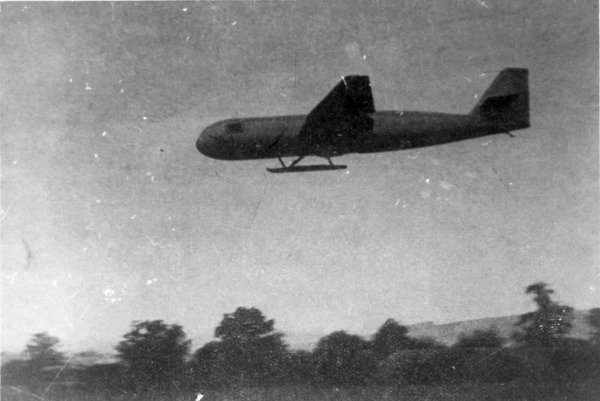
The DFS 228 was an experimental high-altitude reconnaissance aircraft developed by the Deutsche Forschungsanstalt für Segelflug (DFS) during World War II. The project originated from the pre-war DFS 54 high-altitude research glider, but was revived in 1940 following a requirement from the Reichsluftfahrtministerium (RLM) for a rocket-powered platform capable of strategic reconnaissance. Designed by Felix Kracht as a cantilever mid-wing aircraft, the DFS 228 was intended to operate at altitudes between 20,000 and 23,000 meters, with an absolute ceiling of 25,000 meters.
To reach these heights, the aircraft was designed to be carried piggyback by a Dornier Do 217 K-3 to approximately 10,000 meters before igniting its own propulsion. The planned powerplant was a single Walter HWK 109-509 A-1 liquid-fuel rocket engine, manufactured by Walter Werke, which provided a throttleable thrust range of approximately 1 to 14.7 kN (roughly 100 to 1,600 kgf). Despite these plans, no test flights were documented to have occurred with the rocket engine actually installed; consequently, the aircraft only flew as unpowered prototypes. The first prototype was completed in March 1944, and gliding tests were underway by mid-1944, specifically by August 1944.
Structurally, the DFS 228 was a high-aspect-ratio glider with a wing area of 30 m² and a glide ratio of approximately 25. This efficiency allowed for long-range unpowered returns; from 12,000 meters, it could theoretically glide for 300 km, while a total reconnaissance radius of 1,000 km was envisioned using intermittent rocket thrust. For pilot safety at extreme altitudes, the aircraft featured a pressurized cockpit and a jettisonable cabin designed to act as a rescue capsule. Planned reconnaissance equipment included two Zeiss infrared cameras.
Production was limited to prototypes, with most sources confirming at least two were built, though one uncorroborated source claims twelve. Testing took place at the Luftwaffe's Rechlin test center, where the aircraft was noted to be sluggish on all axes at high altitudes. The second prototype was destroyed in an air raid in May 1945, and the first was captured by U.S. forces in June 1945. After being shipped to the United Kingdom in 1946, the surviving airframe was apparently scrapped in 1947. The DFS organization itself was dissolved after 1945 due to Allied occupation policies.