
Production and Manufacturer History
The Häfeli DH-1 was produced in 1916 by the aircraft department of the Eidgenoessische Konstruktionswerkstaette (EKW), also known as the Federal Construction Works (K+W), based in Thun, Switzerland. The EKW was a state-owned enterprise established in 1867 to ensure Swiss military self-sufficiency. While originally focused on artillery and vehicles, the company added an aviation department in 1915 to reduce reliance on foreign aircraft during the pressures of World War I. The DH-1 represented the first indigenous effort in this department, with exactly six aircraft built. The project was short-lived; three aircraft were lost in accidents around 1917, and the remaining airframes were withdrawn from service and scrapped by 1919.
Design and Technical Specifications
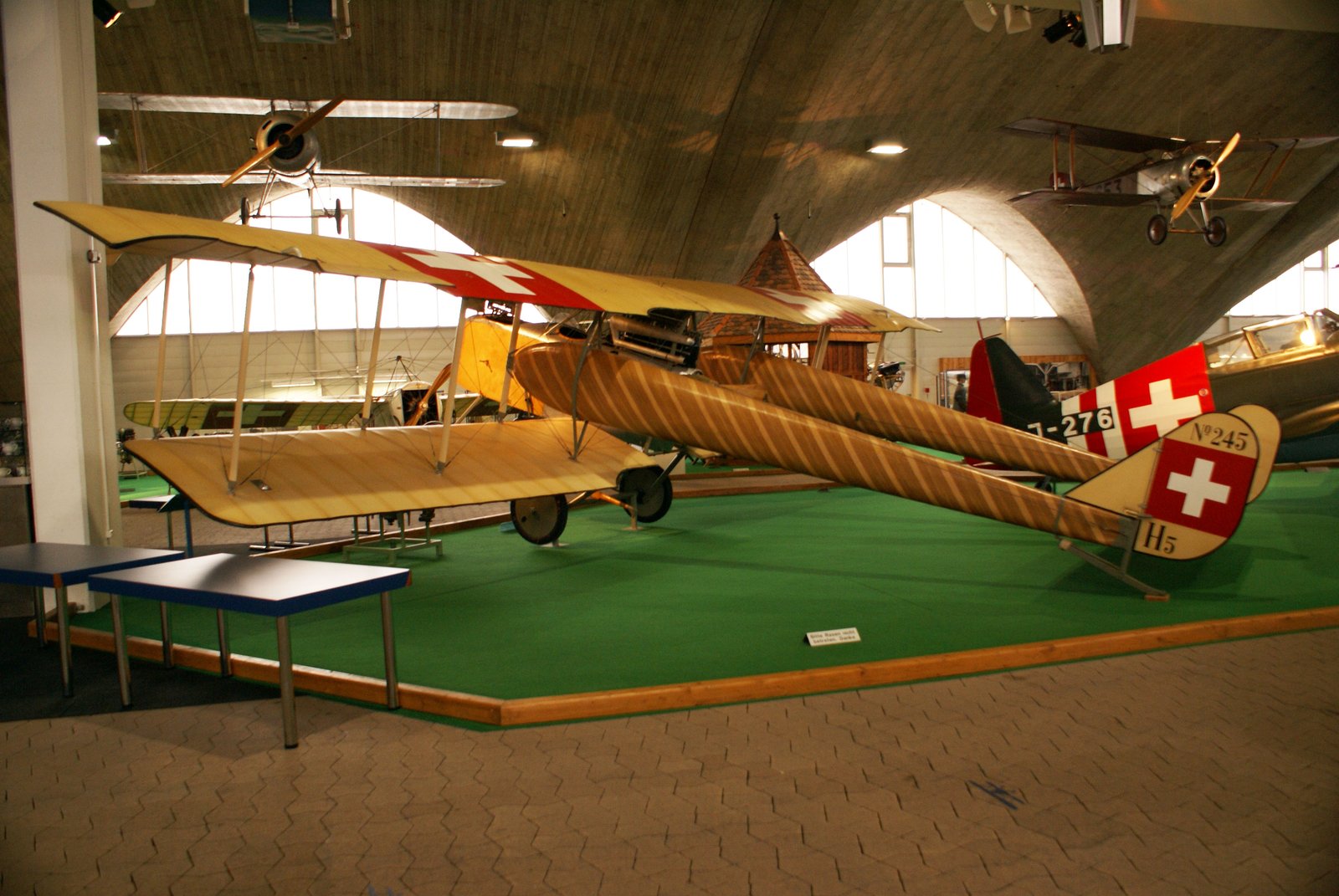
Designed by August Häfeli, who joined EKW as chief engineer in 1915, the DH-1 was a three-bay biplane of wood-and-fabric construction. Häfeli, who had previously developed the AGO C.I and C.II pusher biplanes in Germany, applied a similar pod-and-boom layout to the DH-1. This configuration placed the crew in tandem open cockpits within a central fuselage pod, while the engine was mounted at the rear in a pusher arrangement, supported by twin tail booms. This design was intended to optimize forward visibility and firing arcs for the observer.
The aircraft was powered by a single 120 hp (89 kW) Argus As II six-cylinder, liquid-cooled inline piston engine. While designed by Argus Motoren in Germany, the engines used in the DH-1 were license-built in Switzerland by Bühler Brothers Limited. The engine drove a two-bladed wooden fixed-pitch pusher propeller. Technically, the DH-1 achieved a maximum speed of 126 km/h and a range of 250 km, with a notably high service ceiling of 9,840 m.
Military Service and Legacy
Operated exclusively by the Swiss Air Force (Swiss Army aviation troops), the DH-1 served in a reconnaissance and observation role between 1916 and 1919. It was armed with a single 7.45 mm MG 94 machine gun on a trainable mounting in the observer's cockpit. Alongside six Wild W-1 biplanes, the DH-1 formed the foundation of Switzerland's first domestically owned military aircraft fleet.
Although the DH-1 suffered from reliability and handling issues that led to its early retirement, it paved the way for subsequent Häfeli designs, including the DH-2, DH-3, and DH-5. While no original DH-1 airframes survive, a replica is preserved at the Flieger Flab Museum (Air Force Center) in Dübendorf, where an original Argus As II engine is also displayed.