
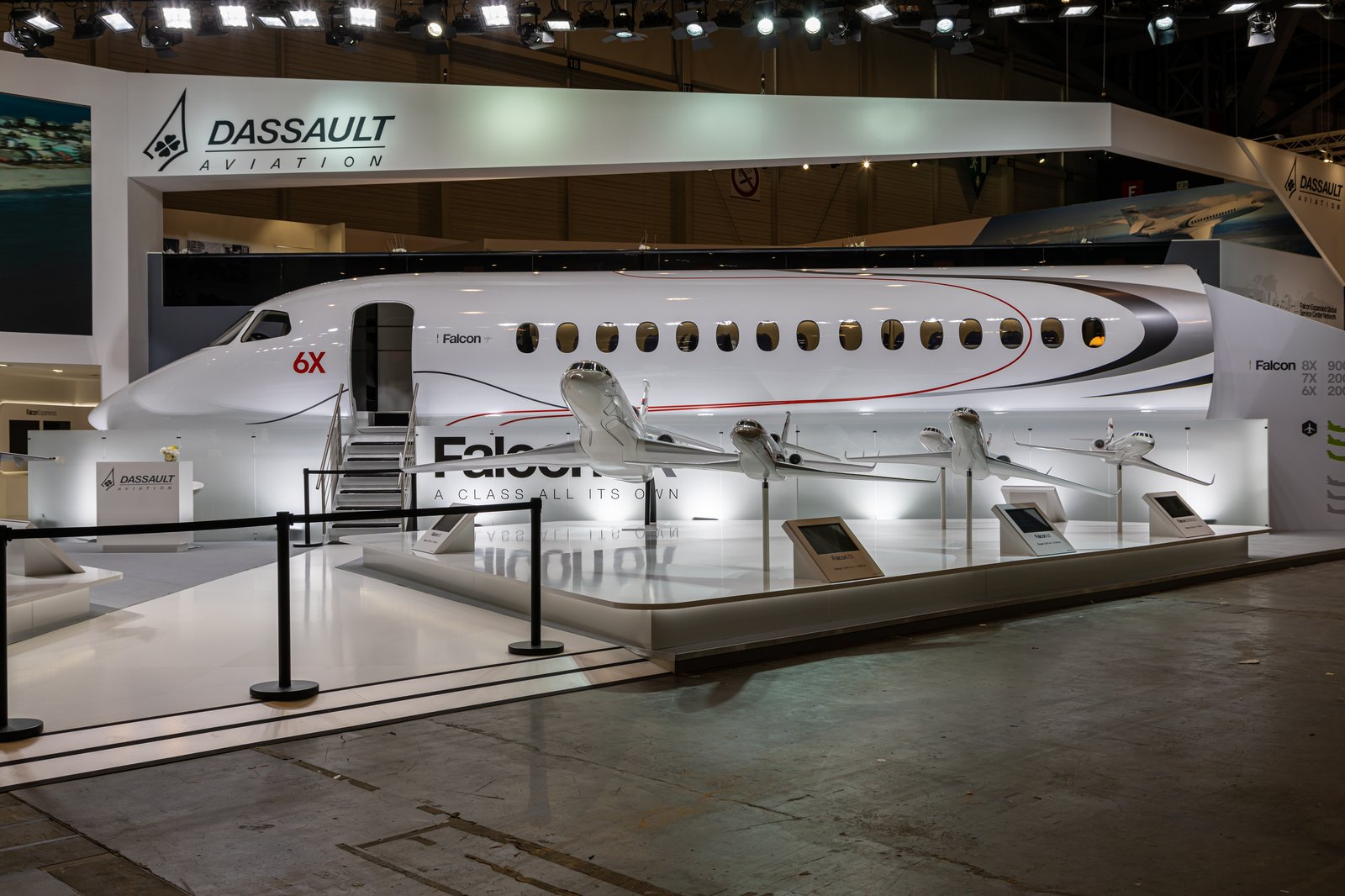
Development Genesis
The Falcon 6X emerged from the ashes of Dassault's troubled Falcon 5X program, which was canceled in December 2017 due to persistent issues with the Safran Silvercrest engines. Rather than abandon the ultra-long-range market segment entirely, Dassault's engineering team salvaged the validated aerodynamics and systems from the 5X program, incorporating them into a completely redesigned aircraft with a new fuselage cross-section and proven Pratt & Whitney Canada PW812D powerplants.
Manufacturing Heritage
Dassault Aviation traces its lineage to 1938 when Marcel Bloch established an engine factory in France. The company evolved through the turbulent war years, emerging as Avions Marcel Dassault before adopting its current name in the 1970s. The manufacturer entered the business jet market with the Mystère 20 prototype in 1963, beginning deliveries of the Falcon 20 in 1965. By July 2017, the Falcon family had achieved 2,500 deliveries, surpassing 2,700 business jets by May 2023. Production of the 6X occurs at Dassault's facilities in France, with final assembly taking place at Bordeaux-Mérignac Airport, where the prototype first took flight.
Technical Innovation
The 6X's powerplants represent a significant improvement over the problematic Silvercrest engines that doomed the 5X. The PW812D turbofans, which also power the Gulfstream G500 and G600, accumulated 120 flight test hours by February 2019 and reached 1,000 test hours by May 2019. Transport Canada certified these high-bypass turbofans on November 30, 2021, after more than 4,900 hours of testing. The engines enable the aircraft to achieve its design goal of 5,500 nautical miles range while maintaining a maximum speed of Mach 0.90 and a service ceiling of 51,000 feet.
The aircraft features Dassault's largest fuselage cross-section to date, accommodating up to 19 passengers in a spacious cabin environment. This represents the company's most significant dimensional expansion in its six-decade history of business jet manufacturing. The cockpit requires a crew of two to three pilots, depending on operational requirements and customer preferences.
Flight Testing and Certification
Prototype F-WSIX rolled out on December 8, 2020, and completed its maiden flight on March 10, 2021, from Bordeaux-Mérignac Airport. The initial flight lasted 2 hours and 30 minutes, with test pilot achieving Mach 0.8 and reaching 41,000 feet altitude. The flight test program progressed steadily, with the test fleet accumulating 850 hours by May 2022.
Both the European Aviation Safety Agency and Federal Aviation Administration granted type certification in August 2023, clearing the path for commercial deliveries. The certification timeline experienced delays from the originally planned 2022 schedule due to COVID-19 supply chain disruptions and complications arising from the conflict in Ukraine.
Market Entry
The Falcon 6X officially entered service on November 30, 2023, marking Dassault's return to the ultra-long-range business jet segment. The first United States delivery under Part 91 operations occurred in late 2024, representing the beginning of North American market penetration. With an equipped price of $53.8 million in 2023, the 6X positions itself as a premium offering in the competitive ultra-long-range market.
The aircraft targets private Part 91 operators and high-end business users who require transcontinental and transoceanic capability without fuel stops. Its 5,500 nautical mile range enables non-stop flights on routes such as New York to London, Los Angeles to Geneva, or Miami to São Paulo, transforming business travel efficiency for corporate operators.
Strategic Positioning
As the largest and most powerful aircraft in the Falcon lineup, the 6X serves as Dassault's flagship business jet, competing directly with established ultra-long-range offerings from Bombardier and Gulfstream. The aircraft represents a crucial market recovery for Dassault following the 5X cancellation, demonstrating the company's commitment to the large-cabin, long-range segment.
Dassault has already announced plans for an even larger Falcon 10X variant, targeted for certification in 2025. This progression indicates the company's long-term strategy to establish dominance across multiple ultra-long-range market segments, building upon the 6X's foundation of proven systems and reliable powerplants.
Current Operations
As a recently certified aircraft type, the Falcon 6X remains in the early stages of fleet deployment. With deliveries beginning in late 2023 and the first U.S. delivery occurring in late 2024, operational examples remain limited. The aircraft's significance lies not in current fleet numbers, but in its role as Dassault's technological flagship and market positioning tool for future Falcon family expansion.