
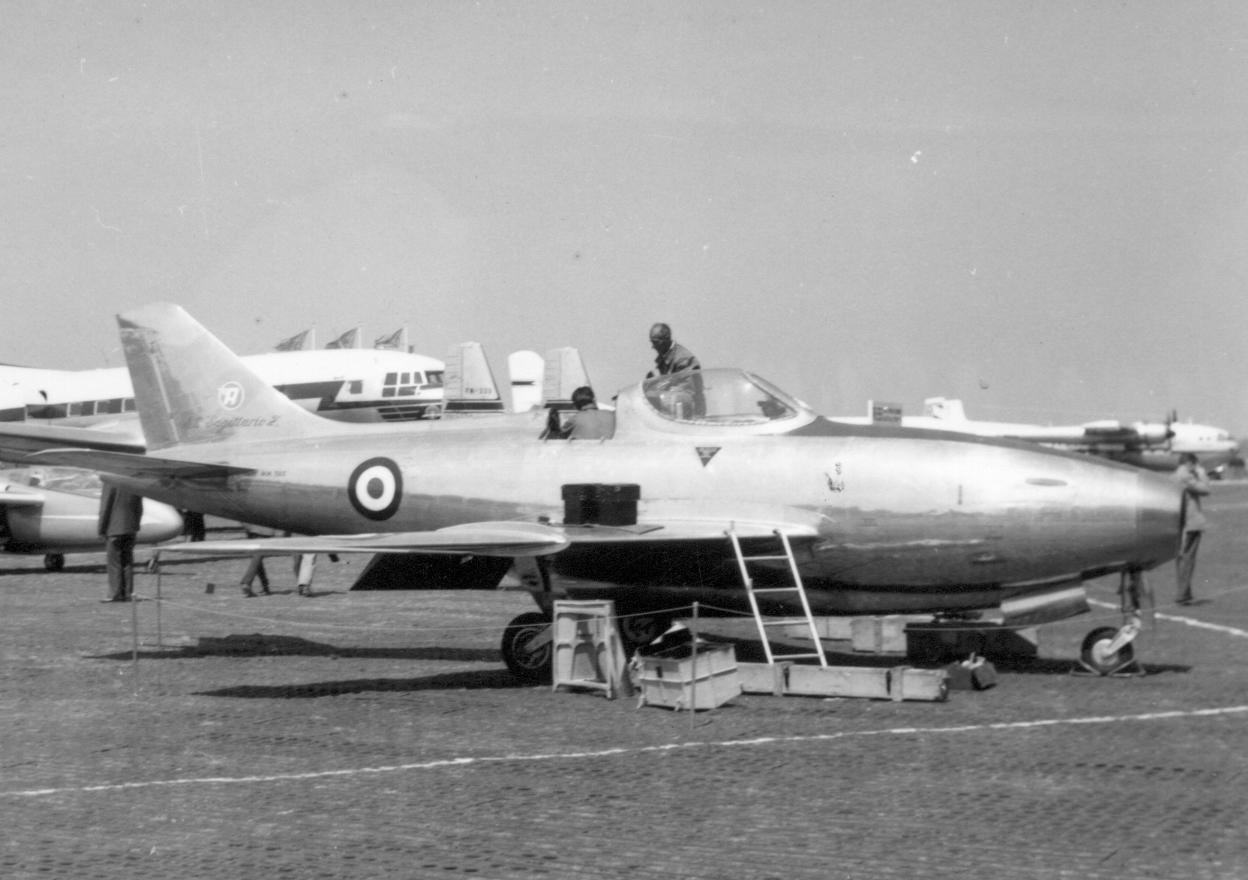
Design and Development
The Aerfer Sagittario 2 was a prototype supersonic light fighter designed by Italian engineer Ing. Sergio Stefanutti. Its development lineage began with the Ambrosini Sagittario, a piston-engined aerodynamic research aircraft first flown in 1953 that utilized a wooden swept wing on an S.7 fuselage. The Sagittario 2 evolved this concept into an all-metal, single-seat jet aircraft intended for interceptor and light tactical support roles. The design was specifically created to meet the NATO Basic Military Requirement 1 (NBMR-1) of December 1953, which sought a standardized light strike and tactical support aircraft for NATO member nations.
Production and Manufacturer
The project originated with SAI Ambrosini (Società Aeronautica Italiana), founded by Angelo Ambrosini. However, the jet-powered Sagittario 2 was built and developed by Aerfer (Industrie Aeronautiche Meridionali). Only two prototype aircraft were constructed in Italy. While Aerfer operated facilities in southern Italy, specifically near Naples, the exact plant location for the Sagittario 2 prototypes is not explicitly recorded. Both SAI Ambrosini and Aerfer no longer exist as independent aircraft manufacturers.
Technical Specifications and Performance
The aircraft was powered by a single Rolls-Royce Derwent 9 centrifugal-flow turbojet, which provided approximately 16 kN of thrust. The airframe featured a wingspan of 7.50 meters, a length of 9.60 meters, and a wing area of 14.50 square meters. For armament, the Sagittario 2 was equipped with two 30 mm Hispano-Suiza HSS 825 L/70 cannons in the nose, each with 300 rounds. It also featured two under-wing hardpoints with a total capacity of 318 kg, capable of carrying two 227 kg bombs, two 318 kg napalm tanks, or 12 rockets.
Service History and Legacy
The Sagittario 2 first flew on 19 May 1956 near Naples. It was evaluated by the Italian Air Force (Aeronautica Militare) as a potential light strike fighter. On 4 December 1956, Lt. Col. Giovanni Franchini flew the aircraft in a dive from 13,725 meters, reaching approximately Mach 1.1. This achievement marked the first time an Italian-designed aircraft broke the sound barrier. Despite this success, the aircraft had limited growth potential and lost the NBMR-1 competition to the Fiat G.91. Development subsequently shifted toward the Aerfer Ariete, a derivative featuring an additional rocket-jet booster. No production orders were ever placed for the Sagittario 2, and it remains a significant milestone in Italian aviation history.