
Service History
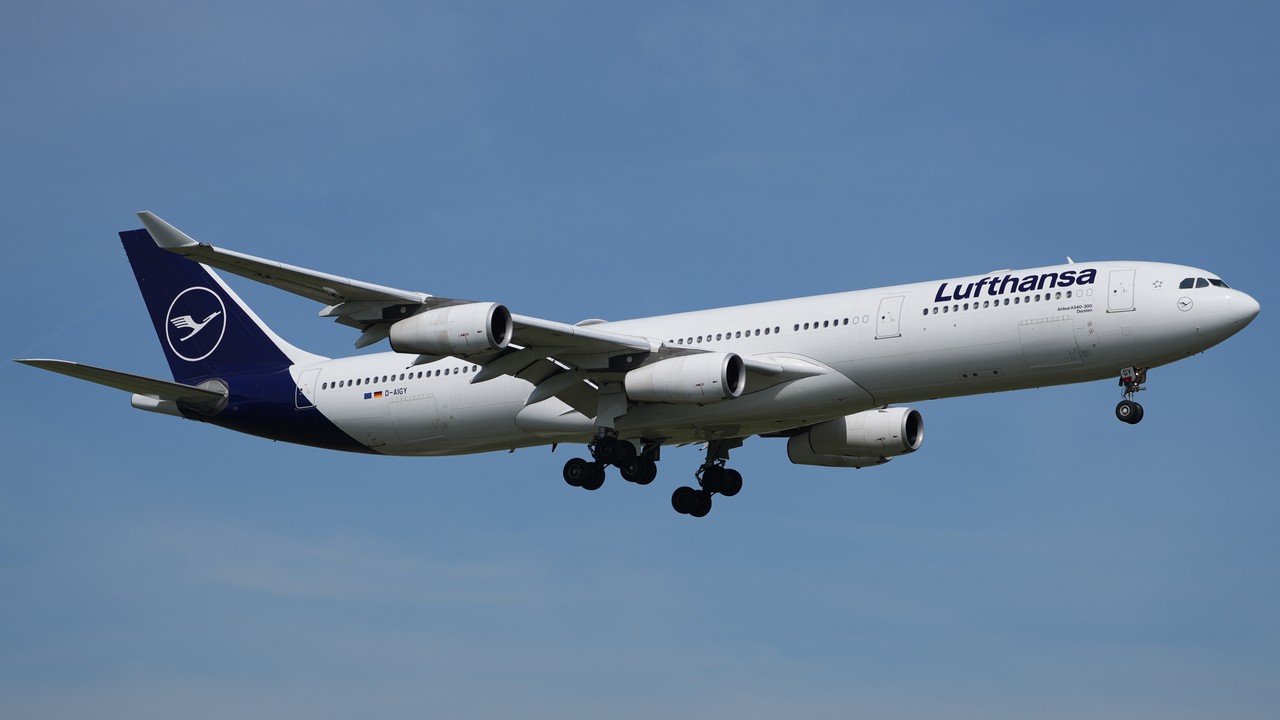
The A340 entered commercial service in 1993 with launch customers Lufthansa and Air France. Lufthansa received the first A340-200 on February 2, 1993, registered D-AIBA and named "Nürnberg," while Air France took delivery of the first A340-300 on February 26, 1993, registered F-GLZB. The aircraft found its niche on ultra-long-haul routes where ETOPS restrictions prevented twin-engine operations, enabling airlines to open direct connections previously impossible.
Major operators included Iberia with 39 aircraft, Virgin Atlantic with 29 units, and carriers like South African Airways, Philippine Airlines, and Cathay Pacific. Virgin Atlantic's first A340, dubbed "The Lady in Red," was delivered in April 1993 and ceremonially baptized by Princess Diana. The type enabled record-breaking flights, including Singapore Airlines' SQ22 service from Newark to Singapore covering 18 hours and 45 minutes, which held the title of world's longest commercial flight for several years.
Record-Breaking Performance
The A340 demonstrated its ultra-long-range capabilities spectacularly on June 16, 1993, when an A340-200 nicknamed "World Ranger" flew nonstop from Paris to Auckland, covering 19,277 kilometers in 21 hours and 32 minutes. This flight established six world records and showcased the aircraft's ability to connect virtually any two points on Earth without refueling. The A340-500 variant later pushed range capabilities even further, achieving up to 16,670 kilometers under optimal conditions.
The Manufacturer
Airbus Industrie originated as a European consortium formed in 1970 as a Groupement d'Intérêt Économique, uniting French, German, Spanish, and British aviation companies to challenge American dominance in commercial aviation. The company transitioned to Airbus SAS in 2001 and became a wholly-owned subsidiary of EADS in 2006, later rebranding to Airbus SE in 2017. Headquartered in Toulouse, France, Airbus began with the A300 in 1972 and achieved a milestone when an A340-300 became their millionth aircraft delivery to Air France on February 26, 1993.
Engine & Technical Innovation
The A340 family utilized two primary engine types across its variants. Early A340-200 and A340-300 models employed four CFM International CFM56 turbofans, the same reliable powerplants used on Boeing 737s, though their relatively modest thrust levels led to some order cancellations, notably from Northwest Airlines. Later A340-500 and A340-600 variants featured the more powerful Rolls-Royce Trent 500 turbofans, specifically designed for ultra-long-haul efficiency.
The aircraft shared significant commonality with the twin-engine A330, including cockpit systems and handling characteristics, allowing airlines to operate both types with common pilot training. This design philosophy reduced operational costs while providing airlines flexibility between twin-engine and four-engine operations. The A340's wing required reinforcement to counter engine flutter at cruise altitudes, and engineers briefly considered variable camber wing technology before abandoning it due to complexity.
Operational Excellence
Pilots appreciated the A340's predictable handling and generous range margins. The aircraft typically operated with a two-pilot crew and maintained a maximum speed of Mach 0.86 with a service ceiling around 13,100 meters. Climb rates averaged approximately 900 meters per minute, varying by weight and variant. The quadjet configuration provided redundancy valued by airlines operating over remote oceanic routes, particularly before ETOPS regulations were relaxed for modern twin-engine aircraft.
Production & Decline
Airbus manufactured 377 A340s between 1991 and 2011, with final deliveries completed in 2012. Production occurred primarily at the company's Toulouse facilities, with components manufactured across European partner nations. The program faced increasing pressure from fuel-efficient twin-engine competitors, particularly the Boeing 777, which offered similar range with lower operating costs. Rising fuel prices and relaxed ETOPS restrictions that allowed twins on previously quadjet-only routes ultimately made the four-engine configuration economically disadvantageous.
Legacy
As of January 2024, approximately 70 A340s remain in active service from the original 377 built. Lufthansa operates 17 aircraft, representing the largest active fleet, while others serve in VIP configurations or with smaller carriers. Many major operators, including Iberia and Virgin Atlantic, retired their fleets by 2020 in favor of more fuel-efficient alternatives.
The A340 represented the final chapter of the four-engine airliner era for most commercial applications, symbolizing European technological achievement while demonstrating the industry's evolution toward twin-engine efficiency. Its contribution to ultra-long-haul aviation and the establishment of previously impossible direct routes remains its most significant legacy, even as the aircraft type faces retirement across most major carriers.