
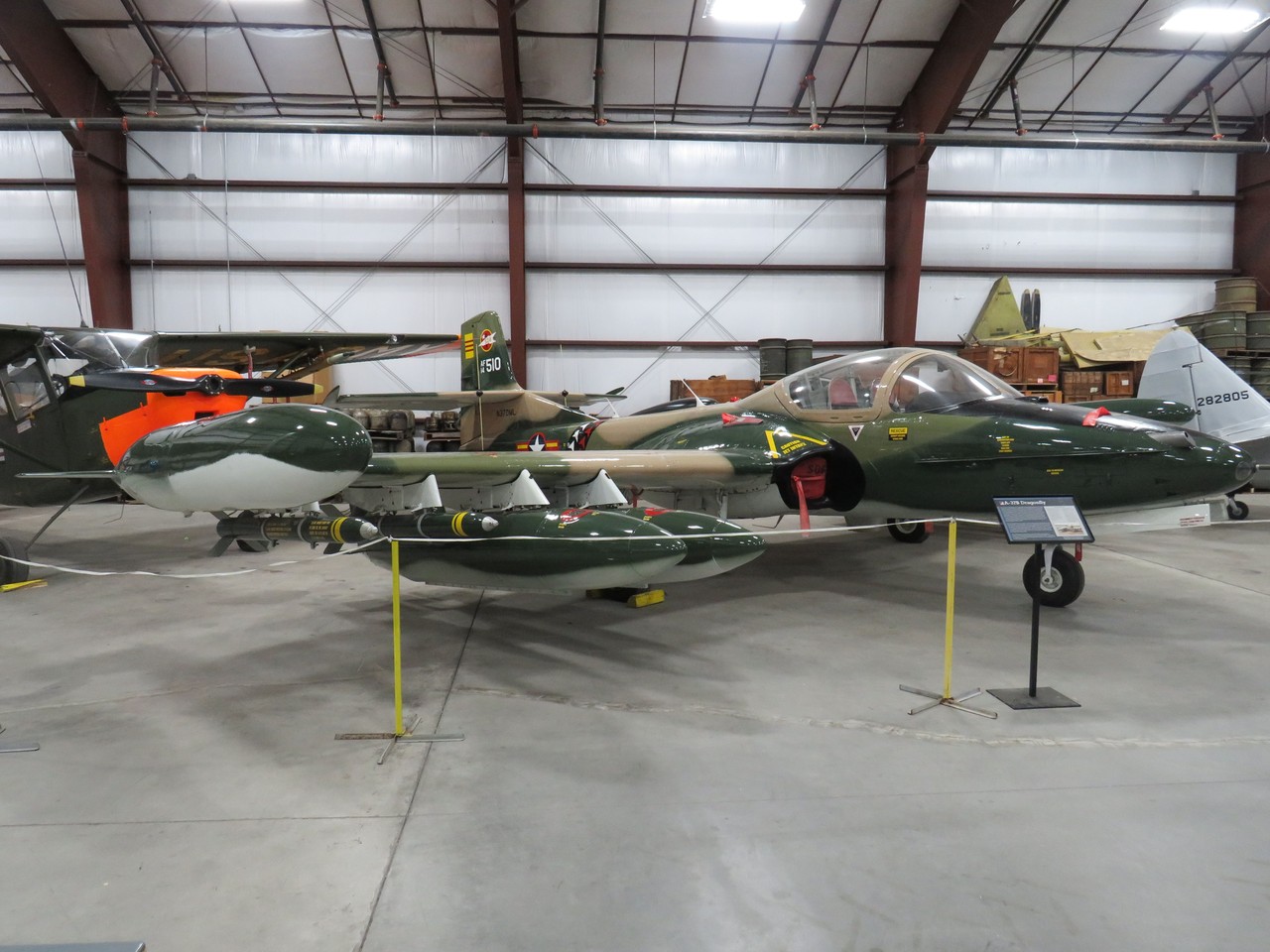
Combat Proven Design
The A-37 Dragonfly emerged from urgent military requirements during the escalating Southeast Asian conflict. Cessna engineers transformed their reliable T-37 Tweet trainer into a potent combat machine by installing twin General Electric J85-GE-17A turbojet engines producing 2,850 pounds of thrust each, adding armor protection, and incorporating eight underwing stores pylons capable of carrying 5,680 pounds of ordnance. The conversion included mounting a nose-mounted 7.62mm GAU-2B/A Minigun and strengthening the airframe to withstand combat stresses.
Vietnam War Operations
Combat evaluation began in August 1967 when the 604th Air Commando Squadron deployed A-37As to Bien Hoa Air Base under the "Combat Dragon" program. The initial 90-day combat assessment proved remarkably successful, with the aircraft completing over 4,000 sorties without a single combat loss. This exceptional performance prompted immediate expansion of the program and orders for the improved A-37B variant.
The Dragonfly's combat record throughout the Vietnam War demonstrated its effectiveness in close air support and counter-insurgency roles. Flying more than 160,000 combat sorties, the type suffered only 22 USAF aircraft lost to enemy action—an extraordinarily low attrition rate that validated the design concept. The aircraft's twin-engine configuration provided crucial redundancy over hostile territory, while its relatively simple systems and robust construction enabled operations from austere forward airfields.
South Vietnamese Service
The Republic of Vietnam Air Force received 254 A-37Bs, making it the largest operator of the type. These aircraft replaced aging Douglas A-1 Skyraiders in RVNAF squadrons and provided South Vietnamese forces with a modern, maintainable light attack platform. The Dragonfly's ease of maintenance and forgiving flight characteristics made it particularly suitable for air forces with limited technical infrastructure and pilot training programs.
When Saigon fell in April 1975, approximately 187 A-37Bs remained in South Vietnamese service. Many of these aircraft were subsequently operated by the victorious North Vietnamese forces, though their service life under new management proved brief due to maintenance difficulties and parts shortages.
Cessna's Military Success
Cessna Aircraft Company, founded by Clyde Cessna in 1927, achieved significant success with the A-37 program despite being better known for civilian aircraft. The company manufactured 577 A-37s between 1963 and 1975 at their Wichita facility, consisting of 39 A-37A conversions and 538 new-build A-37B aircraft. This military contract represented a substantial revenue source during a period when Cessna was establishing dominance in the general aviation market.
The A-37B incorporated numerous improvements over the initial A-37A conversion, including provision for in-flight refueling, increased internal fuel capacity from 507 to 507 gallons, and structural strengthening to handle higher gross weights. The production aircraft featured tip tanks that increased total fuel capacity and extended range to 920 nautical miles.
Performance and Handling
Pilots praised the A-37's responsive handling characteristics and reliable twin-engine safety margin. The aircraft achieved a maximum speed of 507 mph at altitude and maintained a cruising speed of 300 mph, providing excellent responsiveness for close air support missions. Its service ceiling exceeded 25,000 feet, though most combat operations occurred at much lower altitudes where the aircraft's armor protection proved essential.
The side-by-side seating arrangement, inherited from the T-37 trainer, facilitated crew coordination during combat missions. The pilot and weapons systems operator could efficiently manage navigation, target acquisition, and weapons delivery while maintaining situational awareness in the challenging Southeast Asian environment.
Post-War Service
Following the end of American involvement in Southeast Asia, surviving USAF A-37Bs transitioned to Air Force Reserve and Air National Guard units. These aircraft continued flying training and light attack missions until final retirement in 1992, providing nearly three decades of military service. The type's longevity testified to its sound basic design and adaptability to changing mission requirements.
Preservation and Legacy
Several A-37 Dragonflies survive in museum collections, including the second YAT-37D prototype displayed at the National Museum of the United States Air Force at Wright-Patterson Air Force Base. The March Field Air Museum preserves A-37B serial number 71-0790, originally built for the South Vietnamese Air Force in 1971.
The A-37 Dragonfly program demonstrated the viability of converting existing trainer aircraft into effective combat platforms—a concept that influenced subsequent military aircraft development programs. Its exceptional combat record and cost-effectiveness established the light attack aircraft category that continues to attract military interest for counter-insurgency and homeland security missions.