
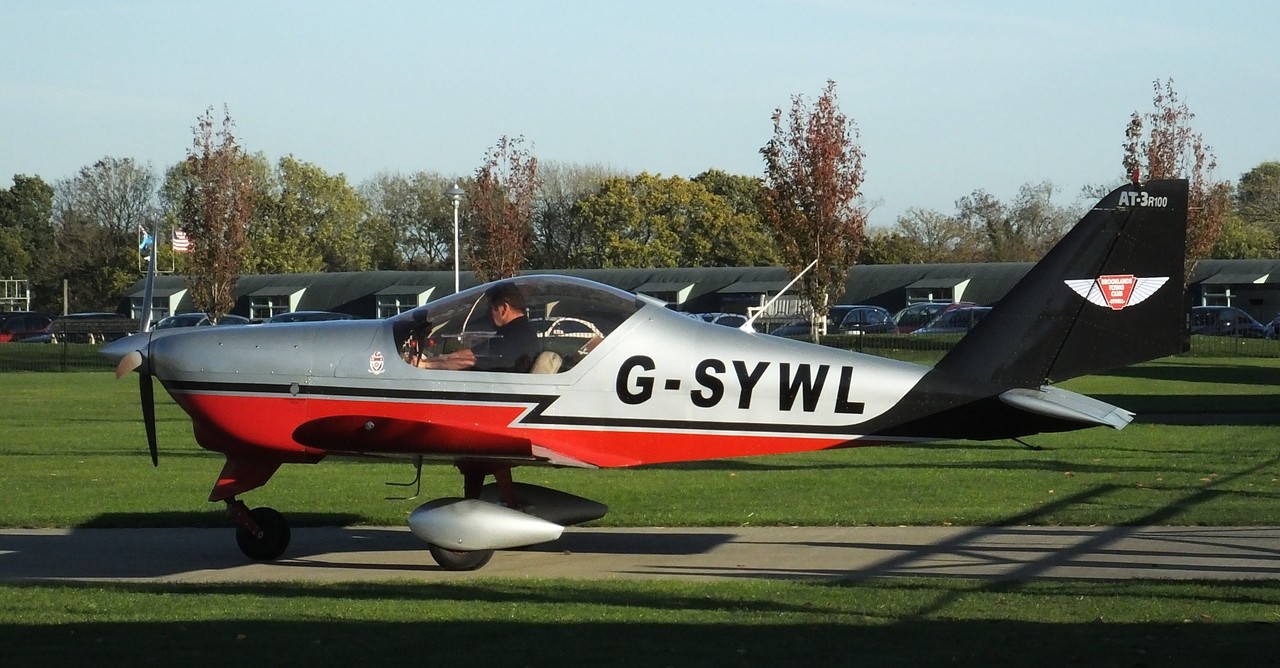
Development and Certification
The AT-3 emerged from Aero Sp's ambitious goal to create an affordable, low-maintenance training aircraft for the European market. Derived from the Pottier P.220S Koala design, the prototype initially flew as the P.220 S-AT2 before being extensively modified. The redesigned aircraft took its maiden flight on January 18, 1998, featuring approximately one square meter more wing area than its predecessor, a 4-centimeter longer cockpit, enlarged fin and rudder, and strengthened landing gear.
The aircraft achieved a significant milestone on May 14, 1999, when it received JAR-VLA (Joint Aviation Regulation – Very Light Aircraft) certification, becoming only the sixth aircraft type to earn this distinction. This certification was later upgraded to European Aviation Safety Agency (EASA) very light aircraft category accreditation in January 2005, establishing the AT-3 as a pioneering example of modern European light aircraft certification standards.
Production and Variants
Aero Sp launched production in the late 1990s, delivering the first customer aircraft in 2002. By 2003, the company had completed at least five aircraft, including four L100 variants and one R100 model. Production continued steadily, with 50 AT-3s built by May 2010, contributing to the company's overall production of well over 100 aircraft across various models.
Two primary variants dominated production: the AT-3 L100, equipped with a 74.6-kilowatt Limbach L-2400DF1 flat-four engine and MT-160L-120-2C propeller, and the AT-3 R100, powered by a 73.5-kilowatt Rotax 912 ULS flat-four engine with MT-165R-152-2M propeller. Later R100 variants utilized the Rotax 912S engine rated at 75 kilowatts, establishing it as the standard powerplant.
Commercial Service and Operators
Telekomunikacja Polska became the AT-3's launch customer, ordering aircraft to support Polish aero clubs with the first two entering service by May 2001. Market analysts identified potential demand for 200 aircraft over five years within Poland alone. International sales followed, with Aeroclub Air France ordering six AT-3s in 2008 and four aircraft entering service with Old Sarum Flying School in the United Kingdom.
The aircraft reached Australian shores in late 2003 through Tiger Flight Aviation, while American markets accessed the design through the Gobosh 700 variant, which received Federal Aviation Administration approval for the light-sport aircraft category. This international expansion demonstrated the AT-3's versatility across different regulatory environments and operational requirements.
Technical Innovation and Performance
The AT-3's all-metal and semi-stressed skin construction utilized solid rivets of carbon or kevlar composites with anodizing for corrosion protection. The forward-folding canopy provided excellent cockpit access, while dual controls came standard for training operations. These design choices reflected the aircraft's intended role as a robust, practical trainer capable of intensive daily use.
Performance specifications positioned the AT-3 competitively within its class: maximum speed of 236 kilometers per hour, cruising speed of 200 kilometers per hour, and stalling speed of just 82 kilometers per hour. The aircraft demonstrated impressive short-field capabilities with takeoff distance of 160 meters and landing distance of 150 meters, enabling operations from unprepared airstrips, dirty airfields, and grass runways under visual flight rules conditions both day and night.
Operational Legacy
The AT-3's durability became legendary among operators, with some early aircraft accumulating over 10,000 flight hours in demanding roles including forest monitoring and border patrol missions. This exceptional service life validated Aero Sp's emphasis on robust construction and reliable powerplants, establishing the aircraft's reputation for low operating costs and minimal maintenance requirements.
With an empty weight of 350 kilograms and useful load of 232 kilograms, the AT-3 achieved an optimal balance between performance and economy. Its 70-liter fuel capacity provided a range of 795 kilometers at cruising speed with conservative fuel consumption of 15 liters per hour, making it particularly attractive to flight schools managing tight operational budgets.
Continuing Service
The AT-3 remains active in training and utility roles across Europe and beyond, testament to its enduring design and construction quality. Aero Sp continues operations today, supporting the existing fleet while the aircraft's certification achievements paved the way for subsequent European light aircraft development. The AT-3's combination of regulatory compliance, operational reliability, and economic efficiency established benchmarks that influenced an entire generation of training aircraft design.