
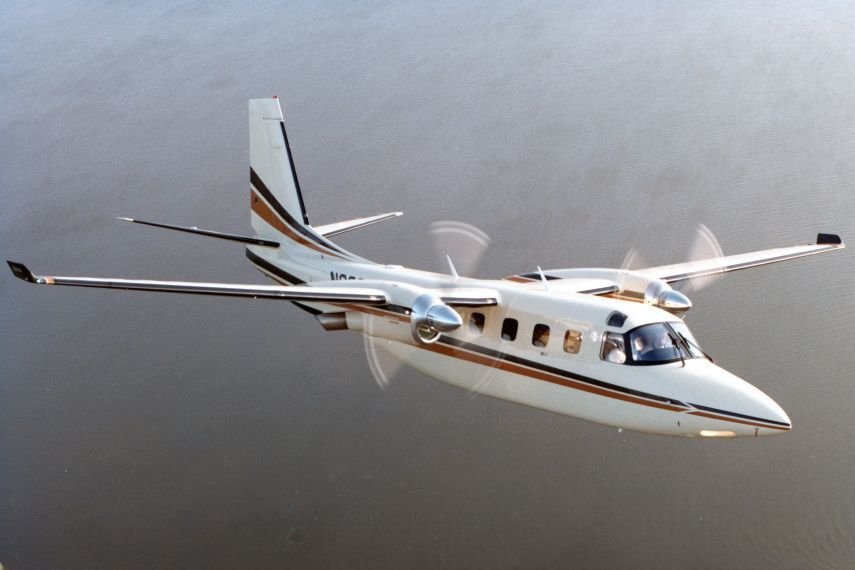
Corporate Aviation Excellence
The Jetprop Commander 1000 dominated the upper tier of turboprop business aviation during the 1980s, offering jet-like performance and cabin pressurization in a more economical twin-engine package. Its 6.7 psi cabin pressurization system maintained a 10,000-foot cabin altitude while cruising at 35,000 feet, providing passenger comfort previously available only in larger corporate jets. The aircraft's impressive single-engine climb rate of 1,000 feet per minute and short-field capabilities made it ideal for accessing smaller airports unavailable to pure jets.
The Manufacturer Legacy
The aircraft's heritage traced back to Ted Smith, a Douglas Aircraft engineer who conceived the original Aero Commander design in 1944 while working part-time with A-20 bomber engineers. Smith's company, initially called Aero Design and Engineering Company, was founded in 1944 and renamed Aero Commander in 1950. The company gained national attention with a dramatic 1950 demonstration flight from Bethany, Oklahoma to Washington, D.C. using a single-engine aircraft to prove the safety of their designs.
Rockwell International acquired Aero Commander in 1965, continuing development of increasingly sophisticated variants. In 1979, Rockwell sold the Commander line to Gulfstream American, which completed production as Gulfstream Aerospace. This corporate evolution reflected the consolidation occurring throughout the general aviation industry during the 1970s and 1980s.
Engine Technology and Performance
Powering the Jetprop Commander 1000 were two Honeywell TPE331-10-501K turboprop engines, each producing between 730 and 820 shaft horsepower. These engines, manufactured by Honeywell (formerly Garrett AiResearch), represented proven technology from the respected TPE331 series known for reliability and fuel efficiency across numerous turboprop applications. The engines enabled the aircraft to achieve maximum cruise speeds of 308 knots true airspeed at Mach 0.60.
The powerplant configuration provided exceptional performance metrics including an initial climb rate of 2,800 feet per minute and takeoff distances of just 1,407 feet. Landing distances of 1,821 feet allowed access to shorter runways, expanding operational flexibility for corporate flight departments.
Design Innovations
The Jetprop Commander 1000 incorporated several advanced design features that distinguished it from earlier Commander variants and competing aircraft. Engineers added winglets to reduce drag and improve fuel efficiency, a relatively novel feature in the early 1980s business aviation market. The aircraft featured wet wing fuel tanks, increased wingspan for improved lift characteristics, and supercritical Dowty Rotol propellers optimized for high-altitude cruise performance.
New engine nacelles reduced high-speed drag by up to 17 percent compared to previous designs, contributing significantly to the aircraft's impressive range and speed capabilities. The aircraft's maximum takeoff weight of 11,200 pounds (with a ramp weight of 11,250 pounds) was carefully optimized to maximize payload while maintaining single-engine safety margins.
Certification and Production
Certification for the 695A/Jetprop Commander 1000 was achieved on April 30, 1981, validating the aircraft's design and performance claims. Production commenced in 1982 and continued through 1985, with serial numbers ranging from 96001 to 96210. The total production run of 108 aircraft reflected the specialized nature of this high-performance turboprop market segment.
Manufacturing took place at facilities associated with the original Aero Commander production sites near Oklahoma City, maintaining continuity with the program's Oklahoma heritage. Each aircraft represented significant hand-craftsmanship and attention to detail characteristic of low-volume, high-value aviation production.
Operational Characteristics
Pilots appreciated the Jetprop Commander 1000's combination of turboprop reliability with jet-like performance and systems sophistication. The aircraft typically operated with a two-person crew and featured separate passenger, lavatory, and baggage compartments in its 36.8-foot fuselage. Maximum passenger capacity reached 11 seats, though typical corporate configurations accommodated 6-8 passengers in executive seating arrangements.
The aircraft's service ceiling of 35,000 feet allowed operations above most weather and air traffic congestion, while its range of 2,080 nautical miles enabled coast-to-coast flights with single fuel stops. These capabilities positioned the Jetprop Commander 1000 as a serious alternative to light jets for corporate flight departments prioritizing operational economics.
Legacy and Current Status
Production ended in 1985 as part of the broader decline in general aviation manufacturing during that decade. The Jetprop Commander 1000 represented the ultimate evolution of Ted Smith's original 1944 vision, incorporating four decades of continuous refinement and technological advancement. While exact numbers of airworthy examples remain undocumented, aircraft from the 1981-1985 production period continue to serve in corporate and utility roles, valued for their ruggedness, performance, and operational efficiency.
The aircraft stands as a testament to American engineering excellence in business aviation, bridging the gap between the pioneering days of twin-engine corporate aircraft and the modern era of sophisticated turboprop and jet transportation.