
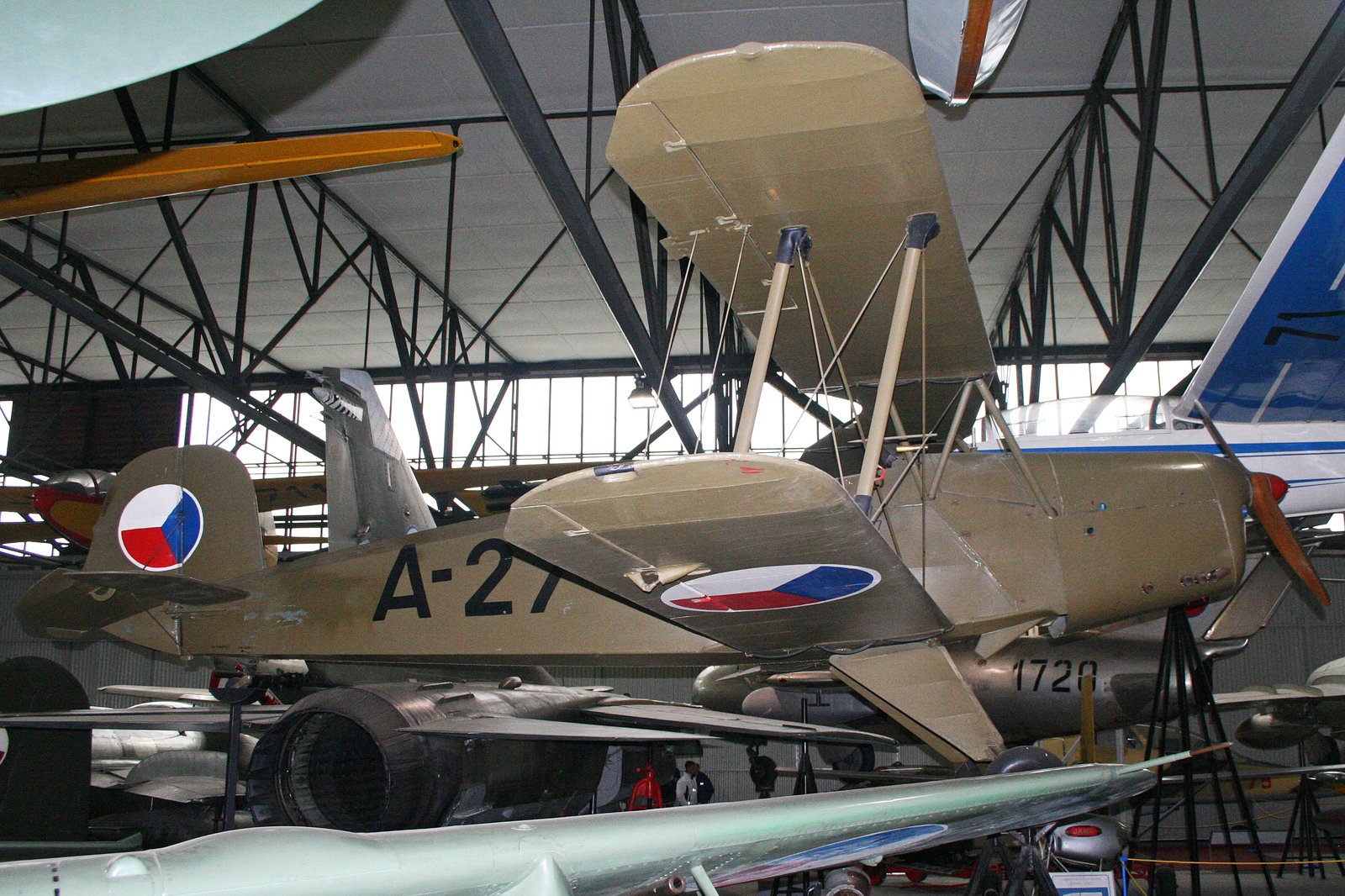
The Aero A.104 was a Czechoslovak light bomber and reconnaissance aircraft developed during the late 1930s. It served as the final derivative of the Aero A.100 family, evolving specifically from the Aero Ab.101. To modernize the design, Aero engineers removed the lower wing of the Ab.101 to create a parasol monoplane configuration and introduced an enclosed cockpit, departing from the open-cockpit layouts seen in earlier variants of the A.100 series.
Two prototypes of the A.104 were constructed and flown in 1937. The aircraft was powered by a single Hispano-Suiza 12Ydrs V-12 liquid-cooled piston engine, which was produced under license in Czechoslovakia by the industrial conglomerate ČKD (Českomoravská-Kolben-Daněk). This powerplant delivered 642 kW (861 hp), providing the aircraft with a maximum speed of 330 km/h (210 mph) and a service ceiling of 9,000 meters. Other technical specifications included a wingspan of 15.5 meters, a length of 10.8 meters, and a wing area of 35.4 square meters. The aircraft had a gross weight of 3,100 kg and was capable of carrying a bomb load of up to 200 kg.
Despite these technical updates, the A.104 did not offer a sufficient performance advantage over other contemporary designs to secure a production contract with the Czechoslovak Air Force. Consequently, the aircraft never entered series production, and no operational or combat service was recorded. The prototypes were flown exclusively by company and state test establishments.
Designed and built by Aero—now known as AERO Vodochody AEROSPACE a.s.—the A.104 reflects the broader transition of European military aviation in the mid-1930s from biplane and sesquiplane configurations toward monoplanes. While the A.104 itself remained a prototype, Aero continued to be a cornerstone of Czechoslovak aviation, later producing successful jet trainers such as the L-29 Delfín and L-39 Albatros. No surviving examples of the A.104 are known to exist in museums or private collections.