
Strategic Evolution
The B-1 Lancer emerged from the Air Force's ambitious 1965 requirement to replace both the canceled B-70 Valkyrie and aging B-52 Stratofortress with a supersonic penetrating bomber. Rockwell International's design team created two distinct variants: the high-speed B-1A prototype capable of Mach 2.2, and the production B-1B optimized for low-level penetration at Mach 1.2 with reduced radar signature.
The program experienced dramatic political reversals. After the B-1A's successful first flight on December 23, 1974, President Carter canceled the program in 1977 following completion of four prototypes. President Reagan revived the program in 1981, leading to the redesigned B-1B variant that first flew on October 18, 1984.
Manufacturing Heritage
Rockwell International built all B-1 aircraft at Air Force Plant 42 in Palmdale, California, between 1983 and 1988. The company traced its aviation roots to North American Aviation, founded in 1929 and builder of legendary warbirds including the P-51 Mustang and B-25 Mitchell. North American merged with Rockwell in the early 1970s, becoming Rockwell International in 1973. Boeing acquired Rockwell's aerospace divisions in 1996, making Boeing the current inheritor of the B-1's manufacturing legacy.
Production totaled exactly 100 B-1B Lancers plus the four B-1A prototypes, for 104 aircraft overall. Each B-1B cost approximately $283 million in 1998 dollars, making it one of the most expensive military aircraft ever produced.
Technical Innovation
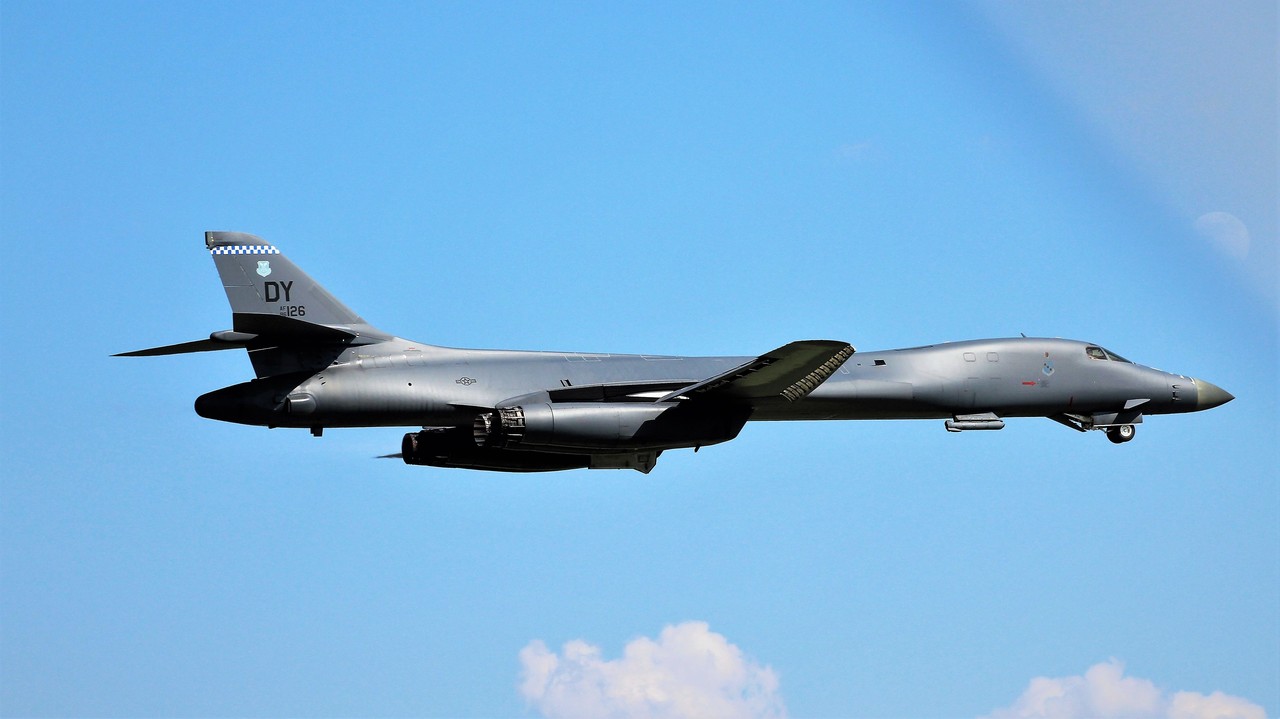
Four General Electric F101-GE-102 afterburning turbofan engines power the B-1B, each producing 30,780 pounds of thrust. The engines feature variable-geometry inlets designed to reduce radar cross-section while maintaining performance across the aircraft's speed range from subsonic cruise to supersonic dash capability.
The B-1's most distinctive feature remains its variable-sweep wing system. Wings extend to 136 feet 8 inches for takeoff and efficient cruise flight, then sweep to 78 feet 3 inches for high-speed penetration. This configuration, combined with the blended wing-body design, provides both long-range efficiency and terrain-following capability at 200 feet altitude.
Combat Operations
The B-1B entered service with Strategic Air Command on October 1, 1986, initially at Dyess Air Force Base, Texas. The aircraft served exclusively in the nuclear role until 1994, when the Air Force began conventional weapons integration. By 2007, all nuclear capability was permanently removed.
First combat occurred during Operation Desert Fox against Iraq in December 1998. The B-1B proved highly effective in subsequent conflicts including Kosovo in 1999, Afghanistan from 2001, and Iraq from 2003. Its massive payload capacity allows carriage of up to 84 Mark 82 500-pound bombs or 24 Mark 84 2,000-pound bombs, far exceeding other strategic bombers.
Crew and Operations
Each B-1B requires a four-person crew: pilot, copilot, and two combat systems officers who operate the sophisticated defensive systems and weapons. The aircraft's terrain-following radar enables automatic flight at extremely low altitudes, while advanced electronic warfare systems provide protection in heavily defended environments.
Unlike the B-52, the B-1B carries no defensive guns, relying instead on speed, low altitude, and electronic countermeasures for survival. Maximum payload reaches 125,000 pounds, distributed among three internal bomb bays and six external hardpoints.
Current Status and Legacy
By 2018, 62 B-1B Lancers remained in active Air Force service, with ongoing upgrades planned to extend service life into the 2030s. The fleet has experienced significant attrition through accidents and structural fatigue, reducing numbers from the original 100 aircraft.
Several B-1 variants are preserved in museums nationwide. The fourth B-1A prototype resides at the Strategic Air Command and Aerospace Museum in Ashland, Nebraska, while B-1B examples are displayed at Wings Over the Rockies in Denver, Colorado, and Hill Aerospace Museum in Utah.
The B-1 Lancer represents the bridge between Cold War nuclear strategy and modern precision conventional warfare, adapting from its original mission of penetrating Soviet defenses to supporting ground forces in counterinsurgency operations across multiple theaters.