
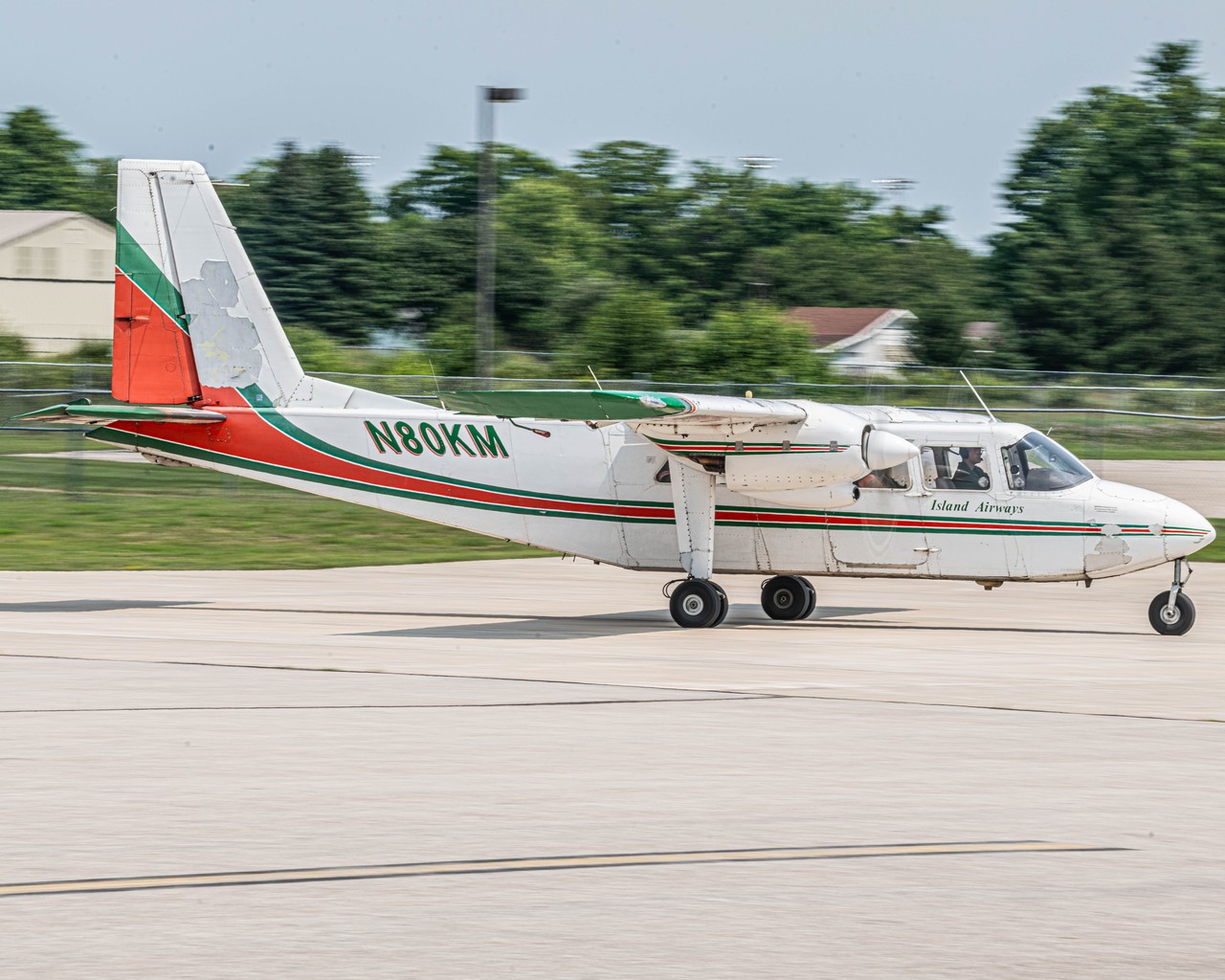
A Design Built for Endurance
When the first production Islander took flight on April 24, 1967, few could have predicted it would still be rolling off assembly lines more than half a century later. The aircraft emerged from Britten-Norman's Bembridge factory on the Isle of Wight following UK type certification in August 1967 and US approval that December. Within its first year of availability, American distributor Jonas Aircraft placed orders for 142 Islanders, signaling immediate market acceptance for this rugged utility transport.
The Islander's early success quickly overwhelmed Britten-Norman's modest production capabilities. High demand forced the company to establish international manufacturing partnerships, beginning with Intreprinderea de Reparatii Material Aeronautic in Romania. The first Romanian-assembled Islander flew in August 1969, marking the start of a partnership that would produce over 500 aircraft, including a substantial 100-unit contract in 1977. At peak production, the Romanian facility manufactured 30 to 40 Islanders annually, making it the type's primary production center for decades.
Global Manufacturing Network
Production diversification continued when Philippine Aerospace Development Corporation began license manufacturing in 1975, ultimately building 67 units through 1995. Following Fairey Aviation's acquisition of Britten-Norman in 1972, some assembly operations shifted to Belgium, where aircraft were completed at Avions Fairey facilities before receiving UK certification. This international production network sustained the Islander through changing market conditions while maintaining the type's reputation for reliability.
After 55 years of overseas manufacturing, Britten-Norman announced in September 2023 the return of production to its original Bembridge facility. The reactivated production line initially targets two aircraft annually, incorporating modern improvements including Garmin glass cockpit systems while preserving the Islander's fundamental design philosophy.
Technical Evolution
The Islander's development began with clear objectives: create a versatile, robust aircraft capable of operating from unpaved airstrips while providing reliable multi-engine safety margins. Early prototypes utilized 260-horsepower Lycoming O-540-E4B5 engines, but production models evolved to meet diverse operational requirements. The BN-2A variant introduced increased takeoff weights and expanded baggage capacity, while the BN-2A-2, available from 1970, featured more powerful 300-horsepower Lycoming IO-540-K1B5 fuel-injected engines specifically designed for improved hot-weather and high-altitude performance.
This powerplant upgrade proved crucial for the Islander's global success, enabling reliable operations in challenging environments from African bush strips to Caribbean island routes. Optional wingtip fuel tanks supplemented the standard four 54-gallon tanks, providing transatlantic ferry range that allowed aircraft to reach distant markets via routing through Gander, Newfoundland.
Proving Its Worth
The Islander's capabilities gained international recognition when it won the 1969 London-Sydney air race, demonstrating exceptional range and reliability over nearly 11,000 miles of varied terrain and weather conditions. This victory showcased the type's suitability for long-distance operations while highlighting its fuel efficiency and mechanical durability.
Commercial operators worldwide embraced the Islander for routes deemed uneconomical for larger aircraft. Airlines like Provincetown-Boston Airline utilized the type for short-haul passenger service, while charter operators appreciated its ability to access small airfields larger aircraft couldn't serve. The Islander filled a crucial niche in regional aviation, connecting isolated communities and supporting specialized operations requiring its unique combination of capacity and field performance.
Military Adoption
More than 30 countries have operated Islanders in military service, primarily as light transports and utility aircraft. While never designed for combat roles, military variants have supported logistics, personnel transport, and training missions across diverse air forces. The type's simple systems and robust construction make it ideal for military operators requiring reliable transport capabilities without complex maintenance requirements.
Enduring Success
By 1974, Islander sales exceeded 548 aircraft, establishing it as Britain's best-selling multi-engine commercial design. The 1,000th delivery occurred in 1982, cementing the type's position as one of aviation's most enduring success stories. Production peaked during the 1970s and early 1980s before declining due to market saturation and the Islander's exceptional longevity—many early examples remain in active service today.
Currently, more than 750 Islanders continue flying commercially worldwide, testament to the design's fundamental soundness. The type's longevity has inspired modernization efforts, including Project Fresson by Cranfield Aerospace Solutions, which aims to develop electric powerplant conversions for the existing fleet of 700-plus airframes.
Legacy of Practical Design
The Islander's 55-year production run represents a remarkable achievement in aircraft manufacturing, proving that straightforward engineering solutions often outlast more sophisticated alternatives. Its success stems from addressing real operational needs rather than pursuing theoretical performance advantages, creating an aircraft that remains relevant decades after its initial design. With production resuming in the United Kingdom and ongoing development of modernized variants, the Islander appears destined to serve operators well into its seventh decade of continuous manufacture.