
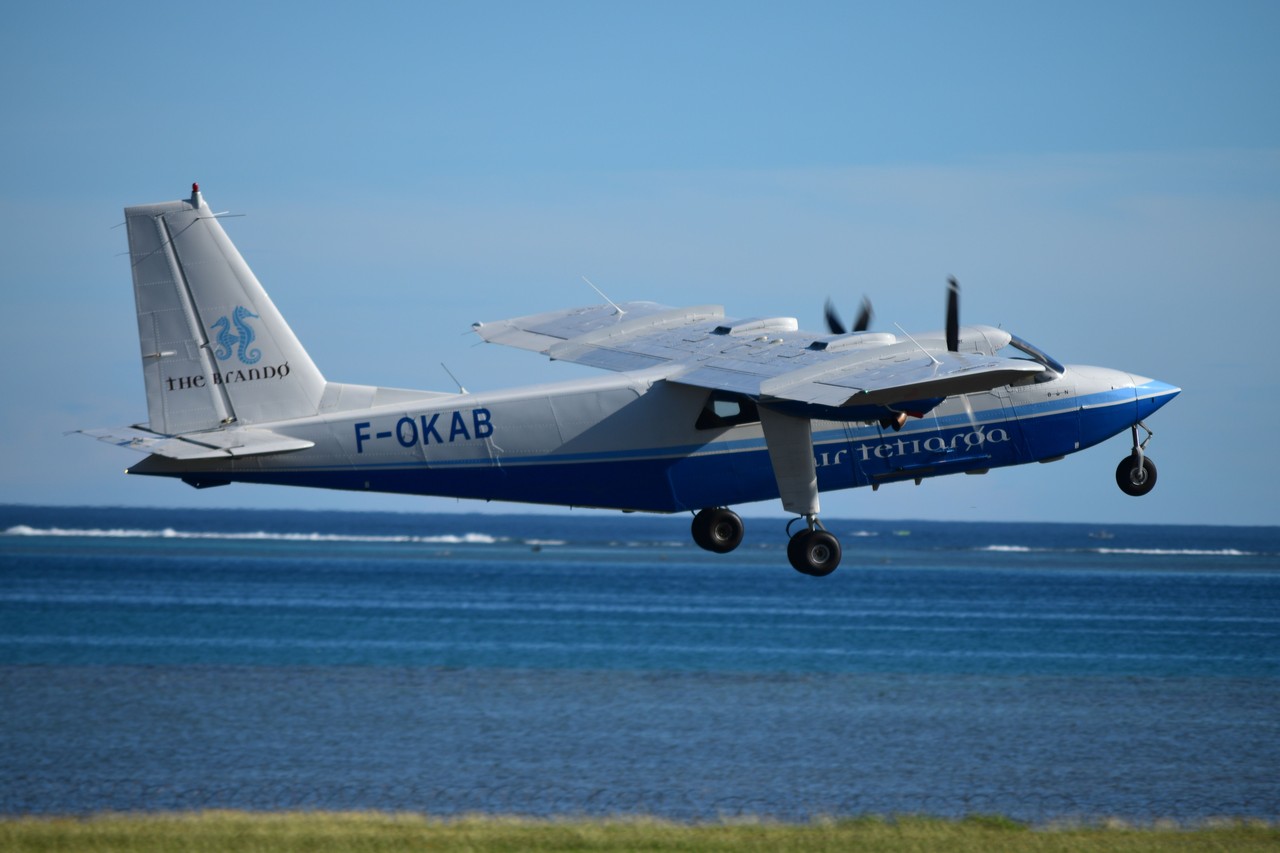
Development and Design Philosophy
The BN-2T emerged from Britten-Norman's innovative approach to aircraft design, prioritizing payload capacity over conventional performance metrics. John Britten and Desmond Norman, the company's founders, had originally developed the piston-powered Islander in 1963 after recognizing that commuter airlines valued carrying capacity more than range or cruising speed. This philosophy proved prescient, as the Islander family would eventually see more than 1,250 aircraft delivered across 126 countries.
The turboprop conversion began experimentally in April 1977 when Britten-Norman fitted the prototype Islander with twin Lycoming LTP-101 turboprops producing 600 shaft horsepower each, derated to 400 shaft horsepower. Designated BN-2A-41, this initial attempt did not proceed to production. However, the concept's potential led engineers to select the more reliable Allison 250 series turboprop for the production variant.
Production and Manufacturing
Production of the BN-2T commenced in 1980, though in far smaller numbers than its piston-powered siblings. The first production aircraft entered service in 1981, marking a significant technological advancement for the Islander line. Manufacturing followed an international model: airframes were constructed in Romania by Intreprinderea de Reparatii Material Aeronautic (IRMA), then shipped to the Pilatus-Britten-Norman facility at Bembridge on the Isle of Wight for final fitting and completion.
This Romanian connection proved crucial to Islander production overall. IRMA manufactured over 500 Islander variants at peak rates of 30-40 aircraft annually, making Romania the primary production center for the Islander family. After Fairey Aviation acquired Britten-Norman, the manufacturing process became even more complex: Romanian-built aircraft were shipped to Avions Fairey in Belgium for finishing before being flown to the United Kingdom for flight certification.
Technical Specifications and Performance
The BN-2T's twin Allison 250-B17C turboprops, now manufactured by Rolls-Royce, each produce 300 kilowatts (400 shaft horsepower) and drive Hartzell three-bladed variable-pitch metal propellers. This powerplant selection provided the aircraft with significantly improved performance over high-altitude airfields and in hot weather conditions where piston engines often struggle.
Externally, the BN-2T remains largely identical to the piston-powered BN-2B variant, with the notable addition of wing fences positioned outboard of mid-span on each wing. These fences improve airflow control and handling characteristics, particularly important given the increased power and torque effects of the turboprop engines. The aircraft maintains the Islander's characteristic high-wing configuration and fixed tricycle landing gear, contributing to its reputation for easy handling and forgiving flight characteristics.
Operational History and Variants
The BN-2T found service with diverse operators worldwide, from commercial airlines to specialized mission operators. SIL Aviation operated the type in New Guinea, where one aircraft served as P2-SIL before transferring to Sunbird Aviation as P2-SAB. Australia saw at least one example, VH-IAE, operated by International Air Parts of Narrabeen, New South Wales, following a 1996 rebuild from accident-damaged components.
The most significant variant, the BN-2T-4S Defender 4000, emerged in the 1990s as a specialized surveillance and patrol aircraft. This version featured increased wingspan, additional fuel capacity, higher operating weights, and a lengthened fuselage providing extra space for mission equipment. Most notably, it incorporated a 360-degree radar system in the nose. The Defender 4000 prototype first flew in August 1994, with the first production aircraft delivered to the Irish Police in August 1997.
The Manufacturer's Legacy
Britten-Norman's journey began in 1953 when John Britten and Desmond Norman formed their company initially focused on agricultural aircraft conversion and operation. Their Islander design, launched in 1965, proved remarkably successful, with approximately 600 examples still operational as of 2015. The company's emphasis on practical utility over glamorous performance metrics created a niche that larger manufacturers had overlooked.
The broader Islander family earned recognition beyond commercial success, winning the Queen's Award to Industry for technological innovation in 1975. This honor acknowledged the design's contribution to connecting remote communities worldwide, particularly in developing nations where the Islander's robust construction and simple maintenance requirements proved invaluable.
Current Status and Legacy
In September 2023, Britten-Norman announced the return of Islander production to the United Kingdom after decades of Romanian manufacturing. This move represents a homecoming for a design that has proven remarkably durable and adaptable across nearly six decades.
The BN-2T, while produced in limited numbers compared to piston variants, demonstrated the viability of turboprop power for the Islander platform. Its enhanced performance capabilities opened new operational possibilities for operators in challenging environments, from high-altitude airfields in developing nations to patrol missions requiring extended endurance. The aircraft's legacy lies not in production numbers but in proving that the Islander's fundamental design philosophy—payload over performance—remained valid across different powerplant technologies.